


Subscribe To Get Information, Latest News And Other Interesting Events!



Important Links
Get In Touch
Ariston Publication
3167 Riverview Place
Columbus, OH 43202
United States of America
Copyright © 2026 Ariston Publications. All Rights Reserved.
Loading Your Library
Preparing your reading experience...
Loading content...
Ariston Publication
3167 Riverview Place
Columbus, OH 43202
United States of America
Faiqua Haque, Amreen Fatima, Suhaima Safdar, Muzamil Liakat Mir, Mohd Aarim, Sadik Tyagi, Nuzhat Parveen, Sana Jameel, G. G. H. A. Shadab
Faiqua Haque 1
Amreen Fatima 1
Suhaima Safdar 1
Muzamil Liakat Mir 1
Mohd Aarim 3
Sadik Tyagi 4
Nuzhat Parveen 2
Sana Jameel 1
G. G. H. A. Shadab 1, *
1 Cytogenetics & Molecular Toxicology Laboratory, Section of Genetics, Department of Zoology, Aligarh Muslim University, Aligarh-202002, Uttar Pradesh, India.
2 Women’s College, Zoology Section, Aligarh Muslim University, Aligarh-202002, Uttar Pradesh, India.
3 Department of Radiotherapy, Jawaharlal Nehru Medical College, Aligarh Muslim University, Aligarh-202002, Uttar Pradesh, India.
4 Department of Biochemistry, Aligarh Muslim University, Aligarh-202002, Uttar Pradesh, India.
* Author to whom correspondence should be addressed: gghas.amu@gmail.com (G.G.H.A. Shadab)
Nanoparticles (NPs), characterized by their nanoscale size (1–100 nm) and unique physicochemical properties, have garnered significant attention for their applications in various fields, including medicine, electronics, and environmental remediation. These materials exhibit enhanced durability, flexibility, and reactivity due to their high surface area-to-mass ratio and small size. While nanoparticles occur naturally through events like wildfires and volcanic eruptions, anthropogenic sources such as welding, combustion, and industrial activities have contributed to increased environmental and human exposure. The aging processes of nanoparticles, such as aggregation, disaggregation, and chemical transformation, further influence their fate and toxicity. This review focuses on the comparative toxicity of three widely used nanoparticles: titanium dioxide (TiO₂), iron oxide (Fe₂O₃), and zinc oxide (ZnO). Despite their varied applications, these nanoparticles share a common ability to enter the human body through inhalation, ingestion, and dermal exposure, often accumulating in vital organs such as the liver, spleen, and brain. Zinc oxide nanoparticles exhibit significant toxicity due to ion release and the generation of reactive oxygen species (ROS), leading to oxidative stress and cellular damage. In contrast, titanium dioxide nanoparticles, although largely inert, show size-dependent toxicity and potential genotoxic effects at the nanoscale. Iron oxide nanoparticles, generally considered biocompatible, may induce oxidative stress at high concentrations but display comparatively lower toxicity. The toxicity of nanoparticles is influenced by their size, shape, surface modifications, and interaction with biological systems. Coating strategies, such as polymer or amino acid functionalization, can enhance solubility and biocompatibility while reducing adverse effects. This comparative evaluation underscores the need for further research into the long-term implications of nanoparticle exposure, highlighting the importance of developing safer nanomaterials and robust toxicity assessment frameworks.
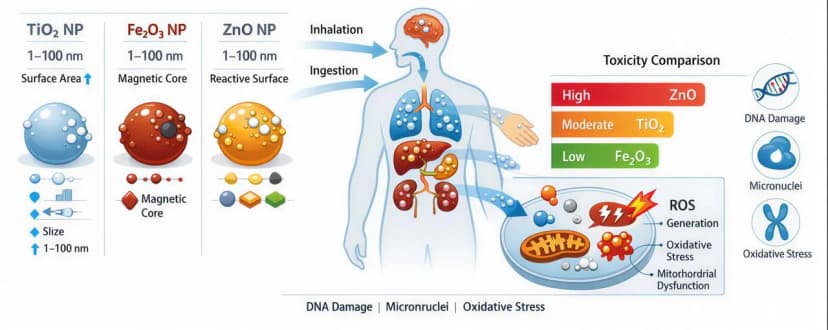
This study is significant due to the rapidly expanding use of titanium dioxide, iron oxide, and zinc oxide nanoparticles in consumer and medical products, increasing human exposure. Despite their utility, their long-term health impacts, particularly genotoxicity, remain inadequately understood. This comparative analysis highlights varying toxicity profiles and exposure risks, underscoring the urgent need for robust safety assessments. The findings advocate for developing safer nanomaterials and improved regulatory frameworks to mitigate potential public health hazards associated with widespread nanoparticle proliferation.
This review comparatively analyzes the toxicity of titanium dioxide (TiO₂), iron oxide (Fe₂O₃), and zinc oxide (ZnO) nanoparticles. It finds ZnO NPs are most toxic, primarily through ion release and reactive oxygen species generation. TiO₂ shows size-dependent effects, while iron oxides are relatively biocompatible but risky at high doses. Toxicity is influenced by physicochemical properties and exposure routes. The study concludes that conflicting data and knowledge gaps necessitate further long-term research and better models for accurate risk assessment.
Article type: Review
Submitted: 29 July 2025
Revised: 2 September 2025
Accepted: 17 October 2025
First published: 29 October 2025
DOI: https://doi.org/10.69626/bba.2025.0204
Volume: 2
Issue: 4
Pages: 204-216
Citation: BioMed and BioSci Advances 2(4), 204-216 (2025)
Haque, F., Fatima, A., Safdar, S., Mir, M. L., Aarim, M., Tyagi, S., Parveen, N., Jameel, S., Shadab, G.G.H.A. 2025 Comparative Analysis of Titanium Dioxide, Iron Oxide, and Zinc Oxide Nanoparticles: Exposure Risks and Toxicity. BioMed and BioSci Advances 2(4), pp. 204-216; https://doi.org/10.69626/bba.2025.0204
Number of downloads: 20
Number of views: 167