


Subscribe To Get Information, Latest News And Other Interesting Events!



Important Links
Get In Touch
Ariston Publication
3167 Riverview Place
Columbus, OH 43202
United States of America
Copyright © 2026 Ariston Publications. All Rights Reserved.
Loading Your Library
Preparing your reading experience...
Loading content...
Ariston Publication
3167 Riverview Place
Columbus, OH 43202
United States of America
Poornima Jeyasekaran, J. Thilshath Yamina, A. Sri Vishalini Rathanam, M. Arun Kumar
Poornima Jeyasekaran*
J. Thilshath Yamina
A. Sri Vishalini Rathanam
M. Arun Kumar
Department of Food Science & Nutrition, The American College, Tallakulam, Madurai-625002, Tamil Nadu, India.
*Author to whom correspondence should be addressed: poornima@americancollege.edu.in (P. Jeyasekaran)
This study aimed to evaluate the anthropometric profile and dietary habits of young adults in a South Indian college setting. A cross-sectional assessment was conducted with a sample of 60 students (34 males, 26 females) aged 18-25 years, recruited from the departments of Psychology, Information Technology, and English at The American College, Madurai. Anthropometric measurements, including height, weight, and Body Mass Index (BMI), were collected. Dietary intake and habits were assessed using a structured questionnaire covering meal frequency, dietary preferences, water and protein consumption, snacking patterns, and intake of processed foods and sugary beverages. The results indicated that the majority of participants (63%) fell within the normal BMI range (18.6–24.9 kg/m²), while 17% were overweight, 15% underweight, and 5% classified with obesity. Height and weight distributions showed central clustering, with most students measuring between 151–180 cm and weighing 41–70 kg. Dietary assessment revealed that 60% consumed three meals daily, yet a significant 80% did not consciously follow a balanced diet. Non-vegetarian diets predominated (88%). While daily water intake was adequate for 52% of participants, nearly half reported suboptimal hydration. Protein consumption was generally low, with 57% consuming only one serving daily. Snacking patterns indicated a preference for processed items like chips and crisps (34%), and while processed food and sugary beverage consumption was mostly occasional, label-reading practices were inconsistent. These findings highlight a discrepancy between generally healthy anthropometric status and suboptimal dietary practices, pointing to a need for targeted nutritional education among young adults to bridge this awareness gap and promote sustained health.
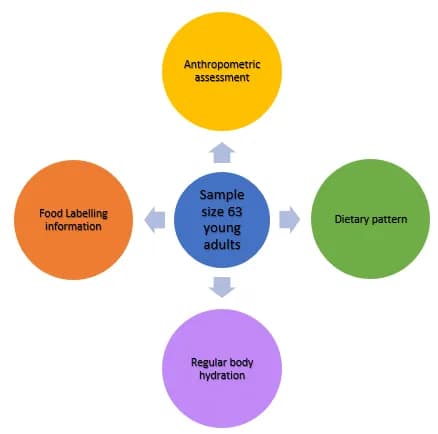
This study is to analyse the body mass index and the dietary pattern of young adults performing their college education. The significance of the study is to showcase the health and nutritional status of young adults of college-going age in South Tamil Nadu, India. Also to find the interest in knowing the nutritional facts in food labels. The results revealed that many students were unaware of what they eat, unhealthy snacking, improper hydration, and few skip their breakfast regularly. These indications show there is a possibility of becoming an unhealthy adult in the near future.
The majority follow a 3-meal pattern for a day, and a meager few go for a 2-meal pattern, which denotes the skipping of breakfast due to lack of time. Nearly half of the sample did not hydrate adequately. A very few participants opt for snacking on fruits, and the majority snack on highly processed foods. The dominance of low-quality snacks is a dietary risk factor. Only one percent of the sample size has a habit of reading the nutritional information on the food label. This evidence clearly says none are aware of what they eat. Therefore, simply maintaining a normal weight is insufficient for long-term wellness; dietary quality plays a fundamental role in physiological and psychological resilience. This change will definitely improve their academic performance.
Article type: Research Article
Submitted: 23 September 2025
Revised: 5 November 2025
Accepted: 5 December 2025
First published: 11 January 2026
DOI: https://doi.org/10.69626/bba.2026.0051
Volume: 3
Issue: 01
Pages: 51-59
Citation: BioMed and BioSci Advances 3(1), 51-59 (2026)
Jeyasekaran, P., Yamina, J. T., Rathanam, A. S. V. and Kumar, M. A. 2026. A Study on Nutritional Status and Dietary Patterns among Young Adults in South India. BioMed and BioSci Advances 3(1), pp. 51-59; https://doi.org/10.69626/bba.2026.0051
Number of downloads: 4
Number of views: 83