


Subscribe To Get Information, Latest News And Other Interesting Events!



Important Links
Get In Touch
Ariston Publication
3167 Riverview Place
Columbus, OH 43202
United States of America
Copyright © 2026 Ariston Publications. All Rights Reserved.
Loading Your Library
Preparing your reading experience...
Loading content...
Ariston Publication
3167 Riverview Place
Columbus, OH 43202
United States of America
Xiaodan Wang, Yinghui Gu, Shiwei Yuan, Xiuzhen Ni, Kai Song
Xiaodan Wang
Yinghui Gu
Shiwei Yuan
Xiuzhen Ni*
Kai Song*
School of Life Science, Changchun Normal University, Changchun 130032, China.
* Author to whom correspondence should be addressed:
2035084581@qq.com (Xiuzhen Ni)
songkai@ccsfu.edu.cn(Kai Song)
The rapid advancement of nanotechnology, coupled with the exacerbation of plastic pollution, has positioned the continuous accumulation of nanoparticles (NPs) and micro/nanoplastics (MNPs) in agricultural soils as a critical global concern. As one of the world's primary staple crops, the root system of rice (Oryza sativa L.) serves as the initial line of defense and response against nano-pollutants. The multidimensional interaction mechanisms of NPs within complex soil-rice systems, however, remain insufficiently elucidated. This review comprehensively synthesizes the interfacial interactions between NPs and rice roots, their uptake and translocation pathways, and the dual biological effects they induce. The assimilation and systemic translocation of NPs are dynamically governed by particle physicochemical traits (e.g., size, surface charge, and coating chemistry) and rice-specific rhizosphere modulators, notably the iron plaque and root exudates. It is particularly noteworthy that NPs exhibit a pronounced "double-edged sword" effect on rice: rationally designed nano-agrochemicals can function as elicitors to activate plant defense systems and effectively immobilize heavy metals. Conversely, emerging nanoplastics induce severe oxidative stress and metabolic disruption. Furthermore, these particles act as potent vectors, utilizing a "Trojan horse" mechanism to facilitate the co-transport of heavy metals and agrochemicals, thereby breaching root barriers and exacerbating dietary exposure risks. To systematically bridge existing knowledge gaps, we propose a comprehensive research roadmap emphasizing realistic field exposures, soil-rice-microbiome coupling, combined pollution dynamics, in planta quantification, and grain bioaccessibility assessments. This holistic paradigm ultimately provides robust scientific substantiation for the risk assessment of nano-pollutants and the promotion of sustainable nano-agriculture.
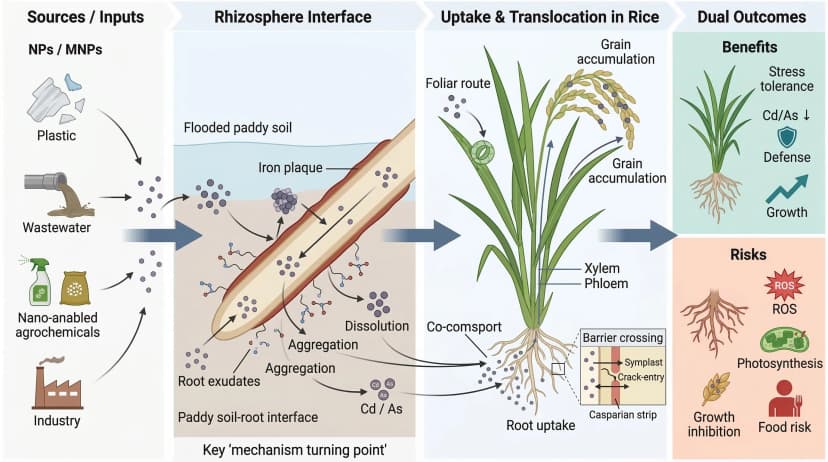
The significance of this research is anchored in its critical contribution to global food security and sustainable agriculture amidst escalating nano-pollution and the expanding application of agricultural nanotechnology. By dissecting the "double-edged sword" effects of nanomaterials on rice, it systematically delineates the boundary between the advantageous utilization of nano-agrochemicals for heavy metal mitigation and the severe phytotoxic risks posed by emerging nanoplastics. Consequently, this review establishes a fundamental scientific framework for rigorous environmental risk assessments and the formulation of safe agricultural practices.
This review systematically synthesizes the multidimensional interaction mechanisms between nanoparticles (NPs) and rice within complex soil-plant continuums. It comprehensively details the distinct uptake and translocation pathways, emphasizing how the intrinsic physicochemical properties of particles and the dynamic rhizosphere microenvironment, particularly iron plaque and root exudates, synergistically dictate transmembrane transport. The dualistic biological responses of rice to diverse NPs are critically evaluated, culminating in targeted perspectives on future research necessities, including realistic field exposure trials and composite pollution assessments.
Article type: Review
Submitted: 12 December 2025
Revised: 19 February 2026
Accepted: 3 March 2026
First published: 15 March 2026
DOI: https://doi.org/10.69626/bba.2026.0083
Volume: 3
Issue: 02
Pages: 83-98
Citation: BioMed and BioSci Advances 3(2), 83-98 (2026)
Wang, X., Gu, Y., Yuan, S., Ni, X. and Song, K. 2026. Breaching the Root Barrier: Uptake Pathways, Rhizosphere Microenvironment Regulation, and Physiological Metabolic Responses of Rice to Nanomaterials. BioMed and BioSci Advances 3(2), pp. 83-98; https://doi.org/10.69626/bba.2026.0083.
Number of downloads: 21
Number of views: 132