


Subscribe To Get Information, Latest News And Other Interesting Events!


Important Links
Get In Touch
Ariston Publication
3167 Riverview Place
Columbus, OH 43202
United States of America
Copyright © 2026 Ariston Publications. All Rights Reserved.
Loading Your Library
Preparing your reading experience...
Loading content...
Ariston Publication
3167 Riverview Place
Columbus, OH 43202
United States of America
Mohd Imran, Mohammad Afzal
Mohd Imran1,*
Mohammad Afzal2
1 Department of Zoology, Jamia Urdu College of Education, Raja Mahendra Pratap Singh University, Aligarh, U.P. India.
2 Section of Genetics, Department of Zoology, Aligarh Muslim University, Aligarh, U.P. India.
* Author to whom correspondence should be addressed:
imranzoology.amu@gmail.com (M. Imran)
Understanding ecosystem structure and functioning requires the integration of complex interactions among species across multiple trophic levels. Recent advances in environmental DNA (eDNA) metabarcoding coupled with next-generation sequencing (NGS) have revolutionized biodiversity assessment by enabling rapid, non-invasive, and comprehensive detection of species assemblages from environmental samples. However, the enormous volume of sequence data generated through NGS requires robust bioinformatics and statistical tools for effective interpretation. The R programming language, together with its graphical user interface RStudio, has emerged as a powerful platform for analysing and visualising eDNA metabarcoding data. Specialized R packages, including vegan, phyloseq, microDecon, betapart, stats, and mgcv, facilitate sequence processing, diversity estimation, community composition analysis, ecological modelling, and multivariate ordination techniques such as Principal Component Analysis (PCA), Principal Coordinates Analysis (PCoA), Non-metric Multidimensional Scaling (NMDS), and Redundancy Analysis (RDA). These analytical tools enable researchers to quantify biodiversity, examine spatial and temporal patterns in species assemblages, and explore relationships between community composition and environmental variables. By transforming complex sequence datasets into meaningful statistical and graphical representations, R has become an indispensable tool in modern eDNA-based ecological research, supporting reproducible analyses, biodiversity monitoring, conservation planning, and ecosystem management.
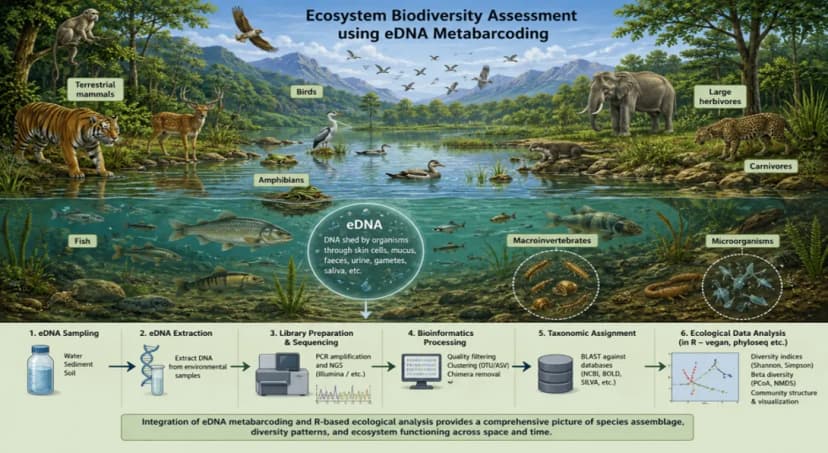
This work highlights the importance of R programming as a versatile bioinformatics platform for interpreting environmental DNA (eDNA) metabarcoding data and understanding ecological complexity. By integrating specialized packages for diversity assessment, community analysis, ecological modelling, and multivariate ordination, R transforms extensive sequencing datasets into meaningful ecological insights. Its statistical and visualization capabilities support the identification of biodiversity patterns, environmental influences, and community relationships. Furthermore, reproducible script-based workflows strengthen analytical reliability, making R valuable for biodiversity monitoring, conservation planning, ecosystem management, and ecological research.
This work highlights the importance of R programming as a versatile bioinformatics platform for interpreting environmental DNA (eDNA) metabarcoding data and understanding ecological complexity. By integrating specialized packages for diversity assessment, community analysis, ecological modelling, and multivariate ordination, R transforms extensive sequencing datasets into meaningful ecological insights. Its statistical and visualization capabilities support the identification of biodiversity patterns, environmental influences, and community relationships. Furthermore, reproducible script-based workflows strengthen analytical reliability, making R valuable for biodiversity monitoring, conservation planning, ecosystem management, and ecological research.
Article type: Review
Submitted: 11 March 2026
Revised: 23 March 2026
Accepted: 3 July 2026
First published: 20 July 2026
DOI: https://doi.org/10.69626/bba.2026.0140
Volume: 3
Issue: 03
Pages: 140-154
Citation: BioMed and BioSci Advances 3(3), 140-154 (2026)
Imran M., Afzal M. 2026. R–programming: A bioinformatic tool bridging the eDNA metabarcoding and its applications in understanding the ecological complexities. BioMed and BioSci Advances 3(3), pp. 140-154; https://doi.org/10.69626/bba.2026.0140.
Number of downloads: 1
Number of views: 16