


Subscribe To Get Information, Latest News And Other Interesting Events!


Important Links
Get In Touch
Ariston Publication
3167 Riverview Place
Columbus, OH 43202
United States of America
Copyright © 2026 Ariston Publications. All Rights Reserved.
Loading Your Library
Preparing your reading experience...
Loading content...
Ariston Publication
3167 Riverview Place
Columbus, OH 43202
United States of America
Qiaoxi Zhang, Shuo Wang, Kai Song
Qiaoxi Zhang
Shuo Wang
Kai Song*
School of Life Science, Changchun Normal University, Changchun 130032, China.
* Author to whom correspondence should be addressed:
songkai@ccsfu.edu.cn (Kai Song)
Blue honeysuckle (Lonicera caerulea L.) is rich in anthocyanins, with cyanidin-3-O-glucoside (C3G) generally being the predominant constituent. Although blue honeysuckle extracts and anthocyanin-rich preparations exhibit antioxidant and anti-inflammatory activities in various in vitro and animal models, an important question remains: are the compounds most abundant in the starting material, or most effectively retained during processing, those primarily responsible for the observed protective effects? This review examines three findings that challenge a straightforward composition–activity relationship. First, the predominance of C3G does not consistently correspond to the strongest statistical association with chemical radical-scavenging measurements. Second, parent anthocyanins decline during simulated digestion, whereas the resulting mixtures retain certain in vitro activities. Third, microencapsulated anthocyanin-rich fractions have not demonstrated superior overall protection in a colitis model, while whole pomace has produced greater improvements than isolated polyphenol fractions in selected outcomes. By comparing chemical composition, gastrointestinal transformation, cellular signaling, and evidence from animal and human studies, we identify two unresolved links: that between compounds measured before consumption and those reaching relevant sites of action, and that between changes in signaling markers and mechanisms necessary for functional protection. Evidence of C3G–TAK1 interactions and intervention studies implicating the Nrf2–GPX7 axis in specific ferroptosis models has advanced mechanistic understanding, but these findings have not yet been integrated under comparable oral-exposure conditions. Component depletion and add-back experiments, quantitative analysis of parent compounds and metabolites, and targeted mechanistic interventions are needed to identify which compounds contribute to biological effects, at which sites, and through which mechanisms.
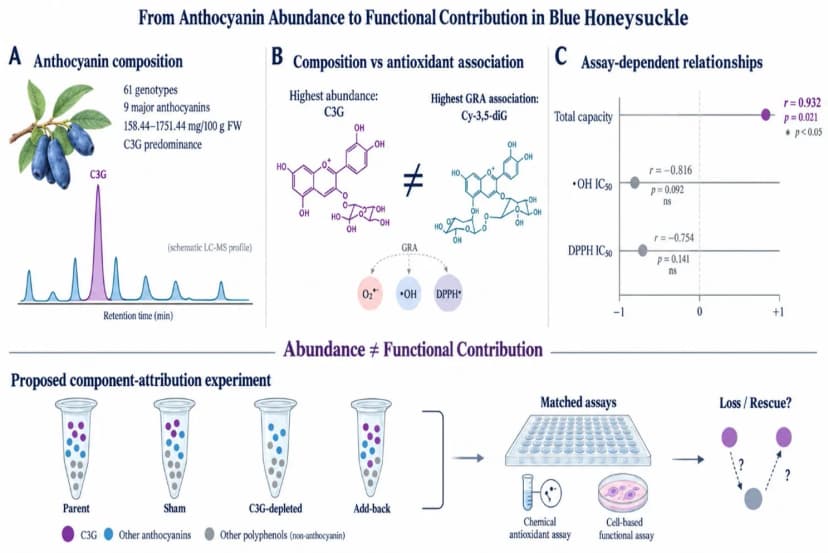
This review critically examines whether the abundance of anthocyanins in blue honeysuckle predicts their antioxidant and anti-inflammatory effectiveness. By evaluating chemical assays, simulated digestion, cellular responses, and animal studies, it highlights inconsistencies between constituent abundance and biological protection. The discussion distinguishes compositional predominance from functional attribution and identifies gaps in understanding gastrointestinal transformation, tissue exposure, and molecular mechanisms. Its proposed experimental strategies, including depletion, add-back, and targeted interventions, provide a framework for identifying bioactive compounds and advancing evidence-based functional food research.
This review evaluates the antioxidant and anti-inflammatory effects of blue honeysuckle (Lonicera caerulea L.), focusing on cyanidin-3-O-glucoside (C3G), its predominant anthocyanin. Evidence from chemical assays, simulated digestion, cellular studies, and animal models shows that abundance, processing stability, and purification do not consistently predict biological protection. The review discusses TAK1/MAPK–NF-κB and Nrf2-related signaling, including GPX7 involvement in specific ferroptosis models. It recommends exposure measurements, component depletion and add-back experiments, targeted mechanistic interventions, and human studies linking metabolites with predefined functional outcomes.
Article type: Review
Submitted: 18 March 2026
Revised: 30 March 2026
Accepted: 10 July 2026
First published: 27 July 2026
DOI: https://doi.org/10.69626/bba.2026.0154
Volume: 3
Issue: 03
Pages: 154-167
Citation: BioMed and BioSci Advances 3(3), 154-167 (2026)
Zhang Q., Wang S., Song K. 2026. Antioxidant and Anti–Inflammatory Effects of Blue Honeysuckle Anthocyanins: From Compositional Predominance to Functional Attribution. BioMed and BioSci Advances 3(3), pp. 140-167; https://doi.org/10.69626/bba.2026.0154
Number of downloads: 0
Number of views: 3