


Subscribe To Get Information, Latest News And Other Interesting Events!


Important Links
Get In Touch
Ariston Publication
3167 Riverview Place
Columbus, OH 43202
United States of America
Copyright © 2026 Ariston Publications. All Rights Reserved.
Loading Your Library
Preparing your reading experience...
Loading content...
Ariston Publication
3167 Riverview Place
Columbus, OH 43202
United States of America
Gargi Tiwari, Shiv Kumar, Madan Singh Chauhan and Dipendra Sharma
Gargi Tiwari1
Shiv Kumar2
Madan Singh Chauhan2
Dipendra Sharma2,*
1 Department of Physics, Patna Science College, Patna-800005, India.
2 Department of Physics, DDU Gorakhpur University, Gorakhpur-273009, India.
* Author to whom correspondence should be addressed:
dipendra.phy@ddugu.ac.in (Dipendra Sharma)
sharmadipendra11@gmail.com (Dipendra Sharma)
Remdesivir is a medicine used to treat COVID-19, or coronavirus illness, which is an infection caused by the SARS-CoV-2 virus. Remdesivir belongs to a class of antiviral drugs that inhibit viral replication within the body. This study describes the electronic properties of remdesivir, its molecular docking, and an investigation of the molecular dynamics simulation using a protein receptor. In this study, the geometry of the remdesivir molecule has been optimized using DFT at the B3LYP and ωB97XD levels with the 6-311+G(d,p) basis set in both gas and aqueous phases. A range of favorable binding sites between the residue positions of the ligand and target protein were produced by the molecular docking that was used to investigate the binding affinity of the remdesivir drug with SARS-CoV-2 nsp7+8C protein complex. The results have been reviewed to provide insight into the efficacy of the remdesivir medicine against the SARS-CoV-2 nsp7+8C complex.
This study provides computational insights into the molecular interactions between remdesivir and the SARS-CoV-2 nsp7/nsp8 protein complex, contributing to the understanding of potential antiviral mechanisms. By integrating density functional theory, molecular docking, and molecular dynamics simulations, it evaluates molecular properties, binding interactions, and complex stability. Analyses of hydrogen bonding, structural fluctuations, solvent accessibility, and MM/GBSA binding free energy strengthen the computational assessment. These findings support further investigation of remdesivir–protein interactions and inform future antiviral drug discovery research.
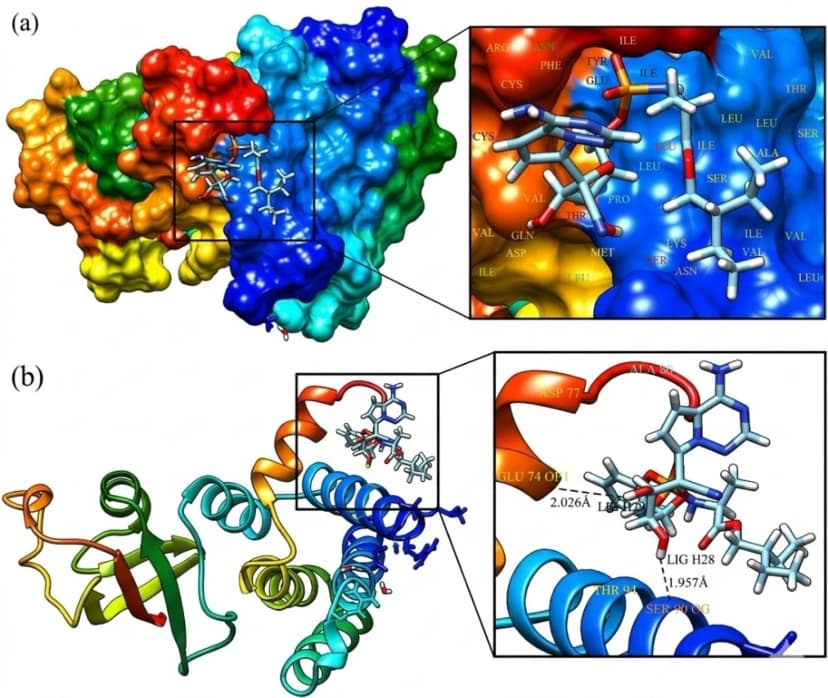
This study investigates remdesivir interactions with the SARS-CoV-2 nsp7/nsp8 protein complex using computational modelling. Molecular geometry and electronic properties are evaluated using density functional theory at the B3LYP and ωB97XD levels with the 6-311+G(d,p) basis set. Molecular docking identifies potential binding interactions involving SER90 of nsp8 and GLU74 of nsp7. Molecular dynamics analyses, including RMSD, RMSF, radius of gyration, SASA, and hydrogen-bond trajectories, assess complex stability, while MM/GBSA estimates binding free energy and affinity.
Article type: Research Article
Submitted: 8 January 2026
Revised: 21 April 2026
Accepted: 1 August 2026
First published: 19 August 2026
DOI: https://doi.org/10.69626/bba.2026.0184
Volume: 3
Issue: 03
Pages: 184-201
Citation: BioMed and BioSci Advances 3(3), 184-201 (2026)