


Subscribe To Get Information, Latest News And Other Interesting Events!


Important Links
Get In Touch
Ariston Publication
3167 Riverview Place
Columbus, OH 43202
United States of America
Copyright © 2026 Ariston Publications. All Rights Reserved.
Loading Your Library
Preparing your reading experience...
Loading content...
Ariston Publication
3167 Riverview Place
Columbus, OH 43202
United States of America
Xinran Yang, Shuyu Huang, Yunfeng Xiao, Ying Hu, Dianbao Zhang, Fei Yu
Xinran Yang1
Shuyu Huang1
Yunfeng Xiao1
Ying Hu2
Dianbao Zhang1,*
Fei Yu2,*
1 Department of Stem Cells and Regenerative Medicine, China Medical University, Shenyang 110122, China.
2 Department of Traditional Chinese Medicine, Shengjing Hospital of China Medical University, Shenyang 110004, China.
* Authors to whom correspondence should be addressed:
dbzhang@cmu.edu.cn (D. Zhang)
yuf1@sj-hospital.org (F. Yu)
Pseudolaric acid B (PAB), a diterpenoid natural product from Pseudolarix amabilis, has been shown to have a wide range of pharmacological effects. Although the chemical properties, structural modifications, and biological activities of PAB have been recently reviewed, how PAB induces apoptosis, ferroptosis, autophagy, senescence and mitotic catastrophe, and the implications from this context-dependent mechanism remain elusive. From a cell fate decision network viewpoint, the underlying mechanisms of PAB are explained here. We propose that PAB is a context-dependent cell death modulator rather than a multi-target cytotoxic agent. Five types of cell death are closely linked to each other via several important factors, namely, reactive oxygen species, p53, glucose metabolism, autophagy, and iron metabolism. We emphasize that ferroptosis is becoming a hotspot in PAB research. This is because PAB can simultaneously target several important nodes in the ferroptosis network by regulating up-regulation of transferrin receptors, activation of Nox4, suppression of xCT, activation of NCOA4-induced ferritinophagy, and degradation of GPX4. Moreover, the conversion of PAB from a multi-target natural product to precision-targeted degrader is discussed in detail, via the development of CD147-based PROTACs. Finally, how PAB can alter the tumor microenvironment, including angiogenesis, polarization of immune cells and regulation of gut microbiota, is discussed. Three key questions are proposed, i.e., how to determine which type of cell death PAB causes; should ferroptosis be considered as a main target for the development of PAB; and can the PROTAC strategy be applied to other natural products? In order to answer these questions, more evidence is required to confirm the cell fate decision network, and biomarkers should be identified to predict cell death, and PAB-based precision medicine should be developed.
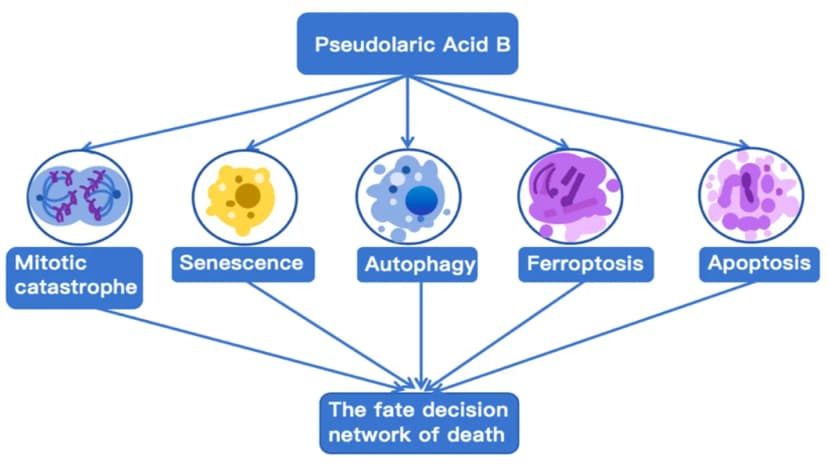
This review advances understanding of pseudolaric acid B (PAB) as a context-dependent modulator of cancer cell fate rather than merely a multi-target cytotoxic compound. By integrating apoptosis, ferroptosis, autophagy, senescence, and mitotic catastrophe into a proposed cell fate decision network, it identifies interconnected regulatory factors and highlights ferroptosis as an emerging therapeutic focus. The discussion of targeted protein degradation, tumor microenvironment remodeling, and predictive biomarkers establishes research directions for precision medicine, patient stratification, and the development of improved PAB-based anticancer strategies.
This review examines the antitumor potential of pseudolaric acid B, a diterpenoid natural product, focusing on its context-dependent effects on cellular death pathways. It explores apoptosis, ferroptosis, autophagy, senescence, and mitotic catastrophe through interconnected mechanisms involving reactive oxygen species, p53, glucose metabolism, iron metabolism, and autophagy. Particular attention is given to ferroptosis regulation and CD147-based PROTAC development. The review also discusses tumor microenvironment remodeling and proposes validating cell fate networks, identifying predictive biomarkers, and advancing precision-targeted therapeutic strategies.
Article type: Review
Submitted: 1 January 2026
Revised: 14 April 2026
Accepted: 24 July 2026
First published: 11 August 2026
DOI: https://doi.org/10.69626/bba.2026.0186
Volume: 3
Issue: 03
Pages: 186-201
Citation: BioMed and BioSci Advances 3(3), 186-201 (2026)
Yang X., Huang S., Xiao Y., Hu Y., Zhang D., Yu F. 2026. Pseudolaric Acid B as a Promising Antitumor Natural Product with Context–Dependent Cell Death Mechanisms. BioMed and BioSci Advances 3(3), pp. 186-201; https://doi.org/10.69626/bba.2026.0186.
Number of downloads: 0
Number of views: 1