


Subscribe To Get Information, Latest News And Other Interesting Events!



Important Links
Get In Touch
Ariston Publication
3167 Riverview Place
Columbus, OH 43202
United States of America
Copyright © 2026 Ariston Publications. All Rights Reserved.
Loading Your Library
Preparing your reading experience...
Loading content...
Ariston Publication
3167 Riverview Place
Columbus, OH 43202
United States of America
N. Purandhar, M.Rajendiran , Ahmed Mudassar Ali , M. Sangeetha
N. Purandhar1,*
M.Rajendiran 2
Ahmed Mudassar Ali 3
M. Sangeetha 4
1 Department of Ccomputer Science and Engineering- Artificial Intelligence, School of Computers Madanapalle Institute of Technology & Science (Deemed to be University), Madanapalle, Andhra Pradesh - 517325, India.
2 Department of Artificial Intelligence and Data Science, VSB Engineering College. Karur, Tamil Nadu, India.
3 Department of Information Technology, S.A. Engineering College, Affiliated to Anna University, Poonamallee-Avadi Road, Thiruverkadu, Chennai - 600 077. Tamilnadu. India.
4 PSGR Krishnammal College for Women), Bharathiar University, Peelamedu, Coimbatore - 641004, Tamil Nadu, India
* Author to whom correspondence should be addressed: purandhar.n@gmail.com (N. Purandhar)
Conventional agricultural practices are increasingly inadequate to meet the demands of a rapidly expanding global population, often leading to inefficient resource use, environmental degradation, and suboptimal crop yields. The Internet of Things (IoT) presents a transformative solution by introducing precision and intelligence into farming operations. This research proposes a comprehensive, IoT-driven autonomous vehicle system designed specifically for large-scale seed monitoring and targeted water distribution. The system is engineered to bridge the gap between rising food demands and the necessity for sustainable farming methods. A primary feature of its design is scalability, enabling effective deployment across farms of varying sizes and facilitating integration with other smart agriculture technologies. By synergizing autonomous vehicles with a network of IoT sensors and real-time data analytics, the platform establishes a data-driven environment for sustainable and efficient agricultural management. The system utilizes IoT-based sensors and actuators to continuously assess seed health and soil conditions, enabling strategic, on-demand water distribution that minimizes waste and optimizes resource allocation. This architecture empowers farms of any scale to achieve operational excellence while actively promoting environmental stewardship through precision agriculture.
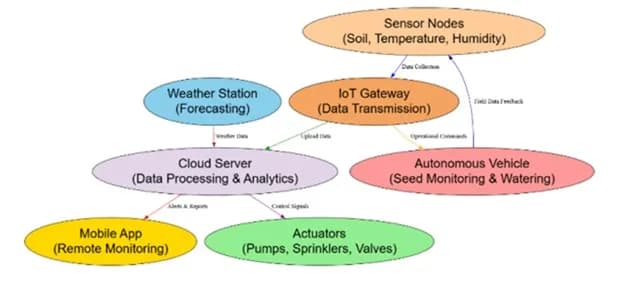
This study demonstrates the importance of AgriRover as an integrated IoT-enabled autonomous system that enhances precision agriculture by combining real-time sensing, multisource data fusion, and intelligent water management. By delivering targeted irrigation and accurate seed-health assessment, the system significantly reduces resource wastage and improves productivity. Its modular, scalable design supports diverse farm sizes, while its closed-loop feedback ensures adaptability to environmental variations. AgriRover provides a practical, sustainable, and technology-driven solution for future smart farming ecosystems..
This study introduces AgriRover, an IoT-based autonomous vehicle designed for precision seed monitoring and adaptive water distribution. Integrating hyperspectral sensing, soil-moisture analysis, GPS, and UAV–satellite data fusion, the system accurately assesses seed health and computes precise irrigation needs. Field experiments show high accuracy, efficiency, and uniformity in water delivery, along with robust autonomous navigation. AgriRover effectively enhances resource utilization, supports early stress detection, and improves field-level decision-making, establishing a scalable and sustainable solution for next-generation precision agriculture.
Article type: Research Article
Submitted: 19 September 2024
Revised: 28 November 2024
Accepted: 15 March 2025
First published: 8 April 2025
DOI: https://doi.org/10.69626/cai.2025.0107
Volume: 2
Issue: 2
Pages: 107-120
Citation: CompSci & AI Advances 2(2), 107–120 (2025)
Purandhar, N., Rajendiran, M., Ali, A. M., & Sangeetha, M. (2025). AgriRover: An IoT–Enabled Autonomous System for Precision Seed Monitoring and Adaptive Water Distribution. CompSci & AI Advances, 2(2), pp. 107–120; https://doi.org/10.69626/cai.2025.0107
Number of downloads: 5
Number of views: 105