


Subscribe To Get Information, Latest News And Other Interesting Events!



Important Links
Get In Touch
Ariston Publication
3167 Riverview Place
Columbus, OH 43202
United States of America
Copyright © 2026 Ariston Publications. All Rights Reserved.
Loading Your Library
Preparing your reading experience...
Loading content...
Ariston Publication
3167 Riverview Place
Columbus, OH 43202
United States of America
R. Shanmuga Sundaram , R. Mohanraj, S. Sasidevi
R. Shanmuga Sundaram*
R. Mohanraj
S. Sasidevi
Department of Electronics and Computer Engineering, Knowledge Institute of Technology, Knowledge College Road, Kakapalayam, Selliampalayam, Tamil Nadu-637504, India
* Author to whom correspondence should be addressed: rsece@kiot.ac.in (R. Shanmuga Sundaram)
The rapid proliferation of edge computing in smart cities has enhanced real-time data processing capabilities, but it has also exposed critical vulnerabilities to sophisticated cyber threats such as zero-day attacks. Traditional signature-based intrusion detection systems often fail to identify these previously unknown threats due to their lack of adaptive intelligence and interpretability. This research proposes an Explainable Artificial Intelligence (XAI)-driven zero-day attack detection framework tailored for edge devices deployed in smart city environments. The proposed system combines deep anomaly detection using a hybrid Convolutional Neural Network–Long Short-Term Memory (CNN–LSTM) model with SHAP (SHapley Additive exPlanations)-based interpretability to detect and explain anomalous behaviors in real-time network traffic. The model is trained on diverse datasets emulating heterogeneous smart city edge infrastructures, ensuring robustness and scalability. Experimental results demonstrate high detection accuracy, a low false-positive rate, and strong resilience against unseen attack patterns. Moreover, the integration of XAI components provides actionable insights to administrators, thereby enhancing trust, transparency, and informed decision-making in cybersecurity operations. This framework represents a significant step toward proactive and explainable security solutions for safeguarding smart urban ecosystems.
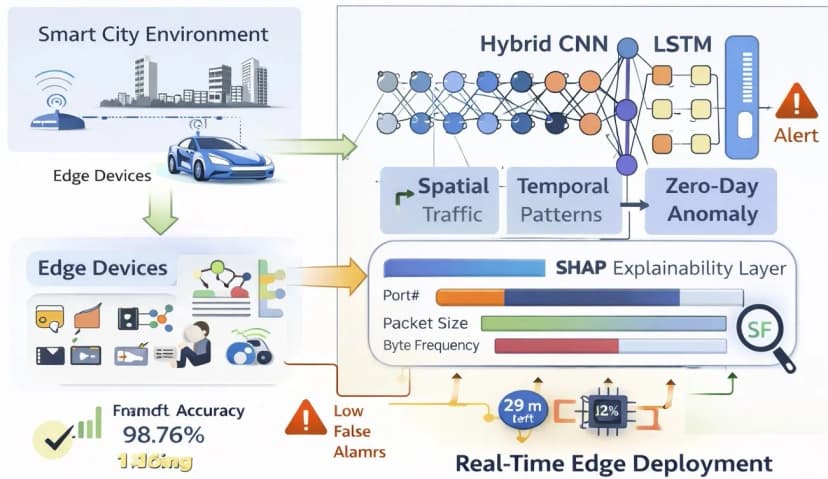
This study strengthens smart city cybersecurity by introducing an explainable AI-driven intrusion detection framework optimized for edge devices. By integrating a hybrid CNN–LSTM model with SHAP-based interpretability, the framework achieves 98.76% detection accuracy, 98.41% recall, and a low false-positive rate of 1.3%, outperforming traditional ML and standalone deep learning approaches. The explainability layer enhances analyst trust, accelerates incident response, and supports forensic investigations, while edge-optimized deployment enables real-time inference with 29 ms latency, ensuring operational feasibility in resource-constrained environments.
This work presents an XAI-driven zero-day attack detection framework for securing smart city edge devices. The hybrid CNN–LSTM model effectively captures spatiotemporal traffic patterns to identify anomalous and previously unseen attacks, while SHAP provides transparent, feature-level explanations for each detection. Extensive evaluations on benchmark datasets confirm high accuracy, robustness, and low false alarms. Real-time edge deployment validates low-latency performance, establishing the framework as a scalable, interpretable, and trustworthy security solution for next-generation smart urban infrastructures.
Article type: Research Article
Submitted: 3 February 2025
Revised: 26 March 2025
Accepted: 19 June 2025
First published: 9 July 2025
DOI: https://doi.org/10.69626/cai.2025.0237
Volume: 2
Issue: 3
Pages: 237–245
Citation: CompSci & AI Advances, 2(3), 237–245.