


Subscribe To Get Information, Latest News And Other Interesting Events!



Important Links
Get In Touch
Ariston Publication
3167 Riverview Place
Columbus, OH 43202
United States of America
Copyright © 2026 Ariston Publications. All Rights Reserved.
Loading Your Library
Preparing your reading experience...
Loading content...
Ariston Publication
3167 Riverview Place
Columbus, OH 43202
United States of America
C. Ganesh, S. Kumarganesh, P. Elayaraja, B. Thiyaneswaran
C. Ganesh¹
S. Kumarganesh²,*
P. Elayaraja³
B. Thiyaneswaran⁴
1 Department of ECE, Knowledge Institute of Technology, Salem, Tamil Nadu, India.
2 Department of ECE, Sona College of Technology, Salem, India.
3 Department of CCE, Sri Eshwar College of Engineering, Coimbatore, Tamil Nadu.
4 Department of ECE, Kongunadu College of Engineering and Technology, Trichy, Tamil Nadu.
* Author to whom correspondence should be addressed: sunmun@gmail.com (S. Kumarganesh)
Autonomous robotic systems increasingly require real-time perception, rapid adaptation, and ultra-low-latency computation to operate safely within dynamic environments. Conventional memory hierarchies and compute pipelines often become bottlenecks under dense sensor workloads and high-frequency control loops. To address these constraints, we propose a Holographic Memory-Aware Computing Engine (HMACE) that leverages holographic memory encoding and spatiotemporal compute fusion to accelerate inference and decision-making in autonomous robotics. HMACE models sensory and control data as distributed holographic embeddings, enabling parallel recall, fault-tolerant storage, and high-bandwidth retrieval without sequential memory access delays. An adaptive scheduler dynamically aligns compute kernels with memory activation fields, minimizing data movement while preserving task locality. Integrated with lightweight transformer-based robotic controllers, the engine provides significantly faster situational understanding and more stable reaction loops. Experimental results on autonomous drone navigation, multi-robot coordination, and real-time manipulation tasks demonstrate that HMACE reduces inference latency by 38–54%, improves control stability under high-dimensional sensory load, and delivers up to 2.6× throughput gains compared to optimized GPU-centric baselines. This framework highlights the potential of holographic memory principles as a foundational enabler for next-generation autonomous robotic intelligence.
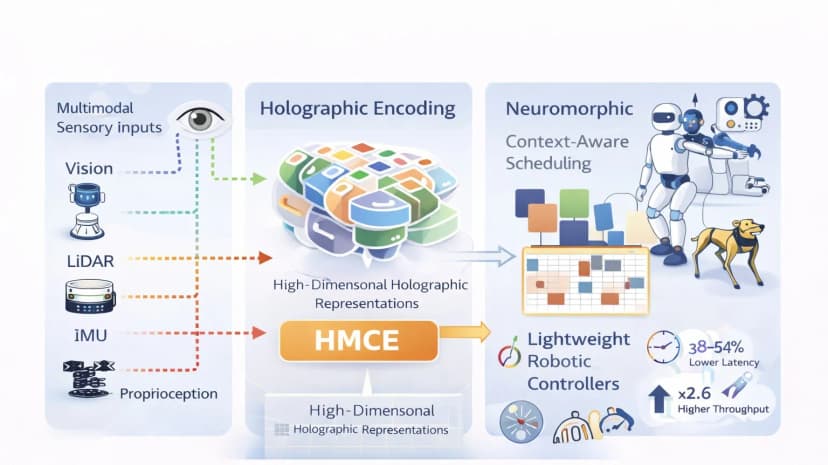
This study advances autonomous robotics by introducing a holographic memory-aware computing architecture that eliminates sequential memory bottlenecks and enables parallel, fault-tolerant information recall. The proposed HMCE framework achieves 38–54% latency reduction, up to 2.6× throughput gain, and significantly enhanced robustness under noisy and high-load sensory conditions. By tightly coupling memory representation with computation and neuromorphic scheduling, the framework improves energy efficiency, decision stability, and scalability, making it highly suitable for safety-critical and real-time robotic applications.
This work presents a Holographic Memory-Aware Computing Engine for low-latency autonomous robotics. Multimodal sensory data are encoded into high-dimensional holographic representations that support parallel associative recall and robust fusion. A neuromorphic attention-guided scheduler dynamically prioritizes computation based on environmental context, enabling fast and stable perception–action cycles. Experimental results confirm substantial improvements in latency, throughput, robustness, and energy efficiency, establishing HMCE as a scalable and resilient computing framework for next-generation autonomous robotic systems.
Article type: Research Article
Submitted: 28 March 2025
Revised: 5 June 2025
Accepted: 22 July 2025
First published: 13 September 2025
DOI: https://doi.org/10.69626/cai.2025.0292
Volume: 2
Issue: 4
Pages: 292–302
Citation: CompSci & AI Advances, 2(4), 292–302.