


Subscribe To Get Information, Latest News And Other Interesting Events!



Important Links
Get In Touch
Ariston Publication
3167 Riverview Place
Columbus, OH 43202
United States of America
Copyright © 2026 Ariston Publications. All Rights Reserved.
Loading Your Library
Preparing your reading experience...
Loading content...
Ariston Publication
3167 Riverview Place
Columbus, OH 43202
United States of America
Abdulaziz Saleh Yeslem Bin-Habtoor, Mohammad Sufyan
Abdulaziz Saleh Yeslem Bin-Habtoor 1, 2
Mohammad Sufyan 3,*
1 Computer Network & Communication, Collage of Engineering, Hadramout University, Hadramout, Yemen.
2 Department of Computer Science, Applied College, Sharurah, Najran University, Saudi Arabia
3 Department of Civil Engineering, Ram Krishna Dharmaarth Foundation University, Bhopal, India.
* Author to whom correspondence should be addressed:
sufirehan8@gmail.com (Mohammad Sufyan)
Sensor-based mobile systems have become integral to ubiquitous and wearable computing by enabling context-aware applications through continuous sensing and intelligent data processing. Selecting the most suitable context recognition framework is a challenging multi-criteria decision-making problem due to trade-offs among accuracy, energy efficiency, and response time. This study presents a comparative evaluation of five context recognition frameworks—RADAR, UbiqLog, LOCATUS, NetHealth, and ExtraSensory—using the Weighted Sum Model (WSM). The frameworks are assessed based on Accuracy, Precision and Recall, Battery Consumption, Latency, and Context Recognition Accuracy. The evaluation identifies the strengths and limitations of each framework and ranks them according to their overall performance. Experimental results indicate that ExtraSensory achieves the highest overall ranking, while NetHealth and UbiqLog demonstrate competitive performance across multiple criteria. The findings provide a practical decision-support framework for researchers and developers to select efficient, reliable, and energy-aware context recognition systems for mobile and wearable computing applications.
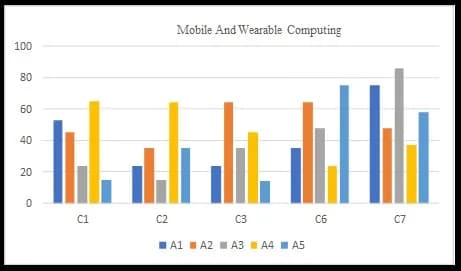
This research provides a systematic decision-support framework for evaluating mobile and wearable context recognition technologies using the Weighted Sum Model (WSM). By considering multiple performance criteria, including accuracy, precision, battery consumption, latency, and context recognition accuracy, the study enables objective comparison of competing frameworks. The findings support informed technology selection for ubiquitous and positive computing applications while promoting energy-efficient and reliable system design. The proposed evaluation methodology can guide researchers and developers in optimizing future intelligent mobile and wearable solutions.
This study compares five context recognition frameworks—RADAR, UbiqLog, LOCATUS, NetHealth, and ExtraSensory—using the Weighted Sum Model to evaluate their overall performance. The frameworks were assessed based on accuracy, precision and recall, battery consumption, latency, and context recognition accuracy. Experimental results identified ExtraSensory as the highest-performing framework, with NetHealth and UbiqLog also demonstrating strong performance across multiple criteria. The proposed multi-attribute evaluation framework provides an effective, data-driven approach for selecting efficient, reliable, and energy-aware mobile and wearable computing technologies.
Article type: Research Article
Submitted: 17 August 2025
Revised: 26 October 2025
Accepted: 26 October 2025
First published: 3 January 2026
DOI: https://doi.org/10.69626/cai.2026.0014
Volume: 03
Issue: 01
Pages: 14–25
Citation: CompSci & AI Advances, 3(1), 14–25 (2026).