


Subscribe To Get Information, Latest News And Other Interesting Events!



Important Links
Get In Touch
Ariston Publication
3167 Riverview Place
Columbus, OH 43202
United States of America
Copyright © 2026 Ariston Publications. All Rights Reserved.
Loading Your Library
Preparing your reading experience...
Loading content...
Ariston Publication
3167 Riverview Place
Columbus, OH 43202
United States of America
G. Gayathiri Devi, P. Umaeswari, S. Jagan, S. Gopinath, T. Thirumalaikumari
G. Gayathiri Devi 1,*
P. Umaeswari 2
S. Jagan 3
S. Gopinath 4
T. Thirumalaikumari 5
1 Department of Science and Humanities, R.M.D. Engineering College, Chennai, Tamil Nadu, India
2 Department of Computer Science and Business Systems, R.M.K. Engineering College, Tamil Nadu, India
3 Department of Computer Science and Engineering, School of Computing, Vel Tech Rangarajan Dr. Sagunthala R&D Institute of Science and Technology, Chennai – 600062, India
4 Department of Information Technology, Gnanamani College of Technology, Namakkal, Tamil Nadu, India
5 Department of Computer Applications, School of Computing Sciences, Vels Institute of Science, Technology & Advanced Studies (VISTAS), Chennai – 600117, India
*Author to whom correspondence should be addressed:
gayathiri.snh@rmd.ac.in (G. Gayathiri Devi)
Autonomous multi-robot coordination in dynamic environments requires intelligent decision-making, adaptability, and real-time collaboration to accomplish complex tasks efficiently. This paper proposes Self-Evolving Swarm Intelligence Algorithms (SE-SIA) that integrate adaptive evolutionary learning, reinforcement learning, and bio-inspired collective behaviour to improve autonomous robotic coordination. The proposed framework dynamically optimizes swarm parameters, communication strategies, and task allocation in response to changing environmental conditions, ensuring robustness, scalability, and fault tolerance. Experimental evaluation in simulated and real-world scenarios, including search-and-rescue operations, industrial automation, and autonomous drone fleets, demonstrates superior performance compared with conventional swarm robotics methods. The framework improves path planning, reduces energy consumption, enhances task completion efficiency, and minimizes communication overhead while maintaining effective decentralized coordination. The self-evolving learning mechanism enables continuous adaptation to unpredictable environments through multi-objective optimization. The proposed approach offers a scalable and reliable solution for next-generation multi-robot systems across industrial, emergency response, and surveillance applications.
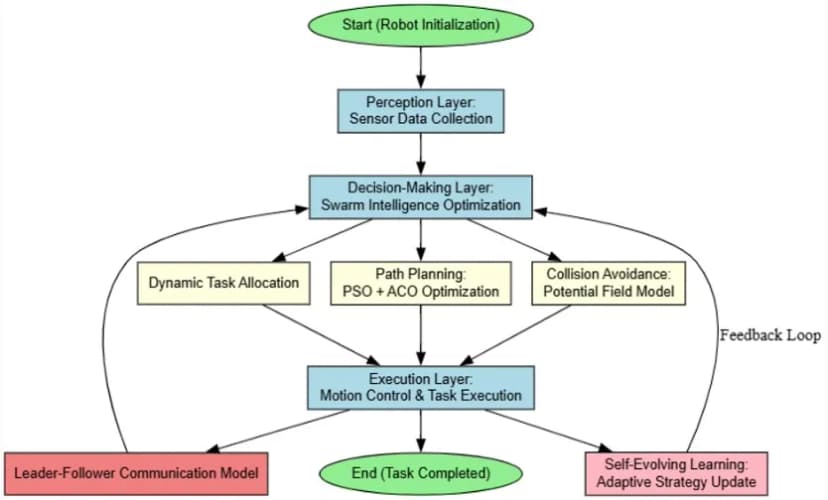
This research advances autonomous multi-robot systems by introducing Self-Evolving Swarm Intelligence Algorithms that combine evolutionary learning, reinforcement learning, and bio-inspired optimization for adaptive coordination. The proposed framework enhances scalability, robustness, energy efficiency, and decentralized decision-making while reducing communication overhead and improving task execution in dynamic environments. Its self-evolving capabilities enable continuous learning and real-time adaptation, making the approach highly suitable for search-and-rescue operations, industrial automation, surveillance, precision agriculture, and other intelligent robotic swarm applications.
This study presents the Self-Evolving Swarm Intelligence Algorithm (SE-SIA) framework for autonomous multi-robot coordination in dynamic environments. The framework integrates bio-inspired swarm optimization, reinforcement learning, and adaptive evolutionary mechanisms to optimize path planning, communication, and task allocation. Experimental evaluations demonstrate significant improvements in path optimization, energy efficiency, and task completion compared with conventional swarm methods. By enabling decentralized, fault-tolerant, and continuously adaptive coordination, the proposed approach provides a scalable and reliable solution for next-generation robotic swarms operating in complex real-world scenarios.
Article type: Research Article
Submitted: 23 August 2025
Revised: 3 November 2025
Accepted: 12 December 2025
First published: 11 January 2026
DOI: https://doi.org/10.69626/cai.2026.0026
Volume: 03
Issue: 01
Pages: 26–39
Citation: CompSci & AI Advances, 3(1), 26–39 (2026).
Devi, G. G., Umaeswari, P., Jagan, S., Gopinath, S. and Thirumalaikumari, T. 2026. Self–Evolving Swarm Intelligence Algorithms for Autonomous Multi–Robot Coordination in Dynamic Environments. CompSci & AI Advances, 3(1), 26–39. https://doi.org/10.69626/cai.2026.0026
Number of downloads: 6
Number of views: 83