


Subscribe To Get Information, Latest News And Other Interesting Events!



Important Links
Get In Touch
Ariston Publication
3167 Riverview Place
Columbus, OH 43202
United States of America
Copyright © 2026 Ariston Publications. All Rights Reserved.
Loading Your Library
Preparing your reading experience...
Loading content...
Ariston Publication
3167 Riverview Place
Columbus, OH 43202
United States of America
Uma Maheshwari
Uma Maheshwari
Department of Electronics and Communication Engineering, Hindusthan Institute of Technology, Valley Campus, Pollachi Highway, Coimbatore - 641 032. TamilNadu, India.
* Author to whom correspondence should be addressed:
umamaheshwari@hit.edu.in (Uma Maheshwari)
The dynamic nature of modern cyber threats presents significant challenges for traditional network intrusion detection systems, which frequently exhibit diminished detection accuracy and elevated false-positive rates when confronted with evolving attack patterns. This investigation introduces a novel Deep Reinforcement Learning framework utilizing Deep Q-Networks to address these limitations through adaptive, real-time network traffic analysis and threat mitigation. The proposed system was rigorously evaluated using the NSL-KDD and CICIDS2017 benchmark datasets, which represent standard reference points for intrusion detection research. Experimental results demonstrate that the DRL-based approach achieves a notable intrusion detection accuracy of 98.2 percent, accompanied by a 25 percent improvement in detection speed relative to conventional systems. Furthermore, the implementation yielded a substantial 30 percent reduction in false-positive rates, significantly enhancing overall network reliability. The framework's capacity to continuously learn from network traffic patterns and adapt its decision-making policies in real-time represents a fundamental advancement in cybersecurity architecture. These findings substantiate the transformative potential of Deep Reinforcement Learning in addressing the inherent complexities of contemporary network security challenges, positioning this methodology as a promising direction for future cybersecurity research and practical deployment in protecting critical digital infrastructure.
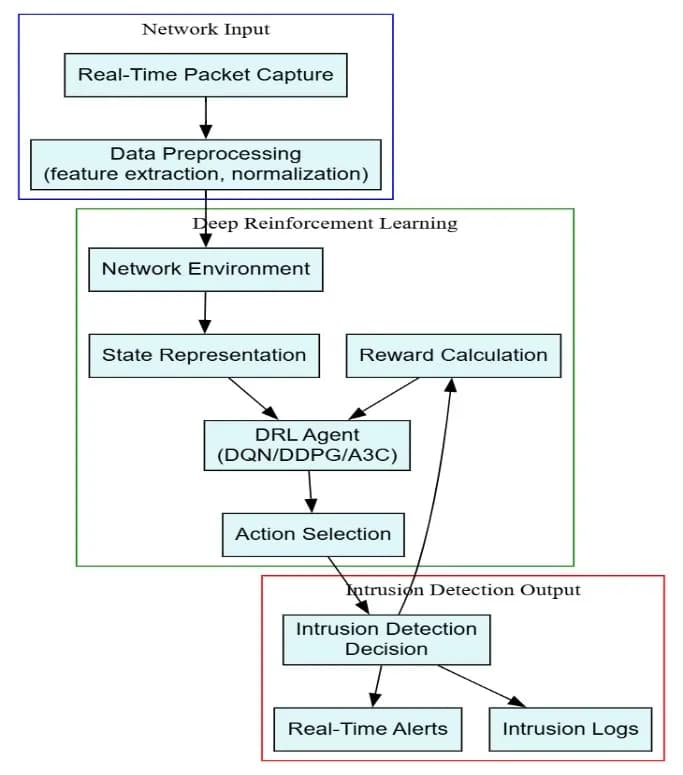
This research advances cybersecurity by introducing a Deep Reinforcement Learning framework for adaptive and real-time network intrusion detection. The proposed approach improves detection accuracy, reduces false-positive rates, and enhances response speed while continuously learning from evolving cyber threats. Unlike conventional rule-based systems, it dynamically adapts to changing attack patterns without frequent manual updates. The framework provides a scalable and intelligent solution for protecting critical digital infrastructures, supporting next-generation cybersecurity systems with improved reliability, efficiency, and resilience against sophisticated network attacks.
This study proposes a Deep Reinforcement Learning framework based on Deep Q-Networks for real-time network intrusion detection. The system analyzes network traffic adaptively and continuously updates its decision-making policy to identify evolving cyber threats. Evaluated using the NSL-KDD and CICIDS2017 benchmark datasets, the framework achieved 98.2% detection accuracy, improved detection speed by 25%, and reduced false-positive rates by 30% compared with conventional methods. The proposed approach offers an intelligent, scalable, and efficient solution for modern network security and cyber defence applications.
Article type: Research Article
Submitted: 20 October 2525
Revised: 23 January 2026
Accepted: 21 February 2026
First published: 15 March 2026
DOI: https://doi.org/10.69626/cai.2026.0104
Volume: 03
Issue: 02
Pages: 104–117
Citation: CompSci & AI Advances, 3(2), 104–117 (2026).