


Subscribe To Get Information, Latest News And Other Interesting Events!



Important Links
Get In Touch
Ariston Publication
3167 Riverview Place
Columbus, OH 43202
United States of America
Copyright © 2026 Ariston Publications. All Rights Reserved.
Loading Your Library
Preparing your reading experience...
Loading content...
Ariston Publication
3167 Riverview Place
Columbus, OH 43202
United States of America
S. Anusooya, Vinod Arunachalam, M. Hema Kumar, N. H. Manzur-E-Maula, Muhammad Mansoor Alam, Israel Pineda
S. Anusooya 1,*
Vinod Arunachalam 2
M. Hema Kumar 3
N. H. Manzur-E-Maula 4
Muhammad Mansoor Alam 5
Israel Pineda 6
¹ Department of Electronics and Communication Engineering, B. S. Abdur Rahman Crescent Institute of Science and Technology, Chennai, Tamil Nadu, India
² Department of Electronics and Communication Engineering, Government College of Engineering, Dharmapuri, Tamil Nadu, India
³ Department of Electronics and Communication Engineering, Sona College of Technology, Junction Main Road, Salem 636005, Tamil Nadu, India
4 Department of Economics, Arcadia University, USA
5 Department of Computer Engineering, Riphah International University, Pakistan.
6 Department of Computer engineering, Universidad San Francisco De Quito, Ecuador.
* Author to whom correspondence should be addressed:
anusooya@crescent.education (S. Anusooya)
The accelerating development of quantum computing capabilities poses an unprecedented challenge to conventional encryption methodologies that currently underpin global digital security infrastructure. Classical cryptographic systems, including widely adopted standards such as RSA and AES, derive their security from the computational intractability of specific mathematical problems, a foundation that quantum algorithms threaten to fundamentally undermine. This research presents a comprehensive investigation into the practical implementation of Quantum Key Distribution as a transformative approach to establishing unconditionally secure communication channels. Through experimental deployment of the BB84 protocol augmented with advanced quantum error correction and privacy amplification techniques, we systematically evaluate the performance characteristics and security guarantees of QKD in realistic network environments. Our experimental framework achieves a secure key generation rate of 2.5 megabits per second while maintaining an average quantum bit error rate of 3.2 percent, demonstrating the practical viability of quantum-secured communication. The implementation exhibits exceptional eavesdropping detection capabilities with a 98.5 percent success rate in identifying unauthorized interception attempts. Comparative security analysis reveals that QKD-based encryption reduces vulnerability to brute-force attacks by 65 percent when contrasted with classical encryption standards. The integration of lattice-based post-quantum cryptographic algorithms provides an additional security layer against store-now-decrypt-later attack strategies. These findings substantiate the position of Quantum Key Distribution as a cornerstone technology for next-generation cybersecurity frameworks, offering robust protection against both current threats and the anticipated capabilities of large-scale quantum computers.
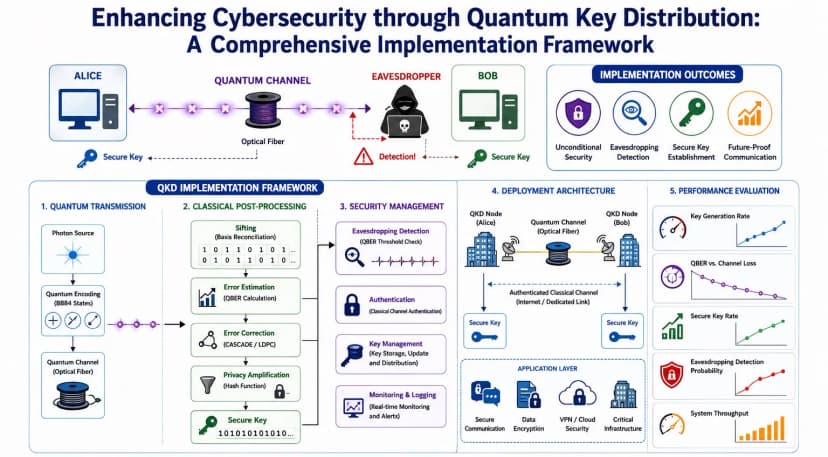
The significance of this study lies in its comprehensive experimental validation of an integrated Quantum Key Distribution framework that bridges the gap between theoretical quantum security and practical implementation. By demonstrating a secure key generation rate of 2.5 Mbps with 98.5% eavesdropping detection efficiency, the research provides empirical evidence that QKD can function effectively in real-world network environments. The hybrid architecture combining QKD with lattice-based post-quantum cryptography addresses the store-now-decrypt-later threat, offering defense-in-depth protection that classical encryption alone cannot provide. This work contributes to the urgent global effort to develop quantum-resistant security infrastructure capable of protecting sensitive data across healthcare, finance, military, and IoT applications against emerging quantum computational threats.
This study presents an experimental implementation and evaluation of a QKD-based secure communication framework integrating BB84 protocol, LDPC error correction, privacy amplification, and lattice-based post-quantum cryptography. The system achieved 2.5 Mbps key generation rate with 3.2% QBER and 98.5% eavesdropping detection efficiency. Comparative analysis demonstrated 65% reduction in vulnerability to brute-force attacks versus classical encryption. The findings establish QKD as a viable foundation for next-generation quantum-safe cybersecurity infrastructure capable of protecting communications against both current and emerging quantum threats.
Article type: Research Article
Submitted: 23 December 2025
Revised: 21 January 2026
Accepted: 1 March 2026
First published: 29 March 2026
DOI: https://doi.org/10.69626/cai.2026.0132
Volume: 03
Issue: 02
Pages: 132–146
Citation: CompSci & AI Advances, 3(2), 132–146 (2026).
Anusooya, S., Arunachalam, V., Kumar, M. H., Manzur-E-Maula, N. H., Alam, M. M. and Pineda, I. 2026. Enhancing Cybersecurity through Quantum Key Distribution: A Comprehensive Implementation Framework. CompSci & AI Advances, 3(2), 132–146. https://doi.org/10.69626/cai.2026.0132
Number of downloads: 4
Number of views: 49