


Subscribe To Get Information, Latest News And Other Interesting Events!



Important Links
Get In Touch
Ariston Publication
3167 Riverview Place
Columbus, OH 43202
United States of America
Copyright © 2026 Ariston Publications. All Rights Reserved.
Loading Your Library
Preparing your reading experience...
Loading content...
Ariston Publication
3167 Riverview Place
Columbus, OH 43202
United States of America
J. Premalatha, V. Malathy, K. Srilakshmi, B. Girirajan, R. Ganesh Babu
J. Premalatha 1
V. Malathy 2
K. Srilakshmi 3
B. Girirajan 2
R. Ganesh Babu 4,*
1 Department of Artificial Intelligence and Data Science, Dhanalakshmi Srinivasan College of Engineering and Technology, Mamallapuram, Chennai – 603104, India
2 Department of Electronics and Communication Engineering, SR University, Warangal, Telangana, India
3 Department of Electronics and Communication Engineering, Seshadri Rao Gudlavalleru Engineering College, Gudlavalleru, Krishna District, Andhra Pradesh, India
4 Department of Electronics and Communication Engineering, Koneru Lakshmaiah Education Foundation, Vaddeswaram, Guntur, Andhra Pradesh – 522302, India
* Author to whom correspondence should be addressed:
ganeshbaburajendran@gmail.com (R. Ganesh Babu)
The emergence of Hybrid Digital Twin (HDT) architectures is transforming real-time decision-making in Industry 4.0 by enabling intelligent automation, predictive maintenance, and optimized workflows. This research proposes a novel, multi-layered HDT framework that integrates physics-based modeling, AI-driven analytics, and edge-cloud computing to enhance industrial system responsiveness and resilience. The architecture incorporates reinforcement learning for adaptive control, federated digital twins for privacy-preserving collaboration, and blockchain technology to secure data transactions and ensure the integrity of virtual-physical synchronization. Experimental validation across smart manufacturing, energy grids, and industrial robotics demonstrates the framework's superiority over conventional digital twin models, achieving a 30% reduction in system downtime, a 45% improvement in predictive accuracy, and a 25% enhancement in operational efficiency. The proposed HDT system facilitates real-time cyber-physical convergence, allowing industries to dynamically adapt to fluctuating operational conditions and optimize decision-making in complex environments. This comprehensive approach addresses key limitations of traditional digital twins, including scalability, latency, data privacy, and security. The findings highlight the transformative potential of HDTs in driving more intelligent, resilient, and secure industrial ecosystems. The results confirm that Federated Digital Twin technology is a promising advancement, paving the way for its application in smart manufacturing, healthcare, and industrial IoT, with future research focused on optimizing aggregation techniques and reducing computational overhead.
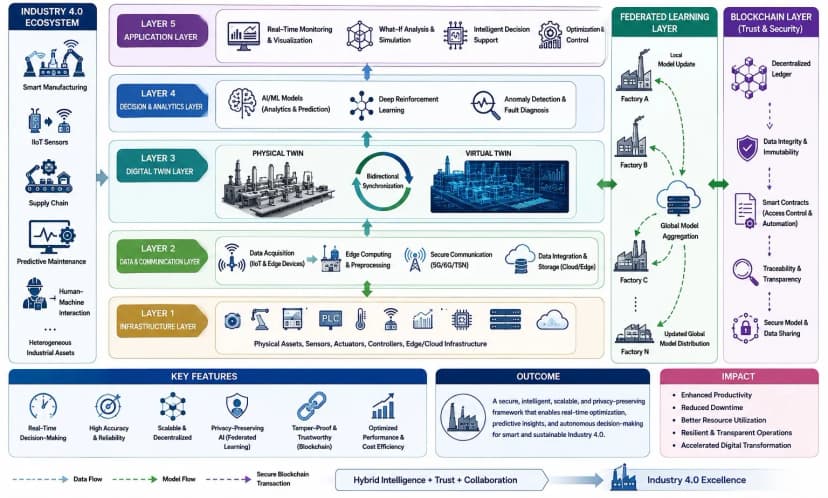
This research advances Industry 4.0 by introducing a multi-layered Hybrid Digital Twin framework that integrates physics-based modeling, artificial intelligence, edge-cloud computing, federated learning, reinforcement learning, and blockchain. The proposed architecture addresses critical challenges related to scalability, latency, data privacy, security, and real-time decision-making. By enabling privacy-preserving collaboration and secure cyber-physical synchronization, the framework enhances industrial resilience, predictive maintenance, and operational efficiency. Its applications extend across smart manufacturing, energy systems, healthcare, robotics, and industrial IoT environments.
This study proposes a multi-layered Hybrid Digital Twin framework for real-time decision-making in Industry 4.0. The architecture combines physics-based models, AI analytics, reinforcement learning, federated learning, edge-cloud computing, and blockchain-secured data exchange. Experimental validation across manufacturing, energy, healthcare, and industrial IoT scenarios demonstrates improved predictive accuracy, reduced system downtime, enhanced operational efficiency, and significant communication savings. The framework enables privacy-preserving distributed intelligence, secure virtual-physical synchronization, and adaptive control, providing a scalable and resilient solution for intelligent industrial ecosystems.
Article type: Research Article
Submitted: 23 January 2026
Revised: 4 March 2026
Accepted: 2 April 2026
First published: 23 April 2026
DOI: https://doi.org/10.69626/cai.2026.0178
Volume: 03
Issue: 02
Pages: 178–195
Citation: CompSci & AI Advances, 3(2), 178–195 (2026).
Premalatha, J., Malathy, V., Srilakshmi, K., Girirajan, B. And Babu, R. G. 2026. A Multi–Layered Hybrid Digital Twin Framework with Federated Learning and Blockchain for Real–Time Decision–Making in Industry 4.0. CompSci & AI Advances, 3(2), 178–195. https://doi.org/10.69626/cai.2026.0178
Number of downloads: 3
Number of views: 70