


Subscribe To Get Information, Latest News And Other Interesting Events!


Important Links
Get In Touch
Ariston Publication
3167 Riverview Place
Columbus, OH 43202
United States of America
Copyright © 2026 Ariston Publications. All Rights Reserved.
Loading Your Library
Preparing your reading experience...
Loading content...
Ariston Publication
3167 Riverview Place
Columbus, OH 43202
United States of America

Bhagawan N. Kadlag, Dhananjay N. Kadlag, Anil G. Khairnar, Chandrakant G. Dighavkar, Arun V. Patil
Bhagawan N. Kadlag*
Dhananjay N. Kadlag
Anil G. Khairnar
Chandrakant G. Dighavkar,
Arun V. Patil
Research Center in Electronic Science, MGV’s L. V. H. Arts,
Science and Commerce College, Panchavati, Nashik 422003,
Maharashtra, India
*Author to whom correspondence should be addressed:
kadlag1985@gmail.com (B. Kadlag)
Grape (Vitis vinifera L.) and pomegranate (Punica granatum L.) are high-value export crops of Maharashtra, India, and fungal and bacterial diseases of their leaves and fruits reduce both yield and export quality. Field diagnosis still relies on slow visual inspection by experts. This study developed a content-based image retrieval (CBIR) tool in MATLAB that identifies diseases in grape and pomegranate images and shows the user the most similar confirmed cases from its image database. Images are enhanced and converted to the HSI and CIELAB colour spaces. Diseased regions are isolated by thresholding, Canny edge detection and K-means clustering, and colour-histogram, grey-level co-occurrence matrix (GLCM) texture and shape features form the image descriptor. Similar images are retrieved by Euclidean distance, and support vector machine (SVM), artificial neural network (ANN), k-nearest neighbour (KNN) and naive Bayes (NB) classifiers assign the disease class. The image collection holds 35,000 images (25,000 grape and 10,000 pomegranate) from public repositories and the authors’ own field collection in Nashik district; 1,000 images train the classifiers and the remaining 34,000 form the retrieval database. On this collection the tool reached 98.2% accuracy and 97.5% sensitivity for grape and 98.8% accuracy and 97.9% sensitivity for pomegranate. On an independent field-validation set of 500 samples from 100 farmers, with diagnoses confirmed by an agricultural expert and by laboratory analysis, it classified 490 samples correctly (98.0% accuracy) with 97.2% sensitivity. The tool needs no graphics processor, and each diagnosis is shown beside the confirmed images it matched
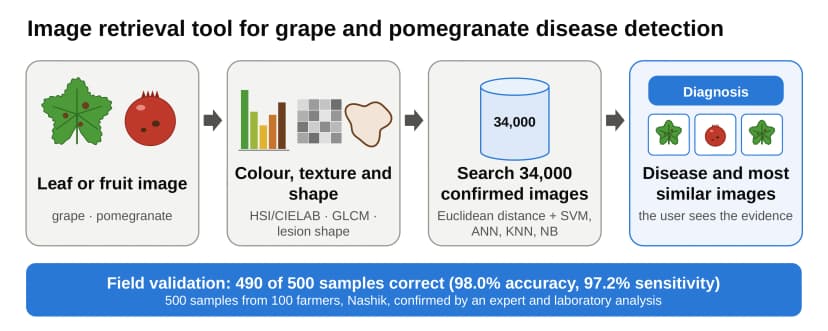
This study is significant because it demonstrates a practical and accessible image-based decision-support approach for the diagnosis of major fungal and bacterial diseases affecting grape and pomegranate, two economically important export crops of Maharashtra. Its novelty lies in combining content-based image retrieval with multi-space image enhancement and segmentation, and in integrating colour, texture and shape descriptors with multiple classifiers to not only assign a disease class but also present the user with visually similar confirmed cases, thereby improving interpretability and user confidence. Scientifically, the work contributes a large mixed-source image collection, a feature-extraction and retrieval pipeline tailored to leaf and fruit disease symptoms, and comparative evaluation of SVM, ANN, KNN and naive Bayes classifiers under both database testing and independent field validation. The reported high accuracy and sensitivity indicate that the system has potential for supporting rapid field-level screening, reducing dependence on expert visual inspection, and assisting farmers, extension personnel and diagnosticians in early disease recognition, management planning and quality control for export-oriented horticultural production.
The study developed a MATLAB-based content-based image retrieval (CBIR) system to diagnose diseases in grape and pomegranate leaves/fruits. The tool enhances images, converts them to HSI and CIELAB color spaces, segments diseased regions using thresholding, Canny edge detection, and K-means clustering, and extracts color-histogram, GLCM texture, and shape features. Disease similarity is measured using Euclidean distance, and SVM, ANN, KNN, and Naive Bayes classifiers are used for class prediction. Using a database of 35,000 images, the system achieved high performance, with 98.2% accuracy for grape and 98.8% for pomegranate, and it also performed well on an independent farmer field-validation set, reaching 98.0% accuracy. The tool is practical for field use, requires no GPU, and displays matched confirmed disease images alongside each diagnosis.
Article type: Research Article
Submitted: 20 October 2026
Revised: 2 November 2026
Accepted: 4 November 2026
First published: 10 November 2026
DOI: https://doi.org/10.69626/cai.2026.0308
Volume: 03
Issue: 04
Pages: 308-316
Citation: CompSci & AI Advances 3(4), 308-316 (2026)
Bhagawan N. Kadlag, Dhananjay N. Kadlag, Anil G. Khairnar, Chandrakant G. Dighavkar, Arun V. Patil 2026. Content − Based Image Retrieval Tool for Grape and Pomegranate Disease Detection using Colour, Texture and Shape Features: Development and Field Validation. CompSci & AI Advances 3(4), pp. 308-316; https://doi.org/10.69626/cai.2026.0308
Number of downloads: 4
Number of views: 8