


Subscribe To Get Information, Latest News And Other Interesting Events!



Important Links
Get In Touch
Ariston Publication
3167 Riverview Place
Columbus, OH 43202
United States of America
Copyright © 2026 Ariston Publications. All Rights Reserved.
Loading Your Library
Preparing your reading experience...
Loading content...
Ariston Publication
3167 Riverview Place
Columbus, OH 43202
United States of America

Annasaheb M. Chougule, Kavita S. Oza, Rohit B. Diwane, Vishal T. Patil
Annasaheb M. Chougule 1
Kavita S. Oza 1
Rohit B. Diwane 1
Vishal T.Patil 2
1 Department of Computer Science, Shivaji University, Kolhapur, Vidya Nagar, Ujalaiwadi, Maharashtra 416004, India
2 Department Of Computer Science, Miraj Mahavidyalaya, Shivaji University, Miraj-416436, Maharashtra, India
* Author to whom correspondence should be addressed:
amc.rs.csd@unishivaji.ac.in (Annasaheb M. Chougule)
The increasing prevalence of phishing and smishing attacks demands robust automated detection systems capable of identifying malicious content across multiple communication channels. This study presents a systematic comparative analysis of text classification techniques for detecting these threats, evaluating traditional TF-IDF vectorization against modern sentence embedding representations. We constructed a novel dataset comprising 27,000 carefully annotated messages collected from cyber cell sources in India, supplemented with 2,000 synthetically generated records to enhance diversity and model generalization. A comprehensive set of eleven machine learning classifiers was evaluated under both feature extraction paradigms, with particular attention paid to generalization behavior, model stability, and the training-testing performance gap. Under TF-IDF representation, the Support Vector Classifier demonstrated reliable performance with a training accuracy of 97.87% and a test accuracy of 89.37%, indicating controlled generalization. The Multilayer Perceptron and Stochastic Gradient Descent classifiers achieved competitive test accuracies of 88.28% and 86.06% respectively. Sentence embeddings, which capture deeper semantic context and linguistic nuance, yielded consistently superior results across all classifiers, with the Support Vector Classifier achieving 94.69% test accuracy and the tuned Multilayer Perceptron reaching 92.70%. The K-Nearest Neighbors classifier followed closely at 90.27%. Tree-based models exhibited comparatively lower stability, with the Decision Tree Classifier achieving only 81.41% with TF-IDF and 73.10% with sentence embeddings. Unlike prior studies that examine traditional features or deep embeddings in isolation, this work provides a controlled, large-scale comparative framework that jointly considers feature paradigms, classifier families, and communication channels. The findings underscore the advantage of semantically enriched representations for identifying sophisticated social engineering threats and establish a benchmark for future research in NLP-based cybersecurity applications.
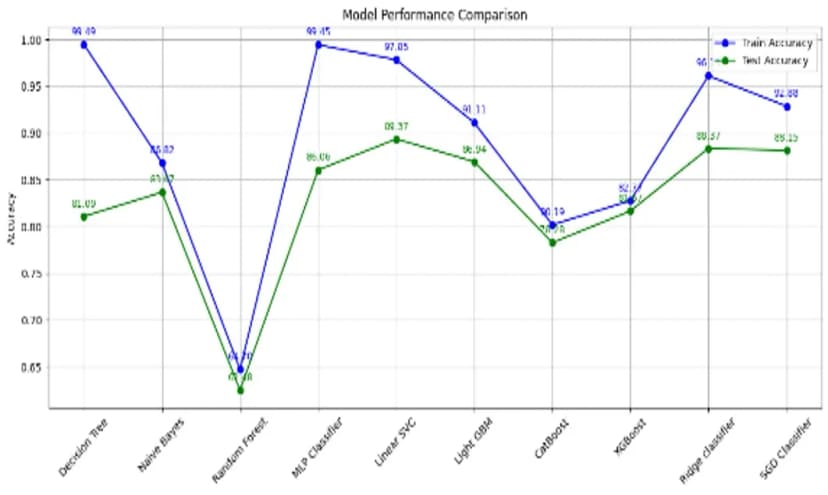
This work is significant because it provides a systematic and controlled evaluation of phishing and smishing detection using both traditional TF-IDF and semantically enriched sentence embeddings. By analyzing eleven machine learning classifiers on a diverse dataset of 29,000 messages, the study establishes reliable performance benchmarks and highlights the importance of contextual representations. The findings demonstrate that sentence embeddings substantially improve detection accuracy and generalization, particularly with SVC and MLP models. This research supports the development of more robust NLP-based cybersecurity systems against sophisticated social engineering attacks.
This study comparatively evaluates eleven machine learning classifiers for phishing and smishing detection using TF-IDF and sentence embedding representations. A dataset containing 27,000 annotated real-world messages and 2,000 synthetic records was developed for experimentation. Results show that sentence embeddings consistently outperform TF-IDF, with SVC achieving 94.69% test accuracy and tuned MLP reaching 92.70%. The analysis also examines generalization gaps and model stability, establishing semantic representation as an effective strategy for improving automated detection of sophisticated malicious messages.
Article type: Research Article
Submitted: 16 August 2026
Revised: 13 October 2026
Accepted: 28 October 2026
First published: 10 November 2026
DOI: https://doi.org/10.69626/cai.2026.0317
Volume: 03
Issue: 04
Pages: 317–332
Citation: CompSci & AI Advances, 3(4), 317–332 (2026).
Chougule, A. M., Oza, K. S., Diwane, R. B. and Patil, V. T. (2026). A Comprehensive Evaluation of Text Classification Methods for Phishing and Smishing Detection Using TF–IDF and Semantic Sentence Embeddings. CompSci & AI Advances, 3(4), 317–332. https://doi.org/10.69626/cai.2026.0317
Number of downloads: 0
Number of views: 8