


Subscribe To Get Information, Latest News And Other Interesting Events!



Important Links
Get In Touch
Ariston Publication
3167 Riverview Place
Columbus, OH 43202
United States of America
Copyright © 2026 Ariston Publications. All Rights Reserved.
Loading Your Library
Preparing your reading experience...
Loading content...
Ariston Publication
3167 Riverview Place
Columbus, OH 43202
United States of America
Shikha Anand, Rajesh K. Yadav, Aditya Nath Yadav, Satyam Singh, Rehana Shahin, Jin-OoK Baeg, Kamini Singh, Maneesha Pandey, Suman Yadav, D. K. Dwivedi
Shikha Anand1
Rajesh K. Yadav1,*
Aditya Nath Yadav1
Satyam Singh1
Rehana Shahin1
Jin-OoK Baeg2,*
Kamini Singh3
Maneesha Pandey4
Suman Yadav 5
D. K. Dwivedi6
1 Department of Chemistry and Environmental Science, Madan Mohan Malaviya University of Technology, Gorakhpur-273010, Utter Pradesh,India.
2 Korea Research Institute of Chemical Technology, N3, 141 Gajeong-ro, Yuseong-gu, Daejeon-34114, South Korea.
3 Department of Chemistry, Deen Dayal Upadhyaya University, Gorakhpur-273009,Utter Pradesh, India
4 Discipline School of Sciences, IGNOU, NewDelhi-110068, India
5 Department of Chemistry, Swami Shraddhanand College, University of Delhi, Delhi– 110036, India.
6 Photonics and Photovoltaic Research Lab, Department of Physics and Material Science, Madan Mohan Malaviya University of Technology, Gorakhpur-273010, India
*Author
to whom correspondence should be address: rajeshkr_yadav2003@yahoo.co.in (Rajesh
K. Yadav)
jobaeg@krict.re.kr
(Jin-Ook
Baeg)
The remarkable mechanical and chemical characteristics of graphene have garnered significant interest in scientific investigations aimed at addressing severe environmental problems and energy shortages. A concerning problem is the careless disposal of industrial wastes that contain a variety of organic contaminants in water bodies. In order to create the ADGCAAQ light harvesting photocatalyst, a simple and extremely effective condensation process involving 1, 4-diamino anthraquinone (AAQ) and graphene generated from aloe vera (ADG) has been urbanized. Several approaches are used to analyze the newly constructed photocatalyst, indicating that it has the requisite potential to degrade 4-nitrophenol. By analyzing the degradation rate and order reaction of the degradation process, the kinetics of the degradation route have been used to analyze the mechanistic pathway for the degradation of 4-nitrophenol using a reducing agent and the ADGCAAQ photocatalyst. Under outside solar spectrum conditions, the photocatalytic activity of ADGCAAQ photocatalyst tested with 4-nitrophenol shows significant degradation efficiency with reducing agent H2O2.
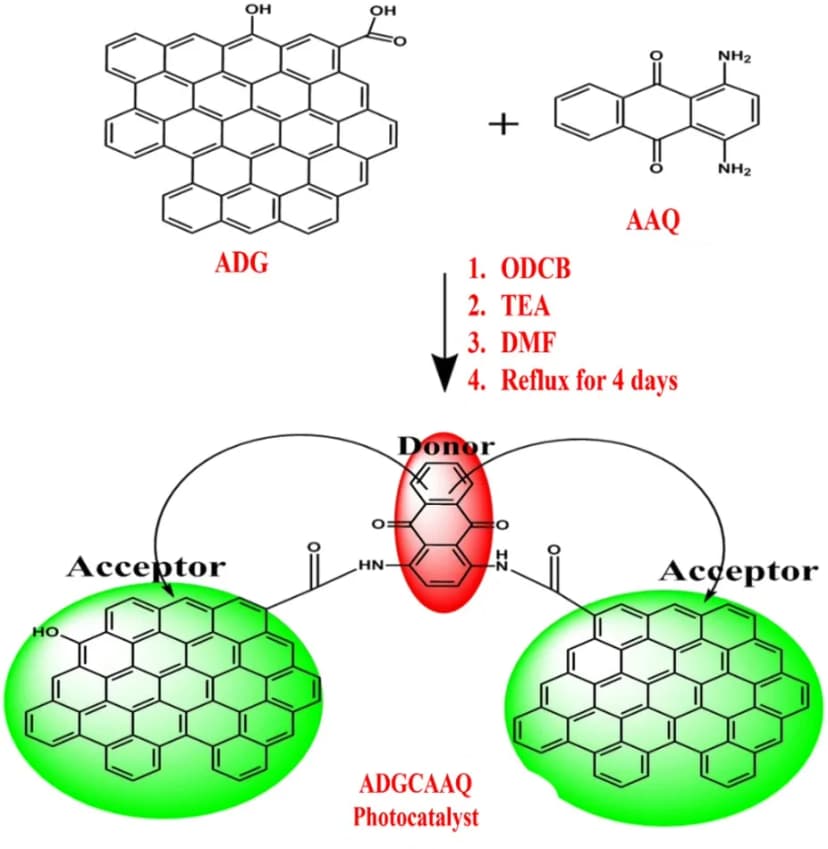
This research presents the ADGCAAQ photocatalyst, developed from aloe vera-derived graphene and 1, 4-diamino anthraquinone, demonstrating its effectiveness in degrading 4-nitrophenol under solar light. The study details the photocatalyst’s synthesis through a condensation method and its impressive properties, such as slow charge carrier recombination and high molar absorption. The ADGCAAQ photocatalyst shows significant degradation efficiency with H2O2, highlighting its potential in environmental pollution mitigation.
Article type: Research Article
Submitted: 25 February 2024
Revised: 28 March 2024
Accepted: 15 April 2024
First published: 1 June 2024
DOI: https://doi.org/10.69626/csa.2024.0077
Volume: 1
Issue: 2
Pages: 77-87
Citation: ChemSci Advances 1(2), 77-87 (2024)
Anand, S., Yadav, R. K., Yadav, A. N., Singh, S., Shahin, R., Baeg, J.-O., Singh, K., Pandey, M., and Yadav, S., Dwivedi, D. K. 2024, Unlocking the Power of Solar Synergy: Enhanced Nitrophenol Degradation using ADGCAAQ Photocatalyst. ChemSci Advances 1(2), pp. 77-87; https://doi.org/10.69626/csa.2024.0077
Number of downloads: 5
Number of views: 50