


Subscribe To Get Information, Latest News And Other Interesting Events!


Important Links
Get In Touch
Ariston Publication
3167 Riverview Place
Columbus, OH 43202
United States of America
Copyright © 2026 Ariston Publications. All Rights Reserved.
Loading Your Library
Preparing your reading experience...
Loading content...
Ariston Publication
3167 Riverview Place
Columbus, OH 43202
United States of America
Achut R. Shinde
Achut R. Shinde*
Department of Analytical Chemistry, Sanjeevanee Mahavidyalaya, Chapoli, Dist. Latur, 413513 (MS), India.
*Author to whom correspondence should be addressed: acachut251114@gmail.com (Achut R. Shinde)
Quinazolines, dihydroquinazolines, and quinazolinones represent a significant class of nitrogen-containing heterocyclic compounds, widely distributed in natural sources such as plants, microorganisms, and animals. Among these, dihydroquinazolines, characterized by the quinazolin-4-(3H)-one core, exhibit a broad spectrum of pharmacological and biological activities, including anticancer, antimicrobial, anti-inflammatory, antiviral, and antitubercular properties. Due to their diverse therapeutic potential, the synthesis of these heterocycles has garnered considerable attention from medicinal and synthetic chemists. Traditional synthetic methods, however, often involve harsh reaction conditions, toxic solvents, and expensive catalysts, prompting the need for more sustainable and efficient approaches. Recent advancements in green chemistry have introduced microwave-assisted synthesis as a powerful tool for the rapid, energy-efficient, and environmentally benign preparation of dihydroquinazoline derivatives. Microwave irradiation facilitates faster reaction rates, higher yields, and reduced energy consumption compared to conventional heating methods. Additionally, the use of green catalysts, such as ionic liquids, nanocatalysts, and biodegradable polymers, further enhances the sustainability of these synthetic protocols. This review comprehensively summarizes the latest developments in microwave-assisted and green catalytic strategies for the synthesis of dihydroquinazoline derivatives over the past decade. Special emphasis is placed on solvent-free conditions, catalyst recyclability, and one-pot multicomponent reactions. By highlighting these eco-friendly methodologies, this review aims to guide researchers in designing more efficient and sustainable synthetic routes for pharmacologically relevant dihydroquinazoline scaffolds.
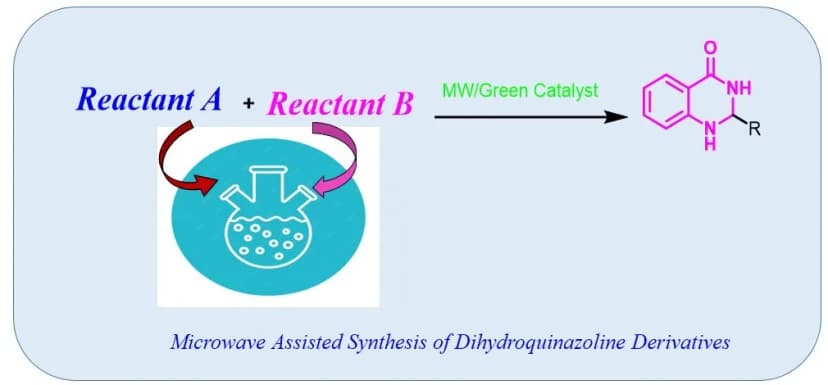
The study is significant as it provides a comprehensive guide for developing efficient, eco-friendly synthetic routes to dihydroquinazoline scaffolds. These compounds exhibit a broad spectrum of biological activities, making these improved methodologies crucial for accelerating drug discovery and enabling the sustainable, scalable production of novel therapeutic agents.
This review details recent advances in the microwave-assisted and green catalytic synthesis of pharmacologically significant dihydroquinazoline derivatives. It highlights how these sustainable methods overcome the limitations of traditional synthesis by offering faster reaction times, higher yields, reduced energy consumption, and minimal environmental impact through solvent-free conditions, recyclable catalysts, and one-pot reactions.
Article type: Review
Submitted: 26 February 2025
Revised: 9 April 2025
Accepted: 24 April 2025
First published: 20 May 2025
DOI: https://doi.org/10.69626/csa.2025.0249
Volume: 2
Issue: 4
Pages: 249-266
Citation: ChemSci Advances 2(4), 249-266 (2025)