


Subscribe To Get Information, Latest News And Other Interesting Events!



Important Links
Get In Touch
Ariston Publication
3167 Riverview Place
Columbus, OH 43202
United States of America
Copyright © 2026 Ariston Publications. All Rights Reserved.
Loading Your Library
Preparing your reading experience...
Loading content...
Ariston Publication
3167 Riverview Place
Columbus, OH 43202
United States of America
Ajit Devale, Amit Varale, Neeraj Prasad
Ajit Devale 1
Amit Varale 1,*
Neeraj Prasad 2
1 Department of Chemistry, Athalye-Sapre-Pitre College, Devrukh-415804, (Maharashtra) India
2 Shivaji University, Maharashtra State, Kolhapur, 416004, India
* Author to whom correspondence should be addressed: dspmaspamitdr@gmail.com (A. S. Varale).
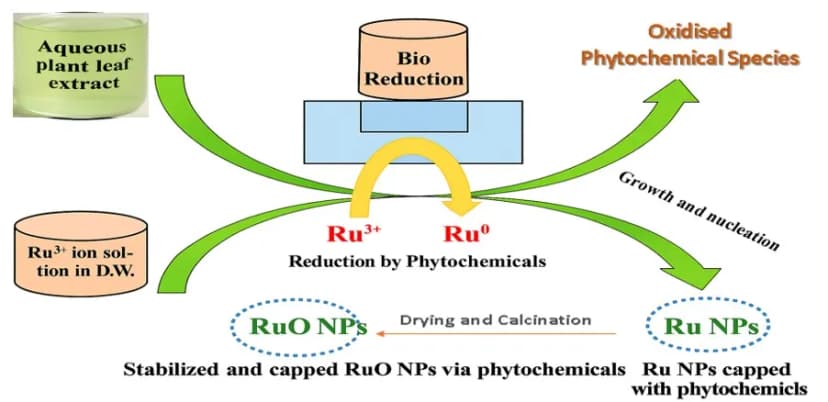
The growing field of nanotechnology demands environmentally responsible production methods. Ruthenium nanoparticles (Ru NPs) are particularly valuable for their exceptional catalytic, electronic, and biomedical potential. However, conventional physical and chemical syntheses rely on hazardous reagents and intensive energy, posing ecological and safety risks. In response, plant-based biosynthesis has emerged as a compelling green alternative. This method utilizes extracts from various plants, where natural phytochemicals, such as polyphenols, flavonoids, and terpenes, serve dual roles as reducing agents and stabilizing capping ligands. This facilitates the facile, room-temperature production of biocompatible and stable Ru NPs. This comprehensive review systematically examines this sustainable approach. It details the diverse botanical sources employed, elucidates the proposed reduction and stabilization mechanisms, and analyzes critical synthesis parameters like pH and temperature. Standard characterization techniques for verifying nanoparticle properties are also outlined. Furthermore, the review extensively covers the resultant bioactivities of plant-synthesized Ru NPs, including potent antimicrobial, antioxidant, and anticancer effects, alongside their catalytic prowess in chemical transformations. By evaluating the current advantages, such as cost-effectiveness and reduced toxicity, alongside existing scalability challenges, the review underscores the significant future potential of this green methodology. It ultimately positions plant-mediated synthesis as a vital pathway for advancing sustainable nanotechnology and pioneering new biomedical applications.
The review is significant for championing a sustainable paradigm in nanotechnology. By systematically consolidating research on plant-based Ru NP synthesis, it underscores a viable path to reduce environmental impact and enhance biocompatibility for medical use. It critically identifies key challenges, like scalability and reproducibility, thereby providing a crucial framework to guide future research toward practical, eco-conscious nanomaterial development for healthcare and industrial catalysis.
This comprehensive review examines the green synthesis of ruthenium nanoparticles (Ru NPs) using plant extracts. It details how phytochemicals act as reducing and stabilizing agents, enabling eco-friendly production under mild conditions. The review analyzes botanical sources, synthesis mechanisms, and characterization, while highlighting the NPs' potent biomedical (antimicrobial, anticancer) and catalytic applications, positioning plant-mediated synthesis as a sustainable alternative to conventional methods.
Article type: Review
Submitted: 21 March 2025
Revised: 3 May 2025
Accepted: 25 May 2025
First published: 13 July 2025
DOI: https://doi.org/10.69626/csa.2025.0267
Volume: 2
Issue: 4
Pages: 267-290
Citation: ChemSci Advances 2(4), 267-290 (2025)