


Subscribe To Get Information, Latest News And Other Interesting Events!


Important Links
Get In Touch
Ariston Publication
3167 Riverview Place
Columbus, OH 43202
United States of America
Copyright © 2026 Ariston Publications. All Rights Reserved.
Loading Your Library
Preparing your reading experience...
Loading content...
Ariston Publication
3167 Riverview Place
Columbus, OH 43202
United States of America
Shuo Wang, Qiaoxi Zhang, Kai Song
Shuo Wang 1
Qiaoxi Zhang 1
Kai Song 1, *
School of Life Science, Changchun Normal University, Changchun 130032, China.
*Author to whom correspondence should be addressed:
songkai@ccsfu.edu.cn (Kai Song)
Black chokeberry (Aronia melanocarpa) is rich in cyanidin glycosides, yet improved extraction yield does not necessarily lead to greater recovery in the final product. This review critically evaluates evidence from integrated extraction–adsorption processes, stand-alone resin purification, and fixed-bed mass-transfer studies. Particular attention is given to extract composition, three-phase dynamic mass balances, transport resistance at multiple scales, and competitive adsorption. Published work has reported increases of more than 25% in phenolic extraction yield and more than twofold in process productivity relative to sequential extraction–adsorption. In a study of chokeberry skin waste, anthocyanin yield increased from 5.25 to 6.34 mg/g dry pomace, while the anthocyanin mass fraction of the dried extract rose from 19.9% to 28.4%. A separate resin purification study recovered approximately 96% of the anthocyanins present in the feed extract; this figure represents step recovery rather than overall recovery from the raw material. Although adsorption demonstrably captures anthocyanins already released into solution, evidence remains insufficient to establish whether lowering their liquid-phase concentration also promotes further release from plant tissue. Changes in circulation, mixing, and chemical loss have not been quantitatively disentangled. Hydrodynamically matched controls, component-resolved mass balances across individual phases, and independent validation of coupled transport models are therefore needed. Product integrity, resin regeneration, and resource consumption should be considered alongside recovery when assessing industrial relevance.
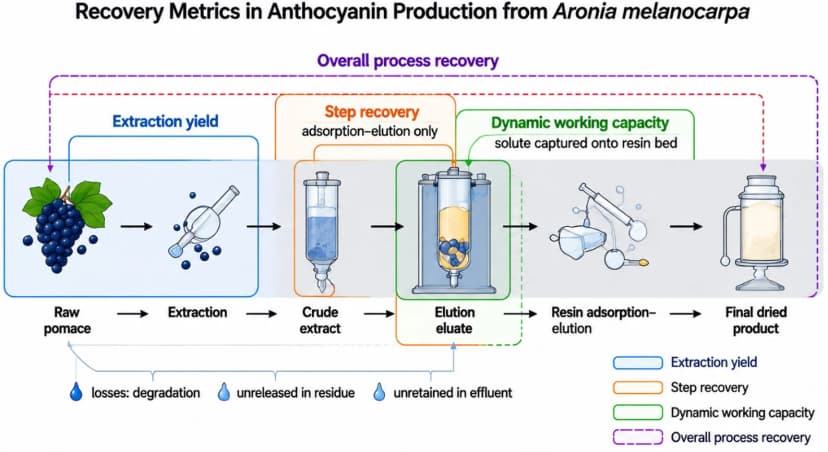
This review provides a critical assessment of integrated extraction–adsorption as an approach to improving anthocyanin recovery from black chokeberry (Aronia melanocarpa). It distinguishes extraction yield, adsorption-step recovery, product enrichment, and overall process recovery, preventing misleading comparisons between performance indicators. By examining dynamic mass transfer, competitive adsorption, phase distribution, and degradation, it identifies important mechanistic uncertainties. Its recommendations for controlled experiments, component-resolved mass balances, and validated transport models offer valuable guidance for developing efficient, sustainable, and industrially relevant anthocyanin recovery processes.
This review evaluates integrated extraction–adsorption, resin purification, and fixed-bed mass-transfer studies for recovering anthocyanins from black chokeberry. It examines reported improvements in phenolic extraction, productivity, anthocyanin yield, and product enrichment while distinguishing adsorption-step recovery from overall recovery. Particular attention is given to three-phase mass balances, transport resistance, competitive adsorption, and potential feedback between adsorption and tissue release. The review identifies unresolved contributions from extraction, capture, and degradation, recommending matched controls, component-specific balances, model validation, and resource-efficiency assessments.
Article type: Review
Submitted: 1 May 2026
Revised: 10 May 2026
Accepted: 1 June 2026
First published: 1 July 2026
DOI: https://doi.org/10.69626/csa.2026.0117
Volume: 3
Issue: 03
Pages: 117-132
Citation: ChemSci Advances 3(3), 117-132 (2026)
Wang S., Zhang Q., Song K. 2026. Integrated Extraction–Adsorption of Anthocyanins from Aronia melanocarpa: Experimental Evidence, Dynamic Mass Transfer, and Process–Wide Recovery Assessment. ChemSci Advances 3(3), pp. 117-132; https://doi.org/10.69626/csa.2026.0117
Number of downloads: 3
Number of views: 7