


Subscribe To Get Information, Latest News And Other Interesting Events!


Important Links
Get In Touch
Ariston Publication
3167 Riverview Place
Columbus, OH 43202
United States of America
Copyright © 2026 Ariston Publications. All Rights Reserved.
Loading Your Library
Preparing your reading experience...
Loading content...
Ariston Publication
3167 Riverview Place
Columbus, OH 43202
United States of America
Mahendra Ramdas Thomare, Vishnu A. Adole, Kailas H. Kapadnis
Mahendra Ramdas Thomare1,*
Vishnu A. Adole2
Kailas H. Kapadnis2
1 Department of Chemistry, G. E. Society’s N. B. Mehta Science College Bordi, Tal. Dahanu, Dist. Palghar-401701, India.
2 Research Centre and Department of Chemistry, Mahatma Gandhi Vidyamandir’s Loknete Vyankatrao Hiray Arts, Science and Commerce College, Panchavati, Nashik-03, India.
* Author to whom correspondence should be addressed:
prachidbhatewal@gmail.com (Prachi K. Bhoi)
Congo red, a toxic anionic azo dye extensively used in textile, paper, and leather industries, poses serious environmental and health risks owing to its recalcitrant nature and carcinogenic potential. This review examines recent progress in photocatalytic degradation technologies for Congo red removal from aqueous solutions. The analysis includes diverse photocatalyst systems such as metal oxides (TiO₂, ZnO, Y₂O₃, NiO), ferrites (MgFe₂O₄, MnFe₂O₄, AFe₂O₄), nanocomposites, and heterostructures. Reported degradation efficiencies vary widely from 24% to 98%, depending on catalyst composition, synthesis route, and operational conditions. Visible-light-active photocatalysts, particularly doped metal oxides and ferrite-based materials with bandgap energies between 2.14 and 2.19 eV, consistently outperform conventional UV-activated catalysts. Hydroxyl radicals and superoxide anions are identified as the dominant reactive oxygen species driving Congo red mineralization. Cerium-substituted Mn–Zn ferrites and alkaline earth ferrites emerge as especially promising systems, achieving degradation efficiencies of 92–97% under visible light irradiation while offering the added benefit of magnetic recoverability. Heterostructure designs, including TiO₂–graphene oxide and CS-BiOCl/ZnO nanocomposites, demonstrate that rational material engineering can overcome the limitations of single-component systems. Despite these advances, challenges related to charge carrier recombination, long-term stability, visible light utilization, and scalability persist. Future research should prioritize the development of cost-effective, magnetically recoverable, and highly efficient photocatalysts, along with pilot-scale demonstrations and comprehensive toxicity assessments, to enable practical wastewater treatment applications.
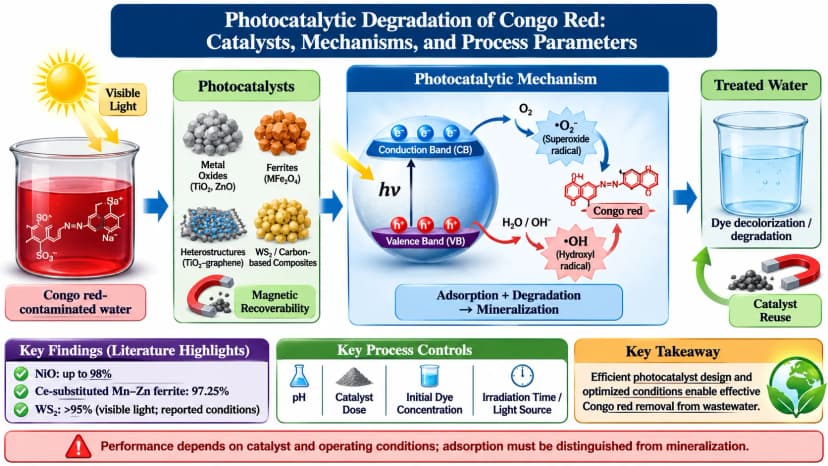
This review highlights photocatalysis as a promising approach for removing toxic Congo red dye from contaminated wastewater. By comparing metal oxides, ferrites, nanocomposites, and heterostructures, it identifies material characteristics and operating conditions that influence degradation efficiency. Particular attention is given to visible-light-active and magnetically recoverable ferrite photocatalysts, offering opportunities for efficient treatment and catalyst reuse. The analysis also distinguishes adsorption from actual mineralization and identifies challenges involving charge recombination, stability, and scalability, guiding future sustainable wastewater treatment research.
This review examines photocatalytic Congo red degradation using metal oxides, ferrites, nanocomposites, and heterostructured catalysts. Reported degradation efficiencies range from 24% to 98%, depending on catalyst properties and operating conditions. Cerium-substituted Mn–Zn ferrites and alkaline earth ferrites demonstrate promising visible-light performance and magnetic recoverability. Hydroxyl radicals and superoxide anions are identified as important reactive species, although their contributions vary between materials. The review discusses adsorption–photocatalysis synergy, charge recombination, catalyst stability, reusability, and requirements for practical wastewater treatment applications.
Article type: Review
Submitted: 15 May 2026
Revised: 13 July 2026
Accepted: 24 July 2026
First published: 15 August 2026
DOI: https://doi.org/10.69626/csa.2026.0151
Volume: 3
Issue: 03
Pages: 151-165
Citation: ChemSci Advances 3(3), 151-165 (2026)