


Subscribe To Get Information, Latest News And Other Interesting Events!


Important Links
Get In Touch
Ariston Publication
3167 Riverview Place
Columbus, OH 43202
United States of America
Copyright © 2026 Ariston Publications. All Rights Reserved.
Loading Your Library
Preparing your reading experience...
Loading content...
Ariston Publication
3167 Riverview Place
Columbus, OH 43202
United States of America

I. S. Jamadar, S. S. Potdar, N. K. Yadav, H. S. Tajanpure, A. B. Deore, K. S. Pakhare
I. S. Jamadar 1
S. S. Potdar 1,*
N. K. Yadav 1
H. S. Tajanpure 1
A. B. Deore 1
K. S. Pakhare 2
1 School of Computing, MIT Art, Design and Technology University, Pune, Maharashtra-412201, India
2Anandibai Raorane Arts, Commerce and Science College, Vaibhavwadi, Sindhudurg-416810, India
* Author to whom correspondence should be addressed:
sachin.potdar@mituniversity.edu.in (S. S. Potdar)
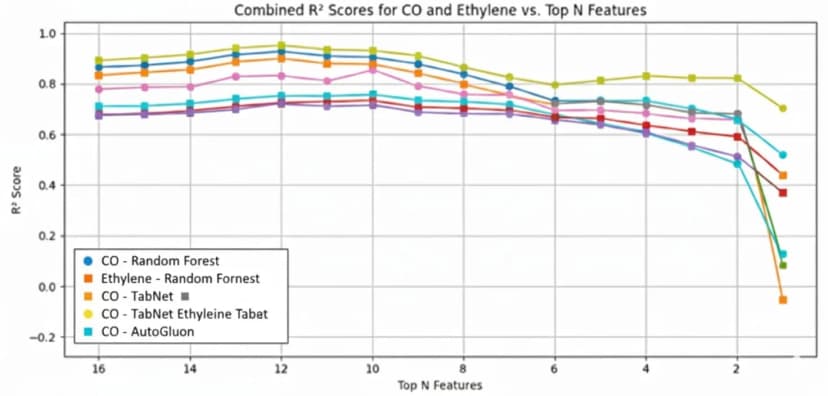
Predicting gas concentrations from metal oxide sensors is challenging. This is due to traditional methods of using extracted features such as sensitivity percentage, response time and recovery time. This study explores the effectiveness of using raw sensor resistance data to predict gas concentrations. We applied three different machine learning models: Random Forest, TabNet and AutoGluon to predict gas concentrations using an open source sensing array dataset provided by the University of California Irvine. The data contained responses from sixteen commercial sensors to CO and Ethylene mixtures. We applied feature importance through correlation to select the best subset of sensors. We evaluated our models using the coefficient of determination, mean absolute error and root mean squared error. AutoGluon performed best when predicting gas concentrations with all subsets of features showing the benefits of using a fully automated ensemble method. TabNet also performed well when more features were used. This is due to the attention mechanisms within the model. Random Forest provides stable results. Feature importance analysis found that at least six to ten most important features are required to ensure accuracy throughout all models. Our results show that raw sensor resistance data can be used to predict gas concentrations using a simplified, scalable and generalisable approach. This study shows progress towards efficient machine learning solutions.
This study demonstrates the potential of raw metal oxide sensor resistance data for accurate and efficient prediction of carbon monoxide and ethylene concentrations. By eliminating dependence on traditionally extracted response and recovery metrics, it simplifies data processing and supports scalable gas sensing applications. The comparative evaluation of Random Forest, TabNet, and AutoGluon highlights the advantages of automated ensemble learning and attention-based feature selection. Its feature-ranking strategy also identifies opportunities to reduce computational complexity while maintaining predictive performance in intelligent gas monitoring systems.
This study evaluates Random Forest, TabNet, and AutoGluon for predicting carbon monoxide and ethylene concentrations using raw resistance measurements from sixteen commercial metal oxide sensors. An open-source University of California Irvine dataset supports model development and evaluation. Correlation-based feature selection identifies influential sensor variables, while R², mean absolute error, and root mean squared error assess predictive performance. AutoGluon achieves the strongest overall results, TabNet benefits from attention-based feature selection, and Random Forest provides stable predictions, demonstrating the value of raw sensor data.
Article type: Research Article
Submitted: 24 May 2026
Revised: 20 July 2026
Accepted: 29 July 2026
First published: 19 August 2026
DOI: https://doi.org/10.69626/csa.2026.0166
Volume: 3
Issue: 03
Pages: 166-176
Citation: ChemSci Advances 3(3), 166-176 (2026)
Jamadar I. S., Potdar S. S., Yadav N. K., Tajanpure H. S., Deore A. B., Pakhare K. S. 2026. Multi–Model Evaluation and Feature–Driven Analysis for Predicting Carbon Monoxide and Ethylene Gas Concentrations. ChemSci Advances 3(3), pp. 166-176; https://doi.org/10.69626/csa.2026.0166
Number of downloads: 0
Number of views: 8