


Subscribe To Get Information, Latest News And Other Interesting Events!



Important Links
Get In Touch
Ariston Publication
3167 Riverview Place
Columbus, OH 43202
United States of America
Copyright © 2026 Ariston Publications. All Rights Reserved.
Loading Your Library
Preparing your reading experience...
Loading content...
Ariston Publication
3167 Riverview Place
Columbus, OH 43202
United States of America
Monika Sharma, Jasvinder Kaur
Monika Sharma
Jasvinder Kaur
Department of Chemistry, School of Basic Life & Applied Science, Apex University Jaipur- 303002, Rajasthan India
* Author to whom correspondence should be addressed:
jasvinder.kaur@apexmail.in (Jasvinder Kaur)
The rapid expansion of textile dyeing industries has led to the discharge of substantial quantities of contaminated water containing toxic heavy metals, posing serious environmental and agricultural concerns. This investigation assessed heavy metal levels in wastewater from a textile dyeing unit in the Bagru industrial area of Rajasthan, India, and examined their deposition in adjacent agricultural soils. Standard analytical techniques were employed to analyse physicochemical parameters and concentrations of chromium, cadmium, lead, copper, zinc, nickel, and iron in both wastewater and soil samples collected from multiple sites affected by industrial effluent discharge. The results demonstrated that wastewater contained several heavy metals exceeding permissible limits established by national and international environmental regulations. Elevated concentrations of these metals were also detected in nearby agricultural soils, indicating long-term infiltration of metals through irrigation with untreated or partially treated textile effluents. Soil quality evaluation revealed deterioration in physicochemical conditions, including altered pH, increased electrical conductivity, and reduced fertility, all of which can adversely affect soil health and crop production. Correlation analysis established a strong relationship between wastewater contamination and soil enrichment with heavy metals. The findings underscore the urgent need for effective wastewater treatment, periodic environmental monitoring, and sustainable wastewater management practices to minimize heavy metal pollution, preserve farmland health, and safeguard human communities residing in industrial regions.
This study highlights the environmental consequences of textile dye wastewater discharge and its contribution to heavy metal accumulation in agricultural soils. By investigating wastewater and soil contamination in the Bagru industrial area, it establishes the relationship between industrial effluent exposure, soil degradation, and potential agricultural risks. The findings emphasize the importance of wastewater treatment, environmental monitoring, and sustainable irrigation practices. This research provides valuable evidence for strengthening pollution control strategies, protecting agricultural productivity, preserving soil quality, and minimizing human exposure to toxic metals.
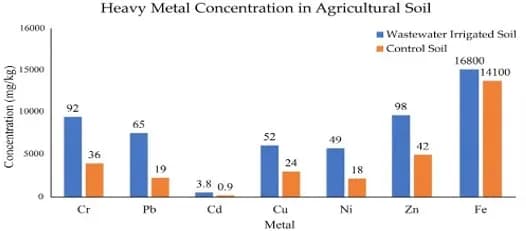
This study investigates heavy metal contamination in textile dye wastewater and surrounding agricultural soils in Bagru, Rajasthan. Wastewater and soil samples were analysed for physicochemical parameters and chromium, cadmium, lead, copper, zinc, nickel, and iron concentrations. Results revealed elevated toxic metal levels exceeding permissible limits in wastewater and increased accumulation in effluent-irrigated soils compared with tube-well-irrigated controls. Altered pH, electrical conductivity, total dissolved solids, COD, and BOD indicated deteriorating environmental quality, highlighting risks to soil fertility, agricultural sustainability, groundwater, and human health.
Article type: Research Article
Submitted: 30 May 2026
Revised: 29 July 2026
Accepted: 6 August 2026
First published: 19 August 2026
DOI: https://doi.org/10.69626/csa.2026.0177
Volume: 3
Issue: 03
Pages: 177-184
Citation: ChemSci Advances 3(3), 177-184 (2026)