


Subscribe To Get Information, Latest News And Other Interesting Events!



Important Links
Get In Touch
Ariston Publication
3167 Riverview Place
Columbus, OH 43202
United States of America
Copyright © 2026 Ariston Publications. All Rights Reserved.
Loading Your Library
Preparing your reading experience...
Loading content...
Ariston Publication
3167 Riverview Place
Columbus, OH 43202
United States of America
Shuo Wang, Qiaoxi Zhang, Kai Song
Shuo Wang
Qiaoxi Zhang
Kai Song*
School of Life Science, Changchun Normal University, Changchun 130032, China
*Author to whom correspondence should be addressed:
songkai@ccsfu.edu.cn (Kai Song)
Ripe black chokeberry (Aronia melanocarpa) fruit is rich in cyanidin glycosides, yet anthocyanin accumulation does not always coincide with changes in other phenolic compounds, sugar metabolism, or fruit growth. This review integrates a reanalysis of published experimental data to examine the physiological and molecular basis of selective anthocyanin accumulation and its responses to environmental conditions. During fruit development, a decline in proanthocyanidin concentration does not necessarily imply a decrease in the amount accumulated per fruit, whereas concurrent declines in anthocyanin concentration and fruit mass during late ripening highlight the importance of pigment retention. Across three cultivars, hexose concentrations increased proportionally much more than sorbitol concentrations during ripening. Reanalysis of data from 23 batches of ripe ‘Nero’ fruit yielded Pearson correlation coefficients of −0.128, −0.029, and −0.190 between anthocyanin concentration and glucose, fructose, and sorbitol concentrations, respectively, contrasting markedly with the strong positive correlations reported across developmental stages. Germplasm comparisons revealed that fruit with similar total anthocyanin concentrations could differ by more than 20-fold in the ratio of cyanidin galactoside to arabinoside. Sensitivity analysis of tissue composition indicated that anthocyanin concentrations were more responsive to changes in the peel mass fraction than were those of flavonols and hydroxycinnamic acids. However, the reduction in fruit size caused by sustained water deficit was not accompanied by an increase in anthocyanin concentration. Collectively, the available evidence identifies the metabolic utilization of sorbitol, the formation and retention of specific glycosides, and the interplay between tissue-specific metabolism and fruit growth under different environmental conditions as key physiological and molecular questions underlying anthocyanin accumulation in black chokeberry.
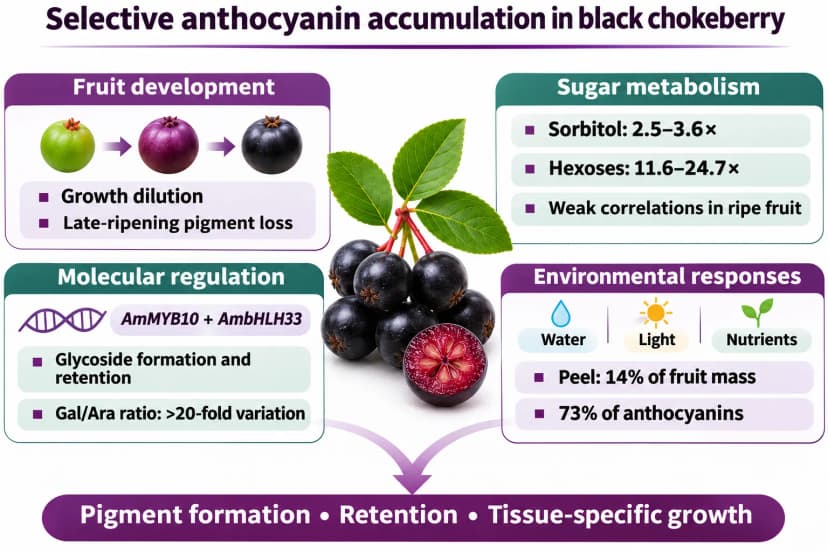
This review provides valuable insights into the physiological and molecular factors governing selective anthocyanin accumulation in black chokeberry fruit. By integrating developmental observations, cultivar comparisons, and environmental responses, it highlights the importance of sugar metabolism, specific cyanidin glycoside formation, pigment retention, and tissue composition. Its analysis challenges conventional interpretations based solely on phenolic concentrations and emphasizes accumulation per fruit and yield per plant. These findings establish important research directions for understanding fruit pigmentation, environmental adaptation, and improving the nutritional quality of black chokeberry.
This review examines selective anthocyanin accumulation in black chokeberry (Aronia melanocarpa) through published experimental data and comparative analyses. It investigates changes in phenolic compounds, sugar metabolism, fruit growth, glycoside composition, and environmental responses during development. Findings reveal weak correlations between anthocyanin and sugar concentrations among ripe fruits, substantial variation in cyanidin glycoside proportions, and sensitivity to peel mass fraction. The review identifies research priorities involving proanthocyanidin metabolism, sorbitol utilization, transcriptional regulation, glycoside biosynthesis, and pigment retention under environmental variation.
Article type: Review
Submitted: 12 July 2026
Revised: 23 September 2026
Accepted: 8 October 2026
First published: 19 October 2026
DOI: https://doi.org/10.69626/csa.2026.0185
Volume: 3
Issue: 04
Pages: 185-199
Citation: ChemSci Advances 3(4), 185-199 (2026)