


Subscribe To Get Information, Latest News And Other Interesting Events!



Important Links
Get In Touch
Ariston Publication
3167 Riverview Place
Columbus, OH 43202
United States of America
Copyright © 2026 Ariston Publications. All Rights Reserved.
Loading Your Library
Preparing your reading experience...
Loading content...
Ariston Publication
3167 Riverview Place
Columbus, OH 43202
United States of America
Shweta Yadav, R. K. Chauhan, Rajan Mishra
Shweta Yadav *
R. K. Chauhan
Rajan Mishra
Department of Electronics & Communication Engineering, Madan Mohan Malaviya University of Technology, Gorakhpur-273010, Uttar Pradesh, India.
* Author to whom correspondence should be addressed: Shwetay0842@gmail.com(Shweta Yadav)
This study presents a comparative performance analysis of kesterite-based solar cells, utilizing absorber layers of CZTS, CZTSe, and CZTSSe. Kesterite materials, renowned for their earth abundance, non-toxicity, and cost-effectiveness, hold significant promise as p-type absorbers in photovoltaic applications. Their direct bandgap, adjustable between 1.0 eV and 1.5 eV by tailoring the selenium-to-sulfur ratio, makes them suitable for high-efficiency solar cells. The simulated device structure comprises ZnO:Al as the window layer, ZnSe as the buffer layer, CZTS/CZTSe/CZTSSe as the absorber layers, and graphene oxide (GO) as the hole transport layer (HTL). Through SCAPS-1D simulations, key parameters such as open-circuit voltage (Voc), short-circuit current density (Jsc), fill factor (FF), and power conversion efficiency (PCE) are analyzed. The study further investigates the effects of absorber thickness, doping concentration of the absorber, electron transport layer (ETL), and HTL, as well as series and shunt resistances. Among the studied configurations, the CZTSSe-based solar cell demonstrates superior performance with a Voc of 0.9367 V, Jsc of 37.44 mA/cm², FF of 82.68%, and a PCE of 30.01%. This research highlights the pivotal role of material composition and device optimization in achieving high-efficiency solar cells. The findings provide valuable insights for the development of advanced kesterite-based photovoltaics, identifying CZTSSe as the most promising absorber material for next-generation solar cells due to its superior performance metrics and tunable properties.
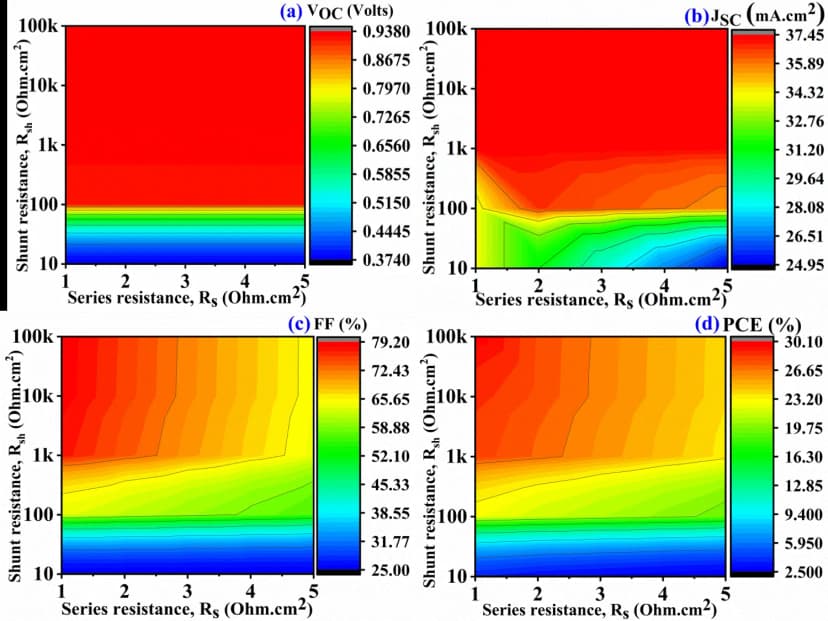
Through SCAPS-1D simulations, the performance of CZTS, CZTSe, and CZTSSe absorber layers was analyzed. CZTSSe demonstrated superior efficiency (30.01%) with optimized parameters, including absorber thickness (1500 nm) and doping concentrations. This research emphasizes material selection and device optimization for advanced kesterite-based solar cells.
Article type: Research Article
Submitted: 25 February 2024
Revised: 17 March 2024
Accepted: 12 April 2024
First published: 3 May 2024
DOI: https://doi.org/10.69626/eea.2024.0049
Volume: 1
Issue: 2
Pages: 49-58
Citation: Energy & Environment Advances 1(2), 49-58 (2024)
Yadav, S., Chauhan, R. K. and Mishra, R. 2024. Comparative Analysis of Earth–Abundant Kesterite Solar Cells: Performance Evaluation of CZTS/CZTSe/CZTSSe Absorber Layers Using SCAPS–1D.Energy & Environment Advances 1(2), pp. 49-58; https://doi.org/10.69626/eea.2024.0049.
Number of downloads: 6
Number of views: 67