


Subscribe To Get Information, Latest News And Other Interesting Events!



Important Links
Get In Touch
Ariston Publication
3167 Riverview Place
Columbus, OH 43202
United States of America
Copyright © 2026 Ariston Publications. All Rights Reserved.
Loading Your Library
Preparing your reading experience...
Loading content...
Ariston Publication
3167 Riverview Place
Columbus, OH 43202
United States of America
S. Ruby, S. S. R. Inbanathan, Sotirios Baskoutas
S. Ruby 1, *
S. S. R. Inbanathan 1,*
Sotirios Baskoutas 2
1 Post Graduate and Research Department of Physics, The American College, Madurai 625002, India.
2 Department of Materials Science, University of Patras, Patras, Greece
* Author to whom correspondence should be addressed: sheruby7@gmail.com (S. Ruby); stepheninbanathan@gmail.com (S.S.R. Inbanathan)
Nanostructured multiferroic materials have garnered significant attention for their potential in environmental remediation. Among these, bismuth ferrite (BiFeO₃) stands out due to its unique coexistence of ferroelectric and antiferromagnetic properties at room temperature. However, its practical applications are often hindered by its spiral spin structure and weak ferromagnetic ordering. In this study, magnesium-doped bismuth ferrite (BMO) nanoparticles were synthesized via a facile microwave-assisted method. Magnesium ions (Mg²⁺) were substituted for bismuth ions (Bi³⁺) in the perovskite structure to enhance the material's magnetic and photocatalytic properties. X-ray diffraction (XRD) confirmed the rhombohedral structure of BMO with reduced crystallite size (22.49 nm) due to lattice contraction caused by Mg doping. Scanning electron microscopy (SEM) revealed a uniform distribution of fine particles with reduced grain size, while Fourier-transform infrared spectroscopy (FTIR) confirmed the functional groups and chemical bonds in the nanoparticles. UV-Vis spectroscopy indicated a significant reduction in band gap energy, enhancing light absorption. Photocatalytic studies demonstrated superior degradation efficiency of methyl orange dye under visible light irradiation, highlighting the role of Mg doping in improving charge separation and reducing recombination rates. These findings underscore the potential of Mg-doped BFO nanoparticles as effective photocatalysts for wastewater treatment, contributing to sustainable environmental management.
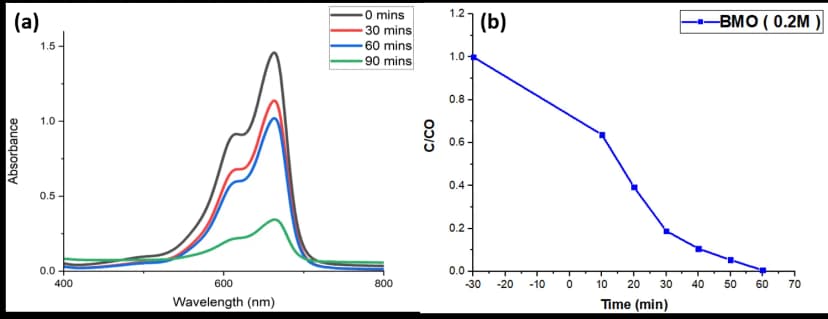
The study successfully synthesized magnesium-doped bismuth ferrite (BMO) nanoparticles using a microwave-assisted method. XRD and SEM analyses confirmed improved structural and morphological properties, including reduced crystallite size and uniform particle distribution. Mg doping lowered the band gap energy, enhancing light absorption and charge carrier separation. Photocatalytic experiments demonstrated superior degradation of methyl orange dye under visible light, achieving an 83% degradation efficiency. These findings establish Mg-doped BFO as a promising photocatalyst for wastewater treatment, showcasing significant advancements in nanostructured environmental materials.
Article type: Research Article
Submitted: 13 March 2024
Revised: 11 April 2024
Accepted: 3 May 2024
First published: 20 May 2024
DOI: https://doi.org/10.69626/eea.2024.0074
Volume: 1
Issue: 2
Pages: 74-84
Citation: Energy & Environment Advances 1(2), 74-84 (2024)
Ruby, S., Inbanathan, S. S. R. and Baskoutas, S. 2024. Enhanced Photocatalytic Degradation of Methyl Orange Dye Using Nanostructured Mg–Doped Bismuth Ferrite Synthesized via Microwave Method. Energy & Environment Advances 1(2), pp. 74-84; https://doi.org/10.69626/eea.2024.0074.
Number of downloads: 5
Number of views: 49