


Subscribe To Get Information, Latest News And Other Interesting Events!



Important Links
Get In Touch
Ariston Publication
3167 Riverview Place
Columbus, OH 43202
United States of America
Copyright © 2026 Ariston Publications. All Rights Reserved.
Loading Your Library
Preparing your reading experience...
Loading content...
Ariston Publication
3167 Riverview Place
Columbus, OH 43202
United States of America
Iram Masood, Mukesh Pratap Singh, Mohd Amir
Iram Masood *
Mukesh Pratap Singh
Mohd Amir
Department of Applied Sciences & Humanities, Faculty of Engineering and Technology, Jamia Millia Islamia, New Delhi, India
* Author to whom correspondence should be addressed: iram188891@st.jmi.ac.in(Iram Masood)
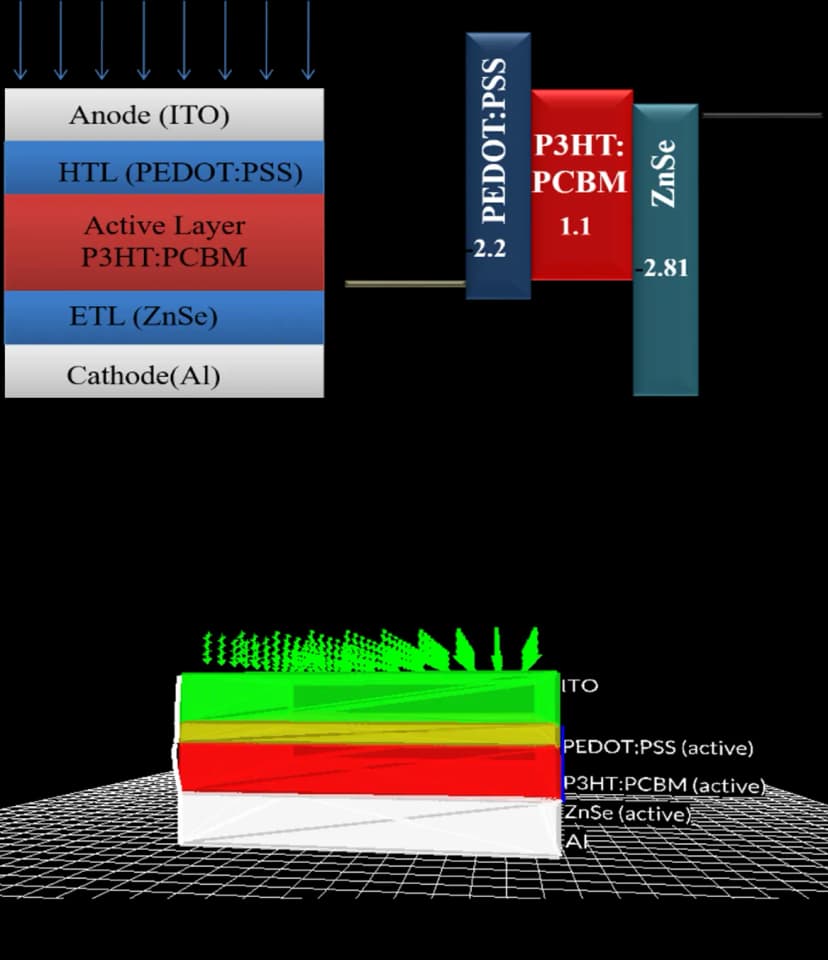
Organic solar cells (OSCs) based on polymer-donor and fullerene-acceptor blends have garnered significant attention due to their cost-effectiveness, flexibility, and ease of fabrication. However, challenges such as low power conversion efficiency (PCE) and poor stability hinder their commercial viability. This study focuses on optimizing the thickness of various layers in a P3HT:PCBM-based OSC with the structure ITO/PEDOT:PSS/P3HT:PCBM/ZnSe/Al, employing OghmaNano simulation software. Additionally, non-geminate recombination effects and temperature stability were analyzed to understand their impact on device performance. The thickness of the active material (P3HT:PCBM) was varied between 100–300 nm, while transport and electrode layers were optimized to achieve balanced charge transport and effective light absorption. Our results demonstrate that the optimized structure achieved a PCE of 9.60%, with an open circuit voltage (VOC) of 0.64 V, a short circuit current density (JSC) of 206.70 A/m², and a fill factor (FF) of 72.13%. Moreover, recombination analysis revealed that mitigating non-geminate recombination could significantly enhance device performance. ZnSe was identified as an effective electron transport layer due to its transparency, favorable energy band alignment, and high electron mobility. This study highlights the importance of layer thickness optimization and recombination control in improving the efficiency and stability of OSCs. The findings pave the way for further advancements in OSC technology, potentially bridging the gap toward their commercialization.
Article type: Research Article
Submitted: 6 March 2024
Revised: 18 April 2024
Accepted: 5 May 2024
First published: 21 May 2024
DOI: https://doi.org/10.69626/eea.2024.0085
Volume: 1
Issue: 2
Pages: 85-94
Citation: Energy & Environment Advances 1(2), 85-94 (2024)