


Subscribe To Get Information, Latest News And Other Interesting Events!


Important Links
Get In Touch
Ariston Publication
3167 Riverview Place
Columbus, OH 43202
United States of America
Copyright © 2026 Ariston Publications. All Rights Reserved.
Loading Your Library
Preparing your reading experience...
Loading content...
Ariston Publication
3167 Riverview Place
Columbus, OH 43202
United States of America
Abhishek Kumar, Rajesh Kumar
1 Department of Mechanical Engineering, Delhi Technological University, Delhi 110042, India
2 Department of Mechanical & Allied Engineering, IILM University, Greater Noida, UP 201306, India
* Author to whom correspondence should be addressed: 2003.abhi@gmail.com(Abhishek Kumar)
Solar distillation offers an eco-friendly and sustainable solution for producing freshwater from seawater or contaminated sources, particularly in arid regions where water scarcity is a pressing issue. However, the efficiency of traditional solar distillation systems is often limited by low heat transfer rates, resulting in suboptimal performance. In recent years, the introduction of nanofluids—suspensions of nanoparticles within base fluids—has emerged as a promising avenue to overcome these limitations. Nanofluids exhibit superior thermal properties, such as enhanced thermal conductivity and convective heat transfer coefficients, which have been shown to significantly improve the productivity of solar distillation systems. This comprehensive review examines the principles of solar distillation, the challenges inherent in conventional systems, and the transformative role of nanofluids in addressing these inefficiencies. Key mechanisms responsible for the improved heat transfer characteristics of nanofluids are discussed, along with the impact of factors such as nanoparticle material, size, shape, and concentration. The review critically analyzes recent experimental and theoretical studies, highlighting significant advancements in system performance, including increased freshwater yield and reduced thermal resistance. Additionally, it identifies gaps in the current body of knowledge, emphasizing the need for further research into optimizing nanofluid formulations, scaling up experimental findings, and exploring long-term environmental and economic impacts. By bridging these knowledge gaps, nanofluid-enhanced solar distillation systems could play a pivotal role in addressing global water scarcity challenges while promoting sustainable development.
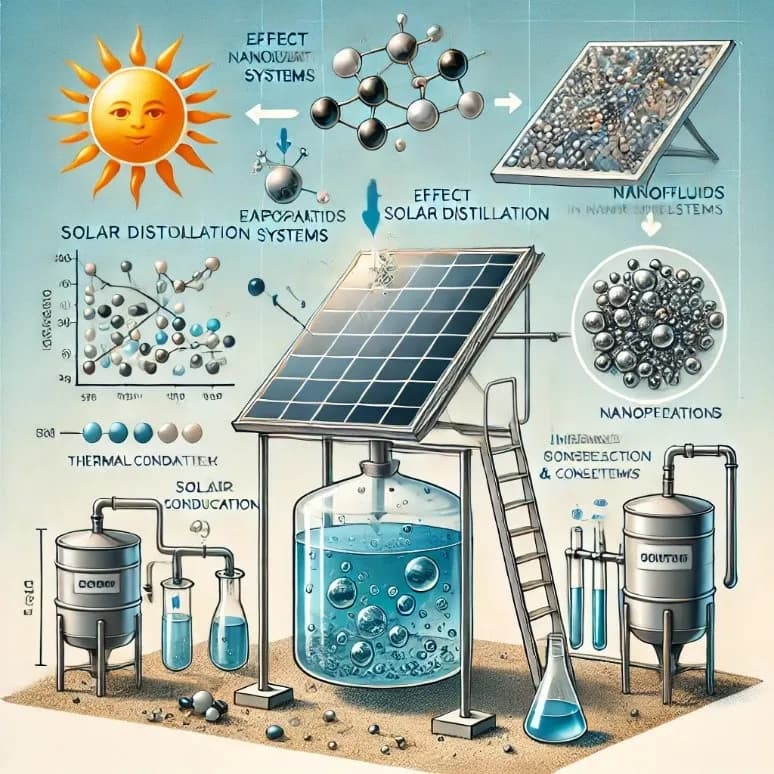
This review explores the integration of nanofluids into solar distillation systems to enhance efficiency and productivity. It highlights the superior thermal properties of nanofluids, such as improved heat transfer and reduced thermal resistance, which significantly boost freshwater yield. The study examines factors influencing nanofluid performance, including nanoparticle material and concentration, and identifies challenges like stability, environmental impacts, and scalability. By addressing these gaps, nanofluid-enhanced solar distillation systems could become a sustainable solution to global water scarcity challenges.
Article type: Review
Submitted: 14 May 2024
Revised: 28 June 2024
Accepted: 26 July 2024
First published: 21 August 2024
DOI: https://doi.org/10.69626/eea.2024.0178
Volume: 1
Issue: 4
Pages: 178-192
Citation: Energy & Environment Advances 1(4), 178-192 (2024)