


Subscribe To Get Information, Latest News And Other Interesting Events!


Important Links
Get In Touch
Ariston Publication
3167 Riverview Place
Columbus, OH 43202
United States of America
Copyright © 2026 Ariston Publications. All Rights Reserved.
Loading Your Library
Preparing your reading experience...
Loading content...
Ariston Publication
3167 Riverview Place
Columbus, OH 43202
United States of America
Afia Asghar, Saima Anjum, Nishat Fatima, Muhammad Imran Khan, Abdallah Shanableh
Afia Asghar 1
Saima Anjum 1, *
Nishat Fatima 1
Muhammad Imran Khan 2, *
Abdallah Shanableh 2,3
1 Department of Chemistry, Govt. Sadiq College Women University, Bahawalpur, Pakistan.
2 Research Institute of Sciences and Engineering (RISE), University of Sharjah, Sharjah 27272, United Arab Emirates.
3 Scientific Research Center, Australian University, Kuwait.
* Author to whom correspondence should be addressed: drsaima@gscwu.edu.pk (Saima Anjum); raoimranishaq@gmail.com (Muhammad Imran Khan)
In this study, CuO/ZnO@hierarchical porous graphitic carbon spheres (CuO/ZnO@HPGCS) nanocomposites were synthesized via a cost-effective low-temperature water-bath technique. Chitosan was employed as a carbon precursor, while PVP and PEG acted as stabilizing agents to ensure the formation of well-structured porous carbon spheres. Comprehensive characterization techniques, including scanning electron microscopy (SEM), X-ray diffraction (XRD), and energy-dispersive X-ray spectroscopy (EDX), were utilized to analyze the morphology, structure, and elemental composition of the synthesized materials. The electrochemical behavior of the CuO/ZnO@HPGCS electrodes was evaluated using cyclic voltammetry (CV), galvanostatic charge-discharge (GCD), and electrochemical impedance spectroscopy (EIS). Compared to pure CuO/ZnO and standalone HPGCS electrodes, the CuO/ZnO@HPGCS nanocomposites exhibited significantly improved supercapacitive performance. The specific capacitance of CuO/ZnO@HPGCS reached an impressive 1875 F/g at a scan rate of 10 mV/s, substantially outperforming CuO/ZnO (1229 F/g) and HPGCS (798 F/g). This enhancement can be attributed to the synergistic effect between the high conductivity and large surface area of HPGCS and the electroactive properties of transition metal oxides. The porous structure of HPGCS provided ample active sites and improved charge transfer dynamics, thereby boosting the overall electrochemical performance. The study demonstrates the potential of CuO/ZnO@HPGCS nanocomposites as advanced materials for energy storage applications, offering a scalable and cost-efficient approach to fabricating high-performance supercapacitor electrodes for industrial and commercial use.
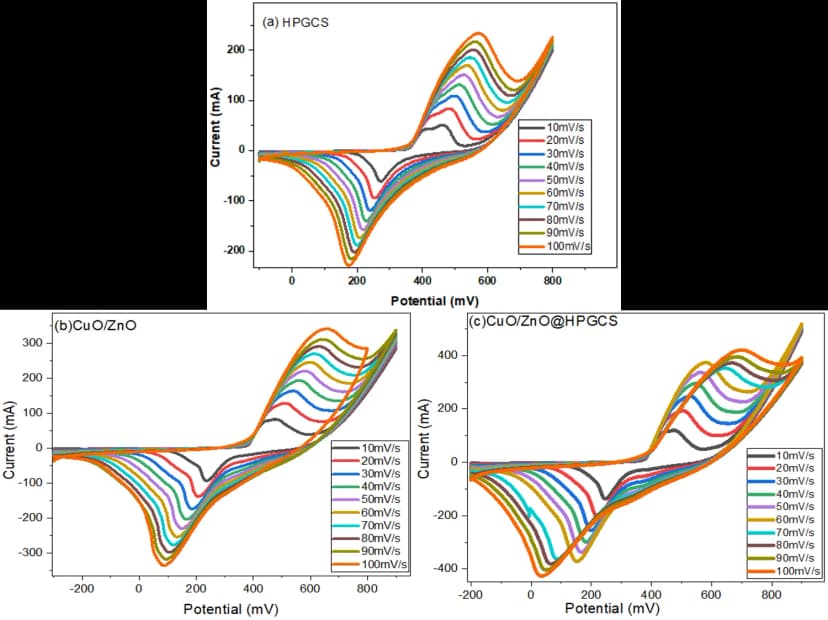
This study presents the synthesis of CuO/ZnO@hierarchical porous graphitic carbon spheres (CuO/ZnO@HPGCS) using a low-temperature water-bath method. Chitosan, PVP, and PEG were employed to form well-structured porous carbon spheres, ensuring high electrochemical efficiency. Characterization techniques confirmed the structural and compositional integrity of the nanocomposite. Electrochemical evaluations demonstrated a remarkable specific capacitance of 1875 F/g, outperforming pure CuO/ZnO and standalone HPGCS. The synergy between the transition metal oxides and the porous carbon structure enhanced charge storage capacity, conductivity, and electrochemical performance, making CuO/ZnO@HPGCS a promising material for next-generation supercapacitor applications.
This study presents the synthesis of CuO/ZnO@hierarchical porous graphitic carbon spheres (CuO/ZnO@HPGCS) using a low-temperature water-bath method. Chitosan, PVP, and PEG were employed to form well-structured porous carbon spheres, ensuring high electrochemical efficiency. Characterization techniques confirmed the structural and compositional integrity of the nanocomposite. Electrochemical evaluations demonstrated a remarkable specific capacitance of 1875 F/g, outperforming pure CuO/ZnO and standalone HPGCS. The synergy between the transition metal oxides and the porous carbon structure enhanced charge storage capacity, conductivity, and electrochemical performance, making CuO/ZnO@HPGCS a promising material for next-generation supercapacitor applications.
Article type: Research Article
Submitted: 13 August 2024
Revised: 15 October 2024
Accepted: 3 December 2024
First published: 11 January 2025
DOI: https://doi.org/10.69626/eea.2025.0010
Volume: 2
Issue: 1
Pages: 10-20
Citation: Energy & Environment Advances 2(1), 10-20 (2025)
Asghar, A., Anjum, S., Fatima, N., Khan, M. I. and Shanableh, A. 2025. Synthesis and Electrochemical Evaluation of CuO/ZnO @Hierarchical Porous Graphitic Carbon Spheres for Enhanced Supercapacitive Applications. Energy & Environment Advances 2(1), pp. 10-20; https://doi.org/10.69626/eea.2025.0010.
Number of downloads: 4
Number of views: 54