


Subscribe To Get Information, Latest News And Other Interesting Events!



Important Links
Get In Touch
Ariston Publication
3167 Riverview Place
Columbus, OH 43202
United States of America
Copyright © 2026 Ariston Publications. All Rights Reserved.
Loading Your Library
Preparing your reading experience...
Loading content...
Ariston Publication
3167 Riverview Place
Columbus, OH 43202
United States of America

Ebru Kuyumcu Savan, Gamze Erdoğdu
Ebru Kuyumcu Savan 1,*
Gamze Erdoğdu 2
1 Department of Basic Pharmaceutical Sciences, Faculty of Pharmacy, İnönü University, 44280, Malatya, Turkey
2 Department of Chemistry, Faculty of Arts and Sciences, İnönü University, Malatya, TURKEY
* Author to whom correspondence should be addressed: ebru.savan@inonu.edu.tr(E. K. Savan)
The present study reports the development of a highly sensitive electrochemical sensor for the simultaneous determination of levodopa and benserazide, two pharmacologically active substances used in the treatment of Parkinson's disease. The sensor was fabricated by electropolymerization of aniline on a glassy carbon electrode (GCE) in a nonaqueous medium, followed by modification with multi-walled carbon nanotubes (MWCNTs). The synergistic effect of polyaniline and MWCNTs resulted in enhanced electrochemical performance, providing high selectivity and sensitivity toward the target analytes. The modified electrode exhibited well-defined differential pulse voltammetry (DPV) responses, allowing for quantitative determination of levodopa in the linear range of 500-1000 µM and benserazide in the range of 100-500 µM, with detection limits of 67.01 µM and 163.60 µM, respectively. The electrochemical behavior of the sensor was evaluated under various conditions, including film thickness, supporting electrolyte type, and pH variations, to optimize its performance. The sensor demonstrated excellent repeatability, stability, and resistance to interference from ascorbic acid, a common interfering species. Additionally, the method was successfully applied to the determination of levodopa and benserazide in real urine samples and pharmaceutical formulations, achieving satisfactory recovery rates. These findings highlight the potential of the developed sensor as a reliable and cost-effective tool for clinical and pharmaceutical applications.
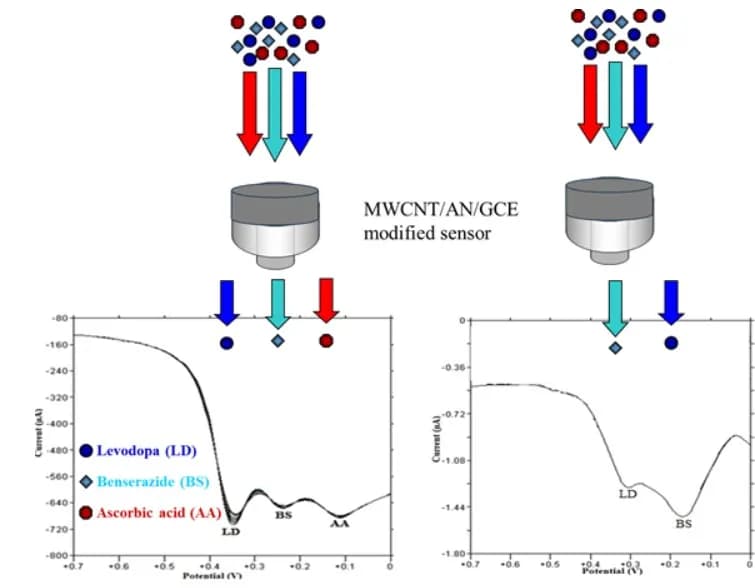
An electrochemical sensor was developed by electropolymerizing aniline on a glassy carbon electrode in a nonaqueous medium and modifying it with multi-walled carbon nanotubes (MWCNTs). This sensor enabled the quantitative determination of levodopa and benserazide, key drugs for Parkinson’s disease treatment. The optimized method demonstrated high selectivity and sensitivity, with detection limits of 67.01 µM for levodopa and 163.60 µM for benserazide. The sensor performed well in real urine samples and pharmaceutical formulations, even in the presence of interfering species.
Article type: Research Article
Submitted: 25 September 2024
Revised: 30 October 2024
Accepted: 24 December 2024
First published: 15 January 2024
DOI: https://doi.org/10.69626/eea.2025.0021
Volume: 2
Issue: 1
Pages: 21-31
Citation: Energy & Environment Advances 2(1), 21-31 (2025)
Savan, E. K. and Erdoğdu, G. 2025. Electrochemical Simultaneous Determination of Levodopa and Benserazide in Aniline and Multi–Walled Carbon Nanotube Modified Sensor. Energy & Environment Advances 2(1), pp. 21-31; https://doi.org/10.69626/eea.2025.0021.
Number of downloads: 5
Number of views: 49