


Subscribe To Get Information, Latest News And Other Interesting Events!



Important Links
Get In Touch
Ariston Publication
3167 Riverview Place
Columbus, OH 43202
United States of America
Copyright © 2026 Ariston Publications. All Rights Reserved.
Loading Your Library
Preparing your reading experience...
Loading content...
Ariston Publication
3167 Riverview Place
Columbus, OH 43202
United States of America

Pratik Kamtekar, Ankita P. Angre, Pratap Patil, Priya A. Patil, Rohit Mahadule, Gayatri S. Bhagwat, Paresh S. Gaikar
Pratik Kamtekar 1
Ankita P. Angre 2
Pratap Patil 2
Priya A. Patil 3
Rohit Mahadule 4
Gayatri S. Bhagwat 5
Paresh S. Gaikar 1,*
1 Rayat Shikshan Sanstha’s, Karmaveer Bhaurao Patil College, Vashi, Navi Mumbai, 400703, Maharashtra, India.
2 Ramnarain Ruia Autonomous College, Matunga, Mumbai, 400019, Maharashtra, India.
3 Changu Kana Thakur A. C. S. College, New Panvel-410206, Maharashtra, India.
4 S. Chandra Mahila Mahavidyalaya, Sadak Arjuni, Gondia, 441807, Maharashtra, India,
5 Mahatma Phule A.S.C. College, Panvel, Raigad, 410206, Maharashtra, India
* Author to whom correspondence should be addressed: psgaikar@kbpcollege.edu.in (Paresh S. Gaikar)
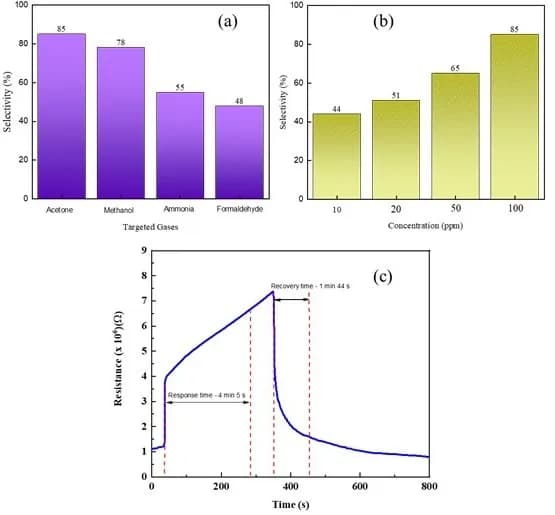
The demand for precise, real-time monitoring of volatile organic compounds such as acetone has driven significant research into advanced gas sensing technologies. Conventional metal oxide sensors typically require elevated operating temperatures, which impose constraints on energy efficiency and device portability. In this work, we present a viable alternative through the development of polyaniline (PANI) thin films fabricated via the Successive Ionic Layer Adsorption and Reaction (SILAR) technique, designed specifically for room-temperature acetone sensing. Comprehensive material characterization was conducted using X-ray diffraction (XRD), scanning electron microscopy (SEM), and ultraviolet-visible (UV-Vis) spectroscopy. These analyses verified the semicrystalline nature and porous nanoscale morphology of the PANI films, which are instrumental in facilitating effective gas adsorption. The sensor demonstrated pronounced selectivity toward acetone, exhibiting an 85% response, substantially higher than that for methanol, ammonia, and formaldehyde. Concentration-dependent studies revealed a progressive increase in sensitivity, reaching 85% at 100 ppm acetone. The dynamic sensing performance showed a response time of approximately 219.6 seconds and a recovery time of about 444.4 seconds, indicative of favorable adsorption-desorption kinetics. These results underscore the potential of SILAR-deposited PANI thin films as selective, energy-efficient, and room-temperature operable sensors for acetone detection. Such sensors hold considerable promise for applications in non-invasive medical diagnostics, such as diabetes breath analysis, and in continuous environmental air quality monitoring.
This research is significant for advancing low-power, room-temperature gas sensing technology. By successfully developing a polyaniline-based acetone sensor using the simple and scalable SILAR method, the study addresses key limitations of conventional metal-oxide sensors, such as high energy consumption and limited portability. The demonstrated selectivity and sensitivity at ambient temperature make this sensor highly promising for practical applications in non-invasive medical diagnostics, like diabetes monitoring through breath analysis, and in real-time environmental air quality assessment.
Polyaniline thin films were synthesized via the SILAR technique and evaluated as room-temperature acetone gas sensors. Material characterization confirmed a semi-crystalline structure and porous, granular morphology conducive to gas adsorption. The sensor exhibited high selectivity (85% response to acetone) and a concentration-dependent sensitivity up to 100 ppm, with a response time of ~219.6 s and recovery time of ~444.4 s. The findings validate SILAR-deposited PANI films as efficient, energy-saving sensing platforms for diagnostic and environmental monitoring applications.
Article type: Research Article
Submitted: 28 January 2025
Revised: 21 April 2025
Accepted: 19 May 2025
First published: 26 July 2025
DOI: https://doi.org/10.69626/eea.2025.0122
Volume: 2
Issue: 3
Pages: 122-130
Citation: Energy & Environment Advances 2(3), 122-130 (2025)
Kamtekar, P., Angre, A. P., Patil, P., Patil, P. A., Mahadule, R., Bhagwat, G. S., and Gaikar, P. S. 2025. Room–Temperature Acetone Detection Using SILAR–Synthesized Polyaniline Thin Film Sensors. Energy & Environment Advances 2(3), pp. 122-130; https://doi.org/10.69626/eea.2025.0122.
Number of downloads: 6
Number of views: 92