


Subscribe To Get Information, Latest News And Other Interesting Events!



Important Links
Get In Touch
Ariston Publication
3167 Riverview Place
Columbus, OH 43202
United States of America
Copyright © 2026 Ariston Publications. All Rights Reserved.
Loading Your Library
Preparing your reading experience...
Loading content...
Ariston Publication
3167 Riverview Place
Columbus, OH 43202
United States of America
Mehejbin Mujawar, Deepak Kumbhar, Prashant Sanadi, Ankush Sargar, Vashishtha Gurame, Shivaji Kulal
Mehejbin Mujawar 1
Deepak Kumbhar 2
Prashant Sanadi 1
Ankush Sargar 3
Vashishtha Gurame 4
Shivaji Kulal 1,*
1 Department of Chemistry, Raje Ramrao Mahavidyalaya, Jath, Sangli-416404, Maharashtra, India
2 Department of Chemistry, Dattajirao Kadam Arts, Science and Commerce College, Ichalkaranji, Kolhapur-416004, Maharashtra, India.
3 Department of Chemistry, Dr. Patangrao Kadam Mahavidyalaya, Sangalwadi, Sangli- 416305, Maharashtra, India
4 Department of Chemistry, Shri Shivaji Mahavidyalaya, Barshi, Solapur-413401, Maharashtra, India
* Author to whom correspondence should be addressed: srkulalresearch@gmail.com (Shivaji Kulal)
The increasing discharge of industrial oily wastewater poses severe risks to environmental integrity and public health, necessitating the development of efficient and sustainable treatment technologies. In this work, we report the synthesis of a superhydrophobic polyurethane sponge functionalized with a composite coating comprising candle soot (CS), silica nanoparticles (SiO₂), polystyrene (PS), and polydimethylsiloxane (PDMS). Superhydrophobic SiO₂ nanoparticles were first prepared via a sol–gel method using methyltrimethoxysilane as the precursor. These nanoparticles were dispersed into a polymer solution containing PS and PDMS, along with candle soot, and subsequently deposited onto a commercial polyurethane sponge through a simple dip-coating process. The resulting material exhibited exceptional wettability characteristics, with a water contact angle of 165° and an oil contact angle of 0°. The sponge demonstrated outstanding oil–water separation performance, achieving an efficiency of 99% over repeated cycles. Mechanical durability tests revealed that the coating withstands over 80 abrasion cycles without significant loss of superhydrophobicity. Furthermore, the sponge maintained high separation efficiency across a broad pH range, confirming its stability under harsh chemical conditions. Adhesion tests using peel tape validated the robustness and coating integrity. Due to its cost-effectiveness, reusability, and environmental sustainability, this superhydrophobic sponge presents a viable and scalable solution for treating industrial effluents and managing oil spills.
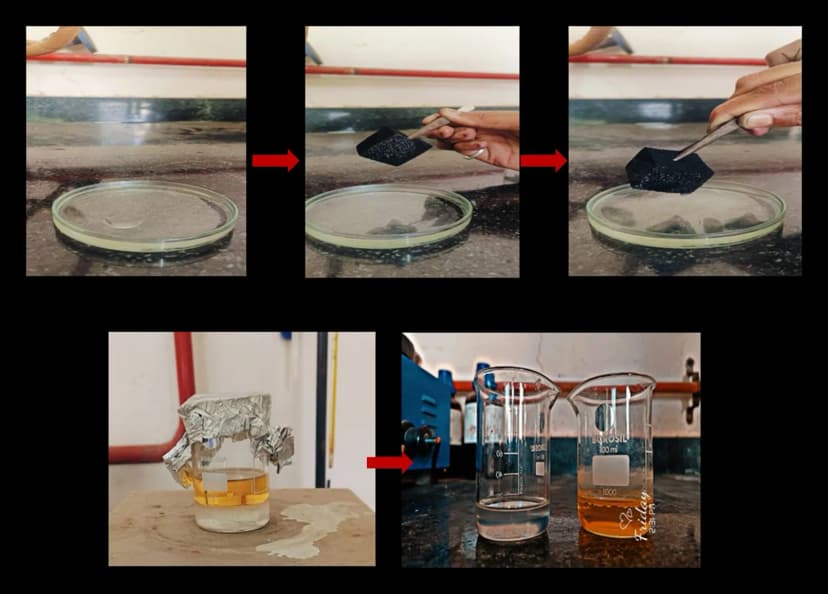
This study presents a significant advancement in environmental remediation by developing a durable, cost-effective superhydrophobic sponge for efficient oil-water separation. The work addresses critical limitations of existing methods, offering a reusable and chemically stable solution capable of operating under harsh conditions. Its practical fabrication process and robust performance directly contribute to sustainable strategies for managing industrial oily wastewater and mitigating oil spills, promising substantial ecological and economic benefits.
The study successfully fabricated a superhydrophobic polyurethane sponge using a dip-coating process with a novel CS/SiO₂/polymer composite. The coating, incorporating methylated silica nanoparticles and candle soot within a PDMS/polystyrene matrix, created a hierarchical rough surface with a water contact angle of 165° and an oil contact angle of 0°. The sponge demonstrated excellent separation efficiency (>99%), remarkable mechanical durability, and stability across a wide pH range, proving highly effective for selective oil absorption and recovery.
Article type: Research Article
Submitted: 2 February 2025
Revised: 28 April 2025
Accepted: 29 May 2025
First published: 26 July 2025
DOI: https://doi.org/10.69626/eea.2025.0131
Volume: 2
Issue: 3
Pages: 131-140
Citation: Energy & Environment Advances 2(3), 131-140 (2025)
Mujawar, M., Kumbhar, D., Sanadi, P., Sargar, A., Gurame, V. and Kulal, S. 2025. Fabrication of a Mechanically Robust Superhydrophobic Polyurethane Sponge via CS/SiO₂/Polymer Composite Coating for High–Efficiency Oil–Water Separation. Energy & Environment Advances 2(3), pp. 131-140; https://doi.org/10.69626/eea.2025.0131.
Number of downloads: 11
Number of views: 113