


Subscribe To Get Information, Latest News And Other Interesting Events!



Important Links
Get In Touch
Ariston Publication
3167 Riverview Place
Columbus, OH 43202
United States of America
Copyright © 2026 Ariston Publications. All Rights Reserved.
Loading Your Library
Preparing your reading experience...
Loading content...
Ariston Publication
3167 Riverview Place
Columbus, OH 43202
United States of America

A. K. Barve, R. B. Lanjewar
A. K. Barve 1,*
R. B. Lanjewar 2
1 Ajeenkya D. Y. Patil School of Engineering, Savitribai Phule Pune University, Lohegoan, Pune-411081, India
2 Dharampeth M.P. Deo Memorial Science College, North Ambazari Road, Nagpur-440033, Maharastra, India
* Author to whom correspondence should be addressed: drashwinibokade@gmail.com (A. K. Barve)
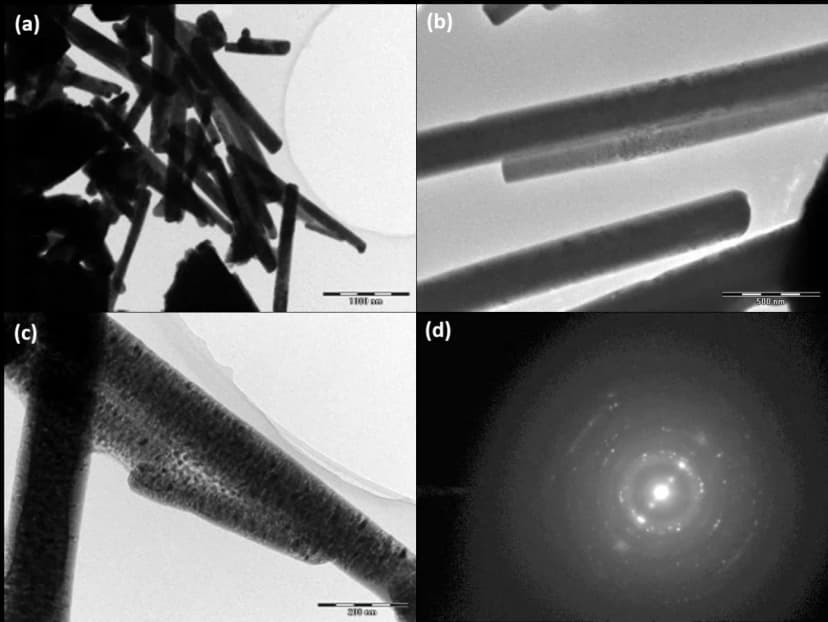
This study presents a simple hydrothermal approach for synthesizing cadmium oxide (CdO) nanorods, utilizing cadmium chloride as a precursor with polyethylene glycol and urea serving as stabilizing agents. The structural, morphological, and optical properties of the as-prepared nanorods were systematically investigated through X-ray diffraction (XRD), transmission electron microscopy (TEM), UV–visible spectroscopy, and Fourier-transform infrared (FTIR) spectroscopy. XRD analysis revealed a cubic crystalline phase with an average crystallite size of approximately 65 nm, a finding consistent with TEM observations, which showed spherical nanorods with sizes ranging between 60–70 nm. FTIR spectra confirmed the presence of Cd–O bonds, while UV–visible absorption measurements indicated a notable blue shift and an increased optical band gap of 3.75 eV, attributed to quantum confinement effects. The photocatalytic performance of the CdO nanorods was evaluated through the degradation of methyl red dye under UV irradiation. Results demonstrated efficient dye degradation, particularly at lower concentrations, with the process following pseudo-first-order kinetics. The study underscores the potential of hydrothermally synthesized CdO nanorods as effective photocatalysts for the remediation of dye-contaminated wastewater, offering a sustainable and eco-friendly treatment option.
This research addresses the pressing environmental concern of dye pollution by presenting a sustainable remediation strategy. The development of an efficient, low-cost hydrothermal method to synthesize CdO nanoparticles offers a practical pathway for degrading toxic azo dyes like methyl red. The demonstrated photocatalytic efficiency underscores the potential of these nanomaterials as viable, eco-friendly catalysts for advanced wastewater treatment applications in industrial settings.
Cadmium oxide nanoparticles were successfully synthesized via a facile hydrothermal method using cadmium chloride, urea, and ethylene glycol. Comprehensive characterization using XRD, TEM, FTIR, and UV-Vis spectroscopy confirmed a pure cubic phase, spherical morphology (~65 nm), and a widened optical band gap of 3.75 eV due to quantum confinement. The nanoparticles exhibited effective photocatalytic degradation of methyl red dye under UV light, with optimal performance observed at lower pollutant concentrations.
Article type: Research Article
Submitted: 13 February 2025
Revised: 3 May 2025
Accepted: 9 June 2025
First published: 26 July 2025
DOI: https://doi.org/10.69626/eea.2025.0141
Volume: 2
Issue: 3
Pages: 141-148
Citation: Energy & Environment Advances 2(3), 141-148 (2025)