


Subscribe To Get Information, Latest News And Other Interesting Events!



Important Links
Get In Touch
Ariston Publication
3167 Riverview Place
Columbus, OH 43202
United States of America
Copyright © 2026 Ariston Publications. All Rights Reserved.
Loading Your Library
Preparing your reading experience...
Loading content...
Ariston Publication
3167 Riverview Place
Columbus, OH 43202
United States of America
Yajvinder Saharan, Joginder Singh
Yajvinder
Saharan1
Joginder Singh2,*
1Department of Chemistry, OM Sterling Global University, Hisar, 125001, Haryana, India
2Department of Chemistry, Maharishi Markandeshwar (Deemed to be University), Mullana, Ambala, 133203, Haryana, India.
*Author to whom correspondence should be addressed: joginderchem@mmumullana.org (J. Singh)
Crude oil spills pose significant risks to both marine ecosystems and human populations. Traditional remediation techniques have their limitations, prompting the exploration of innovative approaches. This study introduces a novel method involving the synthesis of a self-assembled sponge and organic aerogel. These materials were further modified using hexamethyldisilazane (HMDS) and dodecyltrimethoxysilane (DTMS) to impart hydrophobic properties. Characterization via SEM examination and FTIR spectroscopy revealed distinctive features, including bands at approximately 1050 cm-1 and 790 cm-1, indicative of alkyl side chain stretching by Si-O-C and C-H, respectively, enhancing the hydrophobicity of the materials. The SEM images depicted a random rough surface with abundant pores, facilitating oil adsorption from contaminated samples. Notably, after seven cycles of use with contaminated soil samples, the organic aerogel exhibited exceptional oil removal capacity, achieving 100% efficiency according to the Sears method. This innovative sponge and organic aerogel-based approach represents a promising advancement in environmental remediation, offering a highly efficient and sustainable solution for oil spill cleanup.
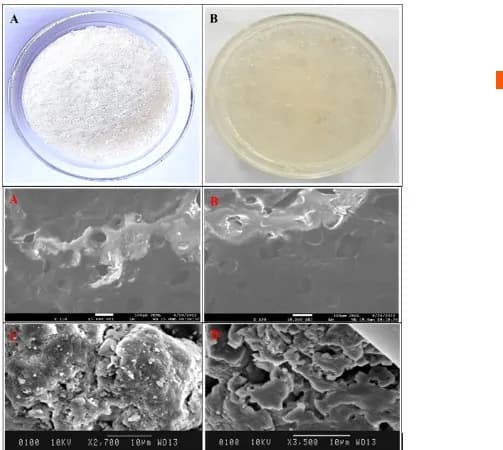
This study introduces a novel, highly efficient, and sustainable method for oil spill remediation using self-assembled organic aerogels and sponges, which exhibit exceptional oil absorption capabilities from contaminated soil samples.
The study presents self-assembled sponges and organic aerogels modified with HMDS and DTMS for hydrophobicity. Characterization shows features enhancing oil adsorption. These materials achieve 100% oil removal efficiency from contaminated soil after seven cycles, offering a promising solution for oil spill cleanup.
Article type: Research Article
Submitted: 5 January 2024
Revised: 3 February 2024
Accepted: 22 February 2024
First published: 15 March 2024
DOI: https://doi.org/10.69626/mse.2024.0033
Volume: 1
Issue: 1
Pages: 33-42
Citation: MatSci Express 1(1), 33-42 (2024)