


Subscribe To Get Information, Latest News And Other Interesting Events!



Important Links
Get In Touch
Ariston Publication
3167 Riverview Place
Columbus, OH 43202
United States of America
Copyright © 2026 Ariston Publications. All Rights Reserved.
Loading Your Library
Preparing your reading experience...
Loading content...
Ariston Publication
3167 Riverview Place
Columbus, OH 43202
United States of America
Sonika Sharma, Shubham Sharma, Meena Kumari
Sonika Sharma 1
Shubham Sharma 2
Meena Kumari 2,*
1 Department of Chemistry, MLSM College, Sunder Nagar, Himachal Pradesh, India
2 Department of Chemistry, Himachal Pradesh University, Summer Hill, Shimla-171005, India.
* Author to whom correspondence should be addressed: drmeenakchandel@gmail.com (Meena Kumari)
A new vanadium (III) hydroxamate complex of composition V(4- NO2C6H4CH=CHCONHO)3 has been synthesized by reaction of VCl3 with potassium salt of 4-nitrocinnamohydroxamate (4-NO2C6H4CH=CHCONHO) in 1:3 molar ratio in dry methanol solvent. The newly synthesized complex is characterized by elemental analysis, molar conductivity, magnetic moment measurements and IR, UV-Vis spectral studies and mass spectrometry. DFT calculations were carried out by using Orca 4.2.1 program and the negative values of the energies of EHOMO and ELUMO for the V(III) complex confirm its stability. A distorted-octahedral geometry around vanadium center has been suggested for complex based upon physicochemical, spectroscopic and DFT studies, involving bonding through hydroxylamine and carbonyl oxygens (O O coordination). The cyclic voltammogram of the complex shows single anodic and cathodic peak. The TGA/DTA curve indicates the single step decomposion of complex. The biological potential of the ligand and complex have been tested by in vitro antimicrobial studies and cytotoxicity assay. Antimicrobial activity of complex has been found increased as compare to precursor and ligand. The results of cytotoxicity reveal the complex less toxic as compared to standard drug simvastatin.
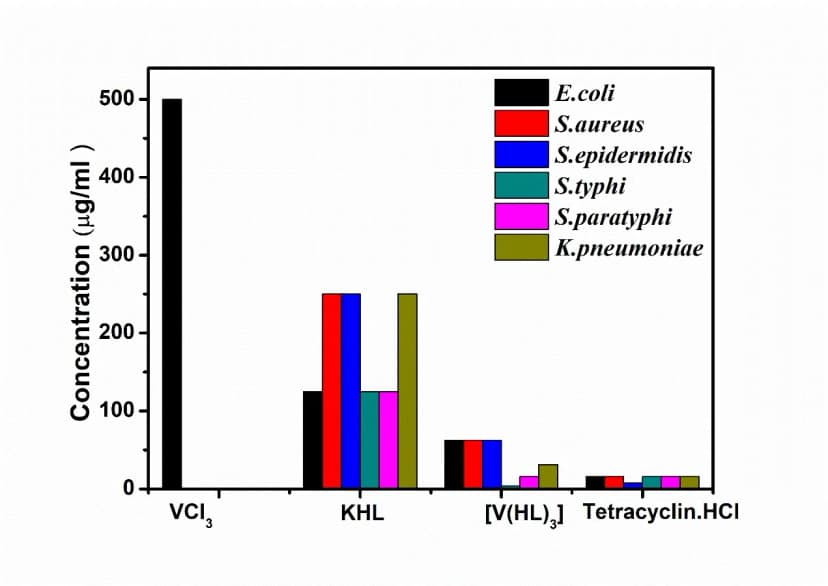
The synthesis and characterization of a new vanadium (III) hydroxamate complex are detailed in this study. Elemental analysis, spectroscopic techniques, and DFT calculations confirmed the complex's stability and distorted-octahedral geometry. The complex exhibits significant antimicrobial activity and lower cytotoxicity compared to simvastatin. These findings underscore the complex's potential for biological applications, particularly as an antimicrobial agent.
Article type: Research Article
Submitted: 26 January 2024
Revised: 13 March 2024
Accepted: 17 April 2024
First published: 1 June 2024
DOI: https://doi.org/10.69626/mse.2024.0081
Volume: 1
Issue: 2
Pages: 81-95
Citation: MatSci Express 1(2), 81-95 (2024)