


Subscribe To Get Information, Latest News And Other Interesting Events!



Important Links
Get In Touch
Ariston Publication
3167 Riverview Place
Columbus, OH 43202
United States of America
Copyright © 2026 Ariston Publications. All Rights Reserved.
Loading Your Library
Preparing your reading experience...
Loading content...
Ariston Publication
3167 Riverview Place
Columbus, OH 43202
United States of America
F. A. Zargar, Hilal A. Bhat, Mohd. A. Zargar, S. A. Malik
F. A. Zargar 1, *
Hilal A. Bhat 2
Mohd. A. Zargar 3, *
S. A. Malik 4
1 Govt Medical College, Bakshi Nagar, Jammu – 180001, India
2Department of Electronics & Instrumentation Technology, University of Kashmir, Srinagar – 190006, India
3 Department of Computer Science, University of Saskatchewan, Saskatoon – S7N 5A2, Canada
4 Higher Education Department, Government of Jammu & Kashmir – 190001, India
* Author to whom correspondence should be addressed: faizanzgr@gmail.com (F.A. Zargar), mohammad.zargar@usask.ca (Mohd. A. Zargar)
Thermotherapy, often called Hyperthermia treatment is a cancer treatment modality that involves raising the temperature of the tumor mass to over 315 K (42°C) for a specific duration, which leads to cell death through apoptosis or necrosis. Magnetic Particle Hyperthermia (MPH) is a non-invasive technique where magnetic nanoparticles are introduced into the tumor and then exposed to a magnetic field which convert magnetic energy into heat. Due to their high acidity, tumor cells are more sensitive to heat than healthy cells, meaning that heating the tumor to 315-319 K (42°C–46°C) can destroy it with minimal damage to the surrounding healthy tissues. During hyperthermia treatment, blood perfusion helps protect the healthy tissues around the tumor by dissipating excess heat. This paper presents a study where the temperature profiles within a spherical hepatic tumor mass are estimated by solving Pennes’ Bio-heat Equation, incorporating a power term. The study uses analytical methods to examine the effects of magnetic fluid hyperthermia treatment. Numerical illustrations are carried out using magnetite (Fe3O4) nanoparticles having an average diameter of 10.9 nm with mineral oil as a carrier liquid, subjected to magnetic fields of varying intensities. By analysing the model, the present work helps in designing an optimal treatment protocol by identify the time threshold of the therapy for varying magnetic field strengths.
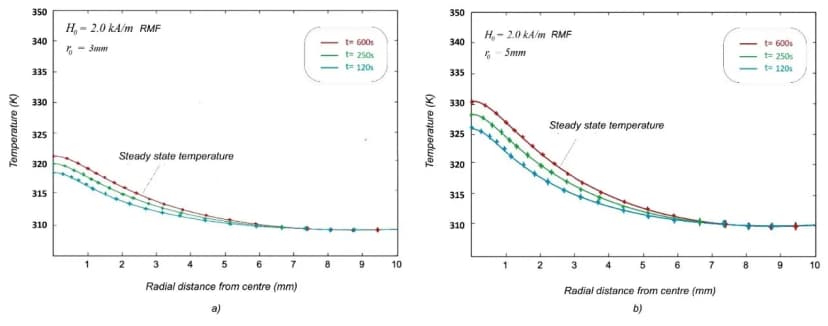
The research investigates magnetic particle hyperthermia (MPH) for cancer treatment by modeling temperature profiles in a spherical hepatic tumor using Pennes’ Bio-heat Equation. Analytical methods and numerical illustrations with magnetite nanoparticles assess the impact of varying magnetic field intensities. The findings aid in designing optimal treatment protocols, maintaining healthy tissue temperatures below 315 K (42°C) while effectively targeting tumor cells.
Article type: Research Article
Submitted: 23 January 2024
Revised: 17 March 2024
Accepted: 15 April 2024
First published: 1 June 2024
DOI: https://doi.org/10.69626/mse.2024.0116
Volume: 1
Issue: 2
Pages: 116-124
Citation: MatSci Express 1(2), 116-124 (2024)