


Subscribe To Get Information, Latest News And Other Interesting Events!



Important Links
Get In Touch
Ariston Publication
3167 Riverview Place
Columbus, OH 43202
United States of America
Copyright © 2026 Ariston Publications. All Rights Reserved.
Loading Your Library
Preparing your reading experience...
Loading content...
Ariston Publication
3167 Riverview Place
Columbus, OH 43202
United States of America
Md Ehsanullah, Satyam Singh, Rohit Kumar
Md Ehsanullah 1
Satyam Singh 2,*
Rohit Kumar 1,*
1 Department of Civil Engineering, Madan Mohan Malaviya University of Technology Gorakhpur, Uttar Pradesh, India
2 Centre of Sustainable Technologies, Indian Institute of Science, Bengaluru-560012, India
* Author to whom correspondence should be addressed: satyammmmut01@gmail.com (S. Singh); rkce@mmmut.ac.in (R. Kumar)
This study explores the thermal conductivity and mechanical properties of mortar compositions incorporating agricultural waste materials, specifically Rice Husk Ash (RHA) and Bagasse Ash (BA), as sustainable alternatives. Experimental results indicate a marked reduction in thermal conductivity as agro-waste content increases. Notably, Rice Husk Ash-based mortar (RH15) and Bagasse Ash-based mortar (BA15) exhibit reductions in thermal conductivity of 19°C and 17°C, respectively, when compared to traditional Portland Pozzolana Cement (PPC) mortar after four hours of exposure. In geopolymer mortars, mix 7 demonstrates superior thermal performance, with RHA and BA reducing thermal conductivity by 12°C and 14°C, respectively, compared to Fly Ash-based Geopolymer mortar (FA7). The study also evaluates the shrinkage tendencies of the mortars, revealing that higher agro-waste content mitigates shrinkage, with Bagasse Ash-based mortars showing the lowest linear shrinkage at 5% sand replacement. Mechanical strength analysis further highlights the beneficial effects of Bagasse Ash, particularly in PPC-based mortars, where strength improvements are observed at both 5% and 15% sand replacement. Among geopolymer mixes, mix 7 emerges as the optimal design in terms of both thermal and mechanical performance. These findings emphasize the potential of agricultural waste materials to enhance the sustainability and efficiency of mortar compositions, contributing to reduced environmental impact and improved construction materials.
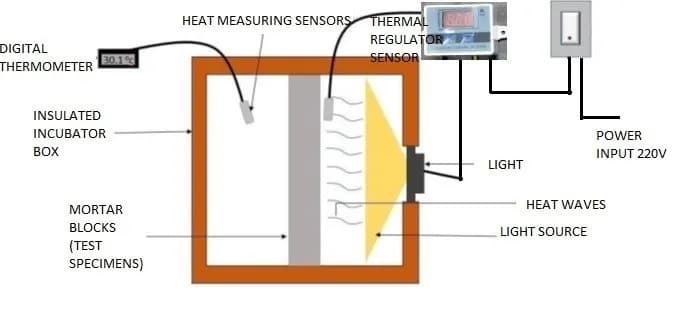
The study investigates the thermal and mechanical properties of mortar incorporating Rice Husk Ash (RHA) and Bagasse Ash (BA) as sustainable alternatives. Results show significant reductions in thermal conductivity and shrinkage, with improved mechanical strength in both conventional and geopolymer mortars. RHA and BA-based mortars demonstrated superior thermal performance, particularly at 15% sand replacement levels. The findings underscore the benefits of agro-waste in creating efficient, sustainable construction materials.
Article type: Research Article
Submitted: 13 June 2024
Revised: 7 July 2024
Accepted: 25 July 2024
First published: 1 August 2024
DOI: https://doi.org/10.69626/mse.2024.0269
Volume: 1
Issue: 4
Pages: 269-277
Citation: MatSci Express 1(4), 269-277 (2024)