


Subscribe To Get Information, Latest News And Other Interesting Events!


Important Links
Get In Touch
Ariston Publication
3167 Riverview Place
Columbus, OH 43202
United States of America
Copyright © 2026 Ariston Publications. All Rights Reserved.
Loading Your Library
Preparing your reading experience...
Loading content...
Ariston Publication
3167 Riverview Place
Columbus, OH 43202
United States of America
Gamze Erdoğdu
Gamze Erdoğdu
Department of Chemistry, Faculty of Arts and Sciences, İnönü University, Malatya, TURKEY
* Author to whom correspondence should be addressed:gamze.erdogdu@inonu.edu.tr(Gamze Erdoğdu)
The electrochemical polymerization of 1,4-diaminobenzene in an aqueous KCl electrolyte at a controlled potential of 0.600 V resulted in the formation of an adherent poly(1,4-diaminobenzene) (PDB) film on a gold electrode. This polymeric membrane demonstrated selective permeability for paracetamol while effectively blocking ascorbic acid interference. A comprehensive investigation of polymerization parameters, including film thickness, monomer concentration, electrolyte concentration, and applied polymerization potential, was conducted to optimize the permselective characteristics of the PDB film. Voltammetric studies revealed that a polymeric film with a thickness corresponding to 7 mC charge exhibited the highest selectivity for paracetamol while completely suppressing ascorbic acid oxidation signals. Further analysis demonstrated that the optimal polymerization potential was 0.600 V vs. Ag/AgCl, where the peak oxidation current for paracetamol was maximized. Monomer and electrolyte concentrations were also optimized, with the best response obtained at 50 mM 1,4-diaminobenzene and 100 mM KCl. The findings suggest that the optimized PDB film functions as an effective permselective membrane, enabling highly sensitive and selective electrochemical detection of paracetamol. This approach offers a cost-effective and robust alternative to conventional sensors, addressing issues such as low sensitivity, poor stability, and the need for noble metal electrodes. The optimized polymer membrane holds potential for applications in pharmaceutical analysis and biomedical sensing, where precise and interference-free detection of paracetamol is essential.
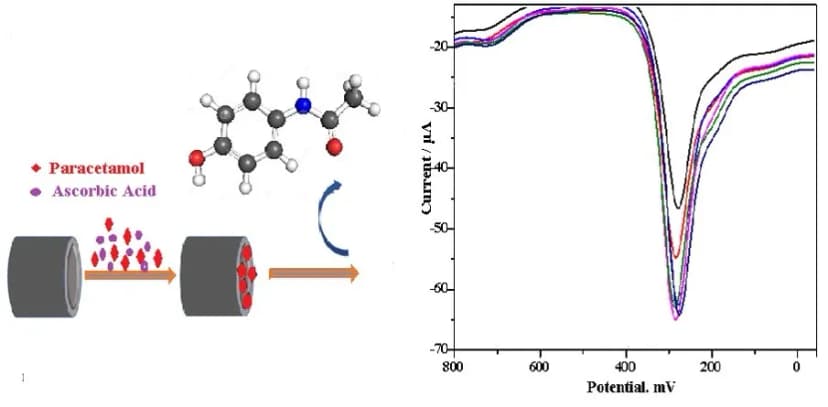
This study presents an optimized poly(1,4-diaminobenzene) (PDB) film for selective electrochemical detection of paracetamol, addressing key challenges of sensor selectivity and interference. By systematically refining polymerization parameters, the developed electrode effectively suppresses ascorbic acid oxidation, ensuring accurate detection. The optimized PDB membrane offers a cost-effective, stable, and reproducible alternative to conventional sensors, making it suitable for pharmaceutical and biomedical applications. This work advances electrochemical sensor technology, providing a practical solution for interference-free paracetamol analysis.
The electrochemical polymerization of 1,4-diaminobenzene at 0.600 V led to the formation of a selective PDB membrane on a gold electrode. The optimized film, with a thickness of 7 mC, demonstrated high selectivity for paracetamol while effectively blocking ascorbic acid. Monomer and electrolyte concentrations were fine-tuned to achieve the best response. The study highlights the membrane's potential as a cost-effective and reliable sensing platform for pharmaceutical and biomedical applications, ensuring precise, interference-free paracetamol detection.
Article type: Research Article
Submitted: 29 August 2024
Revised: 18 October 2024
Accepted: 15 October 2024
First published: 26 January 2025
DOI: https://doi.org/10.69626/mse.2025.0124
Volume: 2
Issue: 2
Pages: 124-131
Citation: MatSci Express 2(2), 124-131 (2025)