


Subscribe To Get Information, Latest News And Other Interesting Events!



Important Links
Get In Touch
Ariston Publication
3167 Riverview Place
Columbus, OH 43202
United States of America
Copyright © 2026 Ariston Publications. All Rights Reserved.
Loading Your Library
Preparing your reading experience...
Loading content...
Ariston Publication
3167 Riverview Place
Columbus, OH 43202
United States of America
Muhammad Bilal Khalid, Syed Salman Hussain, Muhammad Shafiq, Muhammad Asghar, Shahid Hussain
Muhammad Bilal Khalid1
Syed Salman
Hussain1,*
Muhammad Shafiq2
Muhammad Asghar2
Shahid Hussain3,4,*
1 Department of Physics, International Islamic University, Islamabad, 44000, Pakistan.
2 Department of Physics, Quaid-i-Azam University, Islamabad, 45320, Pakistan
3 School of Materials Science and Engineering, Jiangsu University, Zhenjiang, 212013, China
4 Department of Physics, University of Sargodha, Sargodha 40100, Pakistan
* Author to whom correspondence should be addressed: salman.hussain@iiu.edu.pk (S. Salman Hussain); shahid@ujs.edu.cn(Shahid Hussain)
Cathodic cage plasma nitriding (CCPN) is a well-established and economically viable surface engineering technique renowned for enhancing the properties of metallic materials. This study specifically investigates the pivotal role of processing temperature within the CCPN system, focusing on its impact on AISI-201 austenitic stainless steel and copper. Samples of both materials were treated using an aluminum cathodic cage at a temperature of 300°C for a duration of four hours. The modified surface layers were subjected to a comprehensive suite of analyses, including X-ray diffraction (XRD), scanning electron microscopy (SEM), energy dispersive X-ray spectroscopy (EDS), Vickers microhardness testing, ball-on-disc wear testing, and potentiodynamic polarization corrosion analysis. The results demonstrated a substantial improvement in surface properties. XRD analysis confirmed the successful formation of a complex nitride layer, identifying phases such as AlN, CrN, FeN, and FeMnN on AISI-201, and AlN, Cu₃N, CuN₃, CuN₆, and AlCu₄ on copper. This microstructural evolution directly contributed to a remarkable 300% increase in surface hardness for both materials. Consequently, the wear resistance was significantly enhanced, evidenced by reduced wear track width and a lower coefficient of friction. The corrosion resistance in a 3.5% NaCl solution also showed marked improvement for the nitrided samples. This work provides a thorough explanation of the reaction mechanisms within the aluminum CCPN system and successfully correlates the findings with existing literature, underscoring the effectiveness of this method for low-temperature surface enhancement of challenging materials.
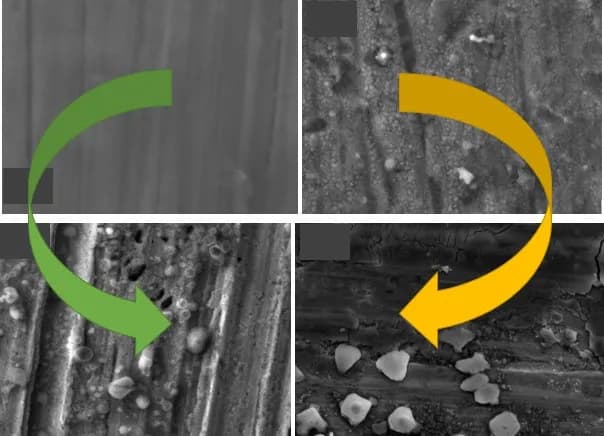
This work investigated the surface modification of AISI 201 steel and pure copper using aluminum cathodic cage plasma nitriding at 300°C for 4 hours. Characterization via XRD, SEM, and EDS confirmed the formation of hard nitride phases (AlN, CrN on steel; AlN, Cu₃N on copper). This resulted in a dramatic 300-900% increase in surface hardness, a significantly reduced coefficient of friction, and improved corrosion resistance in a 3.5% NaCl solution, demonstrating the process's effectiveness for enhancing surface-dependent properties.
Article type: Research Article
Submitted: 23 January 2025
Revised: 28 April 2025
Accepted: 17 May 2025
First published: 9 June 2025
DOI: https://doi.org/10.69626/mse.2025.0207
Volume: 2
Issue: 3
Pages: 207-217
Citation: MatSci Express 2(3), 207-217 (2025)
Khalid, M. B., Hussain, S. S., Shafiq, M., Asghar, M. and Hussain, S. 2025. Enhanced Surface Performance of AISI–201 Austenitic Stainless Steel and Copper via Low–Temperature Aluminum Cathodic Cage Plasma Nitriding. MatSci Express 2(3), pp. 207-217; https://doi.org/10.69626/mse.2025.0207.
Number of downloads: 9
Number of views: 81