


Subscribe To Get Information, Latest News And Other Interesting Events!


Important Links
Get In Touch
Ariston Publication
3167 Riverview Place
Columbus, OH 43202
United States of America
Copyright © 2026 Ariston Publications. All Rights Reserved.
Loading Your Library
Preparing your reading experience...
Loading content...
Ariston Publication
3167 Riverview Place
Columbus, OH 43202
United States of America
K. R. Sanadi, K. C. Rathod, A. S. Varale, V. G. Parale, R. R. Powar, A. V. Mali
K. R. Sanadi1,*
K. C. Rathod2
A. S. Varale3
V.G.Parale4
R. R. Powar5
A. V. Mali6
1 Department of Chemistry,Doodhsakhar Mahavidyalaya Bidri, Kolhapur-416208, India
2 Department of Chemistry, The New College Kolhapur, Maharastra-416004, India
3 Department of Chemistry, Athalye- Sapre- Pitre College, Devrukh, Maharastra-415804, India
4 Seoul National University, Kyujanggak Institute of Korean Studies, Sillim-dong, Seoul, South Korea.
5 Department of Chemitry, Sanjay Ghodawat University, Kolhapur-416118, India
6 Department of Chemistry, Yashwantrao Chavan College of Science, Karad-415124, India
* Author to whom correspondence should be addressed: sanadikishor@gmail.com (K. R. Sanadi)
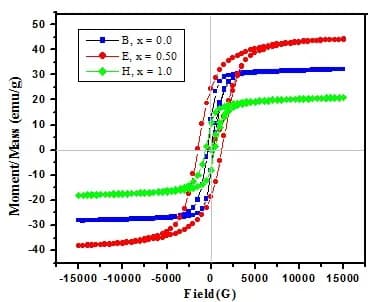
A comprehensive study on the synthesis and properties of nickel-substituted copper ferrite nanoparticles (Cu₁₋ₓNiₓFe₂O₄, where x = 0.0, 0.25, 0.50, 0.75, 1.0) is presented. These nanomaterials were successfully fabricated using a sol-gel auto-combustion technique, a method renowned for its cost-effectiveness and ability to produce homogenous, fine powders at relatively low temperatures. X-ray diffraction analysis confirmed the formation of a pure, single-phase cubic spinel structure for all compositions, with the average crystallite size being approximately 21 nm. Investigations into elemental composition using energy dispersive spectroscopy verified the intended stoichiometry, while scanning electron microscopy revealed the morphology and slight grain growth with increasing nickel content. Electrical resistivity measurements demonstrated semiconducting behavior across all samples, with resistivity decreasing as nickel content increased. Thermoelectric power analysis showed that all compositions exhibited n-type semiconductor characteristics, except for pure nickel ferrite (x=1.0), which displayed p-type behavior. Magnetic characterization via vibrating sample magnetometry confirmed the ferrimagnetic nature of the materials. A significant finding was the transformation from hard magnetic characteristics in copper-rich ferrites to softer magnetic properties in nickel-rich compositions, as evidenced by a reduction in coercivity. These tailored properties highlight the potential of these synthesized ferrites for advanced applications in electronics, including high-frequency magnetic cores, memory devices, and sensors.
This study holds significant value for the field of materials science and engineering by demonstrating a cost-effective and scalable method for tailoring the properties of functional nanomaterials. The systematic tuning of magnetic hardness and semiconductor type in a single material system through cation substitution provides a powerful design strategy. The findings offer critical insights for developing bespoke ferrites with optimized characteristics, paving the way for their enhanced application in next-generation electronic devices, high-frequency transformers, magnetic recording media, and sensors, thereby contributing to advancements in technology and industry.
This research successfully synthesized a complete series of nanocrystalline nickel-substituted copper ferrites (Cu₁₋ₓNiₓFe₂O₄) via the sol-gel auto-combustion method. Comprehensive characterization confirmed the formation of a pure cubic spinel structure, with lattice parameters decreasing and crystallite size increasing with nickel content. Electrical studies revealed semiconducting behavior and a transition from n-type to p-type conductivity. Crucially, magnetic measurements demonstrated a definitive transformation from hard to soft magnetic characteristics as nickel replaced copper. The study conclusively establishes that the material's functional properties can be precisely engineered by controlling the composition.
Article type: Research Article
Submitted: 20 February 2025
Revised: 15 May 2025
Accepted: 28 June 2025
First published: 15 July 2025
DOI: https://doi.org/10.69626/mse.2025.0237
Volume: 2
Issue: 3
Pages: 237-246
Citation: MatSci Express 2(3), 237-246 (2025)
Sanadi, K. R., Rathod, K. C., Varale, A. S., Parale, V. G., Powar, R. R., and Mali, A. V. 2025. Tuning the Structural, Electrical, and Magnetic Properties of Nanocrystalline Copper Ferrite through Nickel Substitution. MatSci Express 2(3), pp. 237-246; https://doi.org/10.69626/mse.2025.0237.
Number of downloads: 83
Number of views: 239