


Subscribe To Get Information, Latest News And Other Interesting Events!


Important Links
Get In Touch
Ariston Publication
3167 Riverview Place
Columbus, OH 43202
United States of America
Copyright © 2026 Ariston Publications. All Rights Reserved.
Loading Your Library
Preparing your reading experience...
Loading content...
Ariston Publication
3167 Riverview Place
Columbus, OH 43202
United States of America

Siddheshwar D. Raut, Vishal V. Awasarmol, Sandip S. Pawar, Mahesh M. Hivrekar, Pravina P. Pawar, Shakuntala A. Shinde
Siddheshwar D. Raut 1
Vishal V. Awasarmol 2
Sandip S. Pawar 3
Mahesh M. Hivrekar 4
Pravina P. Pawar 3
Shakuntala A. Shinde 1,*
1 Sharadchandra Arts, Commerce and Science College, Naigaon, District Nanded-431709, Maharastra, India
2 Swami Vivekanand Senior College, Mantha, District Jalna- 431504, Maharastra, India
3 Dr. Babasaheb Ambedkar Marathwada University, Chh. Smabhajinagar-431004, Maharastra, India
4 Gramin Technical and Management Campus, Vishnupuri, Nanded-431606, Maharastra, India
* Author to whom correspondence should be addressed: shakunshinde1973@gmail.com (Shakuntala A. Shinde)
Zinc ferrite (ZnFe₂O₄) nanoparticle-based petrol vapor sensors were synthesized via a cost-effective sol–gel auto-combustion method and subsequently modified using γ-irradiation at doses of 2 and 5 kGy. The effect of γ-irradiation on the structural, morphological, and textural properties of ZnFe₂O₄ was systematically investigated, with particular emphasis on surface area and pore size distribution. Brunauer–Emmett–Teller (BET) analysis reveals a notable enhancement in specific surface area along with a substantial reduction in average pore size upon γ-irradiation, indicating the formation of a highly accessible mesoporous framework. Pelletized ZnFe₂O₄ sensors were evaluated toward petrol vapor at a concentration of 100 ppm under room-temperature operating conditions. The pristine ZnFe₂O₄ sensor exhibits a response of 23.43%, whereas the 2 and 5 kGy γ-irradiated sensors show significantly enhanced responses of 39.25% and 58.52%, respectively. The pronounced improvement in sensing performance is attributed to irradiation-induced defect states, increased density of active adsorption sites, and improved gas diffusion pathways resulting from optimized pore structure. The study demonstrates that γ-irradiation is an effective post-synthesis modification strategy for achieving highly sensitive, room-temperature petrol vapor sensors based on ZnFe₂O₄ nanoparticles, and the approach can be extended to other ferrite-based sensing materials.
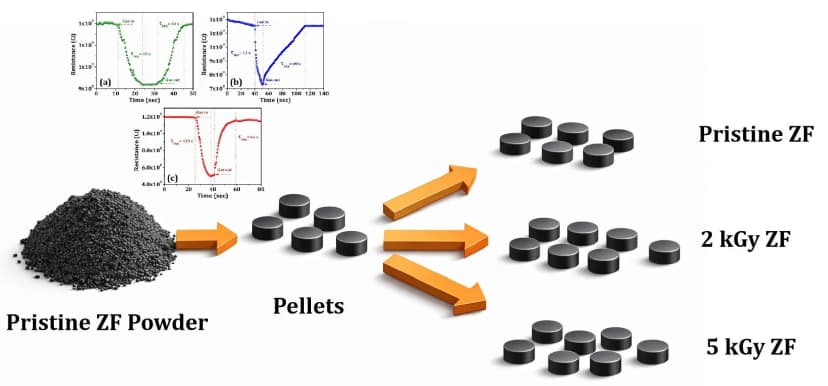
The work highlights γ-irradiation as a simple, scalable, and effective post-synthesis strategy for tuning porosity and defect chemistry in ferrite nanomaterials. By enabling high petrol vapor sensitivity at room temperature, the developed ZnFe₂O₄ sensors address key challenges related to energy efficiency and operational safety. The findings provide valuable insight into defect-driven gas sensing mechanisms and establish ZnFe₂O₄ as a promising low-cost material for practical VOC monitoring and environmental sensing applications.
This study reports the synthesis of ZnFe₂O₄ nanoparticles via a sol–gel auto-combustion route and their performance enhancement through γ-irradiation at 2 and 5 kGy. Structural and textural analyses revealed irradiation-induced defect generation, increased surface area, and reduced pore size without altering the spinel phase. Gas sensing investigations demonstrated a significant improvement in room-temperature petrol vapor response, with the 5 kGy-irradiated sensor exhibiting the highest sensitivity, stability, and reproducibility.
Article type: Research Article
Submitted: 25 September 2025
Revised: 27 October 2025
Accepted: 13 November 2025
First published: 3 December 2025
DOI: https://doi.org/10.69626/mse.2025.0356
Volume: 2
Issue: 4
Pages: 356-365
Citation: MatSci Express 2(4), 356-365 (2025)
Raut, S. D., Awasarmol, V. V., Pawar, S. S., Hivrekar, M. M., Pawar, P. P. and Shinde, S. A. 2025. Porosity and Defect Modulation in Gamma–Irradiated Zinc Ferrite Nanoparticles for High Sensitivity Petrol Vapor Sensing. MatSci Express 2(4), pp. 356-365; https://doi.org/10.69626/mse.2025.0356.
Number of downloads: 6
Number of views: 100