


Subscribe To Get Information, Latest News And Other Interesting Events!


Important Links
Get In Touch
Ariston Publication
3167 Riverview Place
Columbus, OH 43202
United States of America
Copyright © 2026 Ariston Publications. All Rights Reserved.
Loading Your Library
Preparing your reading experience...
Loading content...
Ariston Publication
3167 Riverview Place
Columbus, OH 43202
United States of America
Vaibhav Kashte, Dhanraj N. Aepurwar, Sagar Shirsath, Trishul Kulkarni, Aniruddha Chatterjee, Bhagwan Toksha
Vaibhav Kashte 1
Dhanraj N. Aepurwar 2
Sagar Shirsath 3
Trishul Kulkarni 4
Aniruddha Chatterjee5
Bhagwan Toksha 6,*
1 Department of Physics, Jalna Education Society’s R G Bagdia Arts S SB Lakhotia Commerce and R Bezonji Science College, Jalna, 431203, Maharashtra, India.
2 Department of Metallurgical and Materials Engineering, Malaviya National Institute of Technology, Jaipur, Rajasthan, India.
3 School of Materials Science and Engineering, The University of New South Wales, Sydney, NSW, 2052, Australia
4 Mechanical Engineering Department, Maharashtra Institute of Technology, Chhatrapati Sambhaji Nagar, Maharashtra, India
5 Plastic and Polymer Engineering Department, Maharashtra Institute of Technology, Chhatrapati Sambhaji Nagar, Maharashtra, India
6 Maharashtra Institute of Technology, Chhatrapati Sambhaji Nagar, 431010, Maharashtra, India
* Author to whom correspondence should be addressed:
bhagwan.toksha@mit.asia(Bhagwan Toksha)
This study details the synthesis and characterization of a chromium ferrite-graphene oxide (CrFe₂O₄/GO) nanocomposite, prepared using a sol-gel auto-combustion method with 10 wt.% graphene oxide integrated into the ferrite matrix. The structural and morphological properties were systematically investigated through a suite of analytical techniques. X-ray diffraction confirmed the formation of a single-phase cubic spinel structure with a space group of Fd-3m (227) and a lattice constant of 8.50 Å, indicating high phase purity and crystallinity. Fourier-transform infrared and Raman spectroscopy provided evidence of successful GO incorporation and identified characteristic vibrational modes associated with both the spinel ferrite and the carbonaceous framework. Field emission scanning electron microscopy and high-resolution transmission electron microscopy revealed a homogeneous distribution of ferrite nanoparticles anchored onto exfoliated GO sheets, forming a dense, nano-phase microstructure with minimal agglomeration. Magnetic characterization using vibrating sample magnetometry demonstrated enhanced magnetic properties, including significant coercivity and saturation magnetization, which are attributed to effective interparticle coupling and domain wall interactions facilitated by the GO matrix. The uniform dispersion of GO within the ferrite host promoted conductive pathways and defect-induced polarization, contributing to improved functional behavior. These findings underscore the potential of the CrFe₂O₄/GO nanocomposite in advanced applications such as energy conversion, magnetic storage, and catalytic systems, owing to its structural robustness, magnetic responsiveness, and synergistic component interactions.
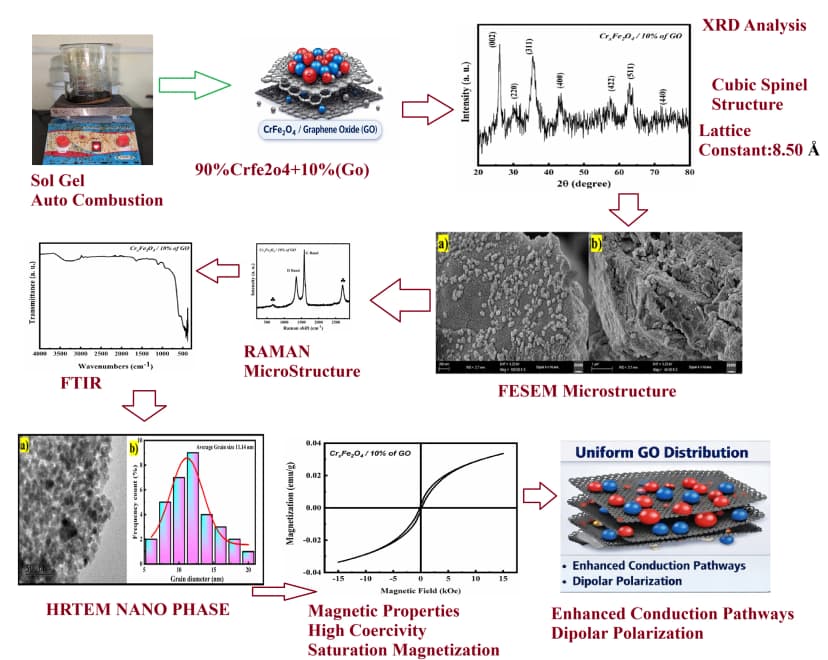
This work is significant because graphene oxide incorporation markedly improves the structural, morphological, and magnetic performance of cobalt ferrite nanocomposites. Uniform graphene oxide distribution enhances electrical conduction pathways and defect-induced dipolar polarization, strengthening magnetic resonance and domain wall loss mechanisms. The nanocomposite also demonstrates structural stability and reusability. These combined advantages indicate strong potential for advanced energy conversion, electromagnetic interference shielding, and multifunctional magnetic material applications using scalable synthesis routes. This approach supports practical device integration and long-term functional reliability.
This study reports the synthesis of a CrFe₂O₄–graphene oxide nanocomposite containing 90 wt% cobalt ferrite and 10 wt% graphene oxide using a sol–gel auto-combustion technique. X-ray diffraction confirmed a single-phase cubic spinel structure with high crystallinity. FTIR, Raman, FESEM, and HRTEM analyses revealed dense nanostructures and uniform graphene oxide dispersion. Magnetic measurements showed enhanced coercivity and saturation magnetization, indicating effective magnetic loss mechanisms suitable for energy conversion applications. The composite exhibited improved microstructural integrity and reproducibility under experimental conditions studied.
Article type: Research Article
Submitted: 3 October 2025
Revised: 27 November 2025
Accepted: 14 December 2025
First published: 7 January 2026
DOI: https://doi.org/10.69626/mse.2026.0001
Volume: 3
Issue: 01
Pages: 01-10
Citation: MatSci Express 3(1), 01-10 (2026)
Kashte, V., Aepurwar, D. N., Shirsath, S., Kulkarni, T., Chatterjee, A., Toksha, B. 2026. Structural and Morphological Enhancement of CrFe2O4/GO Nanocomposites via Sol–Gel Auto–Combustion Synthesis. MatSci Express 3(1), pp. 01-10; https://doi.org/10.69626/mse.2026.0001.
Number of downloads: 18
Number of views: 118