


Subscribe To Get Information, Latest News And Other Interesting Events!



Important Links
Get In Touch
Ariston Publication
3167 Riverview Place
Columbus, OH 43202
United States of America
Copyright © 2026 Ariston Publications. All Rights Reserved.
Loading Your Library
Preparing your reading experience...
Loading content...
Ariston Publication
3167 Riverview Place
Columbus, OH 43202
United States of America

T. A. H. Mir, A. U. Sonawane
T. A. H. Mir 1,*
A. U. Sonawane 2
1Department of Electronics, Smt. G. G. Khadse College, Muktainagar, Jalgaon, Maharashtra, 425001 India.
2 Department of Electronics, DNCVPS Shirish Madhukarrao Chaudhari College, Jalgaon, Maharashtra, 425001 India.
* Author to whom correspondence should be addressed:
tahiramir13@gmail.com (T. A. H. Mir)
This study investigates the influence of tin (Sn) incorporation at varying concentrations (0%, 2%, 4%, and 6%) on the structural, optical, and electrical properties of zinc selenide (ZnSe) thin films synthesized via chemical bath deposition. Structural analysis reveals that increasing tin content leads to a significant narrowing of the dominant diffraction peak, indicating enhanced crystallinity and grain growth. Energy-dispersive X-ray spectroscopy (EDAX) confirms the presence of Sn, Zn, and Se, validating successful tin incorporation into the ZnSe lattice. Optical characterization demonstrates a systematic increase in absorbance with higher tin concentrations, accompanied by a reduction in the optical bandgap from 2.57 eV to 2.38 eV. Electrical measurements reveal a notable decrease in resistivity from 10⁶ Ω-cm to 10³ Ω-cm with increasing tin content, suggesting improved conductivity. These findings highlight the potential of tin-doped ZnSe thin films for optoelectronic applications, offering tunable optical and electrical properties through controlled tin incorporation.
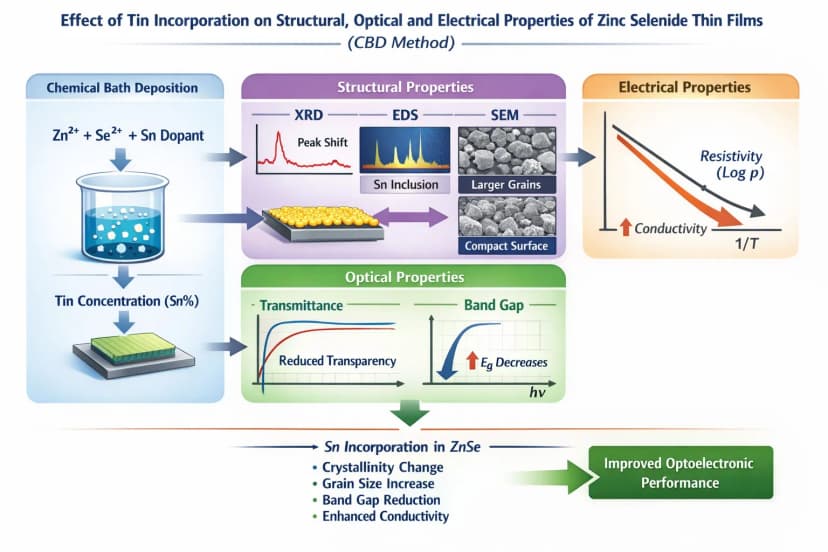
This study demonstrates an effective approach to tailor the structural, optical, and electrical properties of ZnSe thin films through tin incorporation. The reduction in bandgap and resistivity enhances light absorption and electrical conductivity, which are crucial for optoelectronic and photovoltaic applications. The use of a simple and cost-effective chemical bath deposition method further adds practical value. These findings contribute to the development of efficient, tunable semiconductor materials for advanced solar cells and optoelectronic devices.
This study examines the effect of tin (Sn) incorporation (0–6%) on zinc selenide (ZnSe) thin films prepared by chemical bath deposition. Results show improved crystallinity and grain growth with increasing Sn content. Optical analysis reveals increased absorbance and reduced bandgap (2.57–2.38 eV). Electrical measurements indicate a significant decrease in resistivity (10⁶ to 10³ Ω-cm), enhancing conductivity. Overall, tin incorporation effectively tunes structural, optical, and electrical properties, making ZnSe thin films suitable for optoelectronic and solar cell applications.
Article type: Research Article
Submitted: 13 November 2025
Revised: 30 December 2025
Accepted: 17 January 2026
First published: 3 February 2026
DOI: https://doi.org/10.69626/mse.2026.0033
Volume: 3
Issue: 01
Pages: 33-40
Citation: MatSci Express 3(1), 33-40 (2026)
Mir, T. A. H. and Sonawane, A. U. 2026. Effect of Tin Incorporation on Structural, Optical and Electrical Properties of Zinc Selenide Thin Films Prepared by Chemical Bath Deposition Method. MatSci Express 3(1), pp. 33-40; https://doi.org/10.69626/mse.2026.0033.
Number of downloads: 11
Number of views: 91