


Subscribe To Get Information, Latest News And Other Interesting Events!



Important Links
Get In Touch
Ariston Publication
3167 Riverview Place
Columbus, OH 43202
United States of America
Copyright © 2026 Ariston Publications. All Rights Reserved.
Loading Your Library
Preparing your reading experience...
Loading content...
Ariston Publication
3167 Riverview Place
Columbus, OH 43202
United States of America
Mostafa Ahmed, Mesfer Alalyani, Hesham Fares
Mostafa Ahmed1,*
Mesfer Alalyani 1
Hesham Fares2
1 Department of Physics, Faculty of Science, King Abdulaziz University, Jeddah, 80203, Kingdom of Saudi Arabia.
2 Department of Physics, Collage of Science, Taibah University, Medina, 41477, Kingdom of Saudi Arabia.
* Author to whom correspondence should be addressed:
mhafidh@kau.ed.sa(Moustafa Ahmed)
We present a comprehensive numerical modeling of Fano resonance induced by plasmon-exciton coupling (PEC) in hybrid nanostructures composed of a Ag/Au core and a monolayer WS2 shell. The study is based on Maxwell-Garnett effective-medium to homogenize a concentric core of metal and silicon and Mie theory. We are aimed to examine the impacts of the core radius and shell thickness on the absorption efficiency, PEC strength, and generated Fano resonance, including resonance tuning, cavity dissipation, and hybrid-mode formation near the WS2 A-exciton around 2.005618 eV. The study compares the efficiency of gold and silver in the proposed metal–Si-WS2 core-bishell architectures. The results are used to distinguish strong PEC from mere spectral splitting by evaluating the exciton linewidth, cavity decay rate, coupling strength, and Rabi splitting. We show that Ag-Si-WS2 nanoshells achieve the most favorable balance between tunability and low dissipation, which produces clear Fano resonance with hybrid splitting. The smallest Ag-Si and Au-Si structures are shown to achieve the highest PEC strength. Au-Si-WS2 nanoshells exhibits clear Fano resonance appearance but in the weak regime of PEC due to larger cavity dissipation. These findings identify AgSi- WS2 as practical design guidelines for future plexcitonic nanodevices.
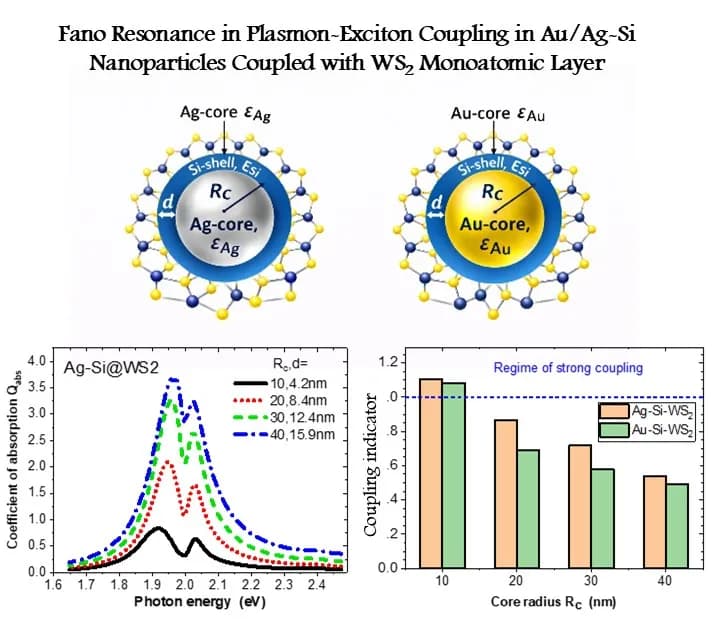
This study advances nanophotonic control of light–matter interactions By quantitatively designing Fano-resonant plasmon–exciton coupling in metal–Si–WS₂ core–bishell nanoparticles. The paper finds realistic Ag–Si–WS₂ geometries that exhibit strong coupling, distinct hybrid-mode splitting, and lower cavity losses as compared to Au-based counterparts by combining effective-medium theory with Mie simulations. These observations provide useful design principles for small plexcitonic platforms appropriate for quantum nanodevices, biosensors, and ultrafast optical switches.
The study investigates plasmon–exciton coupling and Fano resonance in hybrid Au–Si–WS₂ and Ag–Si–WS₂ core–bishell nanoparticles using effective-medium and Mie theories. By tuning the metal core radius and Si shell thickness, the plasmon resonance is overlapped with the WS₂ A-exciton, enabling hybrid-mode splitting and Fano line shapes in the absorption spectra. The findings direct the design of plexcitonic devices by demonstrating that Ag–Si–WS₂ provides better strong-coupling conditions and smaller losses than Au–Si–WS₂.
Article type: Research Article
Submitted: 25 December 2025
Revised: 17 February 2026
Accepted: 3 March 2026
First published: 21 March 2026
DOI: https://doi.org/10.69626/mse.2026.0065
Volume: 3
Issue: 02
Pages: 65-74
Citation: MatSci Express 3(2), 65-74 (2026)