


Subscribe To Get Information, Latest News And Other Interesting Events!



Important Links
Get In Touch
Ariston Publication
3167 Riverview Place
Columbus, OH 43202
United States of America
Copyright © 2026 Ariston Publications. All Rights Reserved.
Loading Your Library
Preparing your reading experience...
Loading content...
Ariston Publication
3167 Riverview Place
Columbus, OH 43202
United States of America
M. Beaula Ruby Kamalam, G. Geetha, E. Shanthini, S. S. R. Inbanathan
M. Beaula Ruby Kamalam*
G. Geetha
E. Shanthini
S. S. R. Inbanathan
Postgraduate and Research Department of Physics, The American College, Madurai, Tamilnadu, India
*Author to whom correspondence should be addressed:
bealthambu10@gmail.com (M. Beaula Ruby Kamalam)
Vanadium pentoxide nanoparticles were successfully synthesized using two distinct approaches, namely the conventional sol-gel method and an environmentally benign green synthesis route utilizing orange peel extract as a reducing agent. The structural, optical, and morphological properties of the as-prepared nanoparticles were systematically investigated through various characterization techniques including X-ray diffraction, Fourier transform infrared spectroscopy, ultraviolet-visible spectroscopy, photoluminescence spectroscopy, and ultraviolet-visible diffuse reflectance spectroscopy. X-ray diffraction analysis confirmed the formation of orthorhombic phase V2O5 with average crystallite sizes of 32 nm for the sol-gel derived sample and 35 nm for the green synthesized sample, both exhibiting particle dimensions below 100 nm. The Fourier transform infrared spectra revealed characteristic vibration modes corresponding to V-O-V asymmetric stretching, V-O-V symmetric stretching, and terminal V=O stretching, confirming the successful formation of vanadium oxide structure. Optical studies demonstrated that the green synthesized nanoparticles possessed a reduced band gap compared to their sol-gel counterparts, enabling enhanced light absorption in the visible region. The photocatalytic performance of both samples was evaluated through the degradation of methylene blue dye under visible light irradiation. Remarkably, the green synthesized nanoparticles exhibited superior photocatalytic activity with 68.58% degradation efficiency within 80 min, whereas the sol-gel synthesized nanoparticles showed only 12.63% degradation within 50 min before reaching saturation. The enhanced photocatalytic performance of the green synthesized nanoparticles is attributed to their higher crystallinity, reduced band gap, and improved charge carrier separation efficiency. This study demonstrates that the green synthesis approach using orange peel extract offers a sustainable and efficient route for producing highly photoactive V2O5 nanoparticles with promising applications in wastewater treatment and environmental remediation.
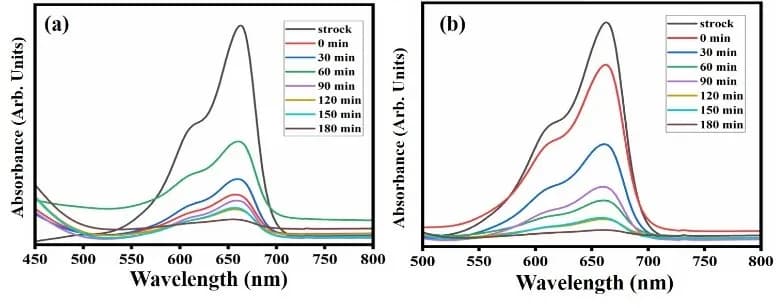
This study compares V₂O₅ nanoparticles synthesized through sol-gel and green methods using orange peel extract. XRD confirmed orthorhombic V₂O₅, with crystallite sizes of 32 and 35 nm, respectively. FTIR verified characteristic V–O–V and V=O bonds, while optical analyses revealed a reduced band gap and improved charge separation for green-synthesized nanoparticles. Under visible light, green V₂O₅ achieved 68.58% methylene blue degradation within 80 minutes, compared with 12.63% for the sol-gel sample. These findings establish green synthesis as a sustainable route for efficient photocatalysts and wastewater treatment.
This work is significant because it demonstrates a sustainable green synthesis route for producing highly photoactive V₂O₅ nanoparticles using orange peel extract. Compared with conventional sol-gel synthesis, the green-derived nanoparticles exhibit superior crystallinity, reduced band gap, improved charge carrier separation, and substantially enhanced visible-light photocatalytic activity. Their 68.58% methylene blue degradation efficiency highlights strong potential for wastewater treatment and environmental remediation. The study also promotes the utilization of renewable biomass resources, providing an environmentally friendly, cost-effective, and efficient alternative for advanced photocatalyst production.
Article type: Research Article
Submitted: 5 February 2026
Revised: 24 March 2026
Accepted: 10 April 2026
First published: 1 May 2026
DOI: https://doi.org/10.69626/mse.2026.0093
Volume: 3
Issue: 02
Pages: 93-104
Citation: MatSci Express 3(2), 93-104 (2026)