


Subscribe To Get Information, Latest News And Other Interesting Events!



Important Links
Get In Touch
Ariston Publication
3167 Riverview Place
Columbus, OH 43202
United States of America
Copyright © 2026 Ariston Publications. All Rights Reserved.
Loading Your Library
Preparing your reading experience...
Loading content...
Ariston Publication
3167 Riverview Place
Columbus, OH 43202
United States of America

Fotios I. Michos, Christina Papaspiropoulou, Nikos Aravantinos Zafiris, Michail M. Sigalas
Fotios I. Michos¹,*
Christina Papaspiropoulou¹
Nikos Aravantinos‑Zafiris²
Michail M. Sigalas¹,*
1 Department of Materials Science, University of Patras, Patras 26504, Greece.
2 Department of Environment, Ionian University, Zakynthos, 29100, Greece.
* Author to whom correspondence should be addressed:
fotismixos@gmail.com (Fotios I. Michos)
sigalas@upatras.gr (Michail M. Sigalas)
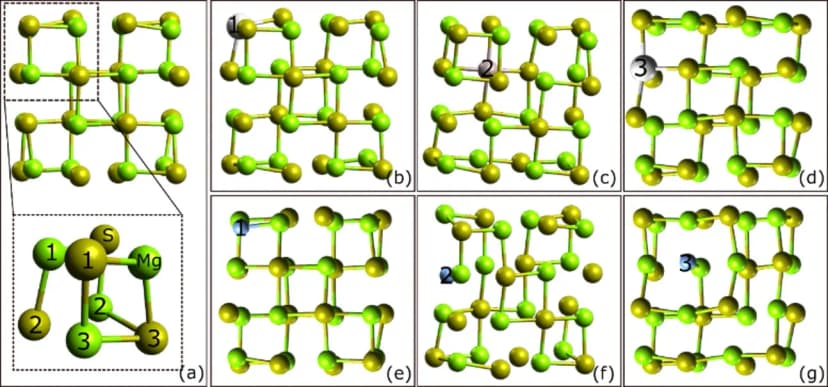
A systematic density functional theory and time-dependent density functional theory study of the optical absorption properties of MgS nanostructures with varying dimensionality and substitutional defect configurations is presented. Using the stoichiometric Mg₄S₄ nanoparticle as the fundamental building block, one-dimensional and two-dimensional MgS nanostructures were constructed through controlled geometric extension. Substitutional defects were also introduced by replacing Mg or S atoms with selected elements of the periodic table, enabling a comprehensive assessment of the effects of the size, the dimensions, the defect type, and the defect position. The results reveal that the extension to one-dimensional and two-dimensional geometries induces a pronounced red-shift of the absorption onset, accompanied by a substantial reduction of the HOMO–LUMO gap. These effects are further amplified by defect engineering, with proper element substitutions and positions of the defects, exhibiting particularly strong influence on low-energy absorption features. Overall, this study establishes clear structure related properties and demonstrates that the nanostructure dimensions in combination with the position of the defect could provide an effective strategy for tuning the optical absorption of MgS nanostructures toward lower energies.
This work is significant because it establishes dimensionality control and defect engineering as effective strategies for tuning the optical absorption of MgS nanostructures. Density functional theory and time-dependent calculations reveal that structural extension and substitutional defects reduce the HOMO–LUMO gap and shift absorption toward lower energies. The strong influence of defect identity and position provides valuable insights for tailoring electronic and optical properties. These findings support the rational design of low-dimensional metal–chalcogenide nanomaterials for potential optoelectronic and photonic applications.
This study employs density functional theory and time-dependent density functional theory to investigate optical absorption in MgS nanostructures with varying dimensions and substitutional defects. Starting from Mg₄S₄, one-dimensional and two-dimensional structures were constructed and systematically analyzed. Dimensional extension produced pronounced absorption red-shifts and reduced HOMO–LUMO gaps, while defect engineering further enhanced low-energy absorption. Position-controlled chalcogen defects in one-dimensional Mg₁₆S₁₆ and magnesium substitutions in two-dimensional Mg₁₆S₁₆ particularly influenced near-visible absorption, demonstrating effective theoretical approaches for designing tunable optical nanomaterials.
Article type: Research Article
Submitted: 12 February 2026
Revised: 1 April 2026
Accepted: 17 April 2026
First published: 8 May 2026
DOI: https://doi.org/10.69626/mse.2026.0105
Volume: 3
Issue: 02
Pages: 105-119
Citation: MatSci Express 3(2), 105-1198 (2026)
Michos F. I., Papaspiropoulou C., Zafiris N. A., Sigalas M. M. 2026. Effect of Dimensionality and Defect Engineering on Optical Absorption in MgS Nanostructures: A DFT and TD-DFT Study. MatSci Express 3(2), pp. 105-119; https://doi.org/10.69626/mse.2026.0105
Number of downloads: 1
Number of views: 24