


Subscribe To Get Information, Latest News And Other Interesting Events!



Important Links
Get In Touch
Ariston Publication
3167 Riverview Place
Columbus, OH 43202
United States of America
Copyright © 2026 Ariston Publications. All Rights Reserved.
Loading Your Library
Preparing your reading experience...
Loading content...
Ariston Publication
3167 Riverview Place
Columbus, OH 43202
United States of America

Gul Faroz Ahmad Malik, Hilal Ahmad Bhat, Samiya Shah, C. A. Duque
Gul Faroz Ahmad Malik1,*
Hilal Ahmad Bhat2
Samiya Shah3
C. A. Duque4
1 Department of Electronics and I.T., University of Kashmir, Hazratbal, Srinagar, Jammu and Kashmir, India
2 Department of Physics, Mahindra University, Hyderabad, Telangana, India
3 Department of Electrical Engineering, Institute of Technology, University of Kashmir, Srinagar, 190006, India
4 Grupo de Materia Condensada-UdeA, Instituto de Física, Facultad de Ciencias Exactas y Naturales, Universidad de Antioquia UdeA, Calle 70 No. 52-21, Medellín AA 1226, Colombia
*Author to whom correspondence should be addressed:
gfarozam@gamil.com (G. F. A. Malik)
Detecting weak magnetic fields is important for geophysics, navigation, space weather monitoring, and quantum sensing. This study presents a simulation-based framework for a spin-dependent quantum magnetometer operating within the geomagnetic field range. The model represents an effective two-level spin defect and relates Zeeman splitting to optically detected magnetic resonance (ODMR). A Lorentzian resonance profile incorporates spin coherence decay, linewidth broadening, and Gaussian noise. Simulations across magnetic fields of 25–65 µT, using nitrogen-vacancy center-like parameters, demonstrate a linear relationship between resonance frequency and magnetic field. Longer transverse relaxation times produce narrower resonances and improve sensitivity, whereas noise reduces the signal-to-noise ratio. Nevertheless, the resonance remains resolvable under the investigated conditions. A noise-to-slope estimation method predicts room-temperature magnetic sensitivity in the nanotesla range, consistent in order of magnitude with reported solid-state quantum magnetometers. These findings highlight the potential of spin-based quantum magnetometry for geomagnetic sensing and provide a computational foundation for optimizing coherence, linewidth, and noise before device fabrication.
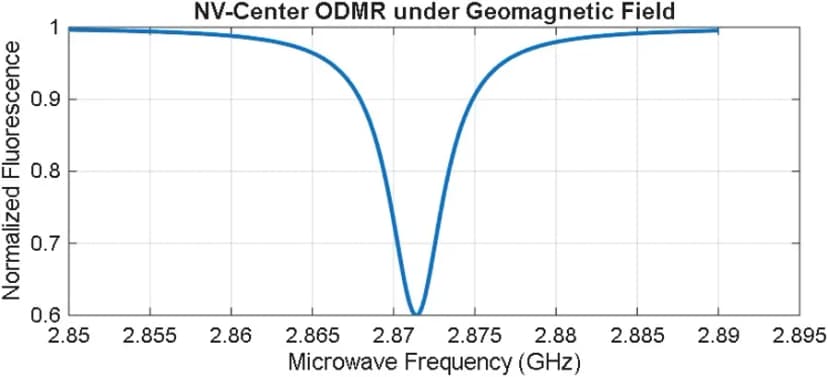
This work is significant because it establishes a computational framework for evaluating spin-dependent quantum magnetometry under weak geomagnetic fields. By integrating Zeeman splitting, optically detected magnetic resonance, coherence decay, and noise effects, the study identifies key factors governing magnetic sensitivity. The results demonstrate that longer transverse relaxation times improve resonance sharpness and sensitivity, while noise degrades signal quality. Achieving simulated nanotesla-range sensitivity highlights the potential of spin-based quantum sensors for geomagnetic monitoring, navigation, and compact low-field sensing applications.
This study presents a simulation-based investigation of spin-dependent quantum magnetometry using optically detected magnetic resonance. An effective two-level spin-defect model was evaluated across magnetic fields of 25–65 µT, incorporating Zeeman splitting, Lorentzian resonance profiles, coherence decay, and Gaussian noise. The resonance frequency exhibited a linear relationship with magnetic field, while longer transverse relaxation times improved linewidth and sensitivity. Despite noise-related signal degradation, resonances remained distinguishable, and sensitivity estimates reached the nanotesla range, supporting potential applications in geomagnetic sensing and compact quantum devices.
Article type: Research Article
Submitted: 17 March 2026
Revised: 3 May 2026
Accepted: 5 June 2026
First published: 1 July 2026
DOI: https://doi.org/10.69626/mse.2026.0120
Volume: 3
Issue: 03
Pages: 120-128
Citation: MatSci Express 3(3), 120-128 (2026)
Malik G. F. A., Bhat H. A., Shah S., Duque C. A. 2026. Simulation of Spin–Dependent Quantum Magnetometry for Weak Geomagnetic Field Detection Using Optically Detected Magnetic Resonance. MatSci Express 3(3), pp. 120-128; https://doi.org/10.69626/mse.2026.0120.
Number of downloads: 3
Number of views: 51