


Subscribe To Get Information, Latest News And Other Interesting Events!


Important Links
Get In Touch
Ariston Publication
3167 Riverview Place
Columbus, OH 43202
United States of America
Copyright © 2026 Ariston Publications. All Rights Reserved.
Loading Your Library
Preparing your reading experience...
Loading content...
Ariston Publication
3167 Riverview Place
Columbus, OH 43202
United States of America
Shishupal Singh, Ajeet Pratap Singh, Yastuti Rao Gautam, Abhay P. Srivastava
Shishupal Singh1
Ajeet Pratap Singh1
Yastuti Rao Gautam1
Abhay P. Srivastava2,*
1 Department of Mechanical Engineering, Chhatrapati Sahu Ji Maharaj University, Kanpur (UP), India.
2 Bansal Institute of Engineering and Technology, Lucknow (UP), India.
*Author to whom correspondence should be addressed:
abhay.srivastava831@gmail.com (Abhay P. Srivastava)
Ferroelectric and multifunctional memory devices must possess polarization stability, low leakage current, and strong electronic response. We offer an in-depth, first-principles investigation of BaFeO₃ as a promising ferroelectric memory material, focusing on its electronic, optical, and polarization-associated switching behavior. BaFeO₃ shows a finite band gap in density functional theory calculations, reflecting semiconducting behavior that favors low leakage current in non-volatile memory modules. The dielectric function, optical conductivity, absorption coefficient, extinction coefficient, and refractive index were characterized to possess strong low-energy polarization, large interband transitions, and a tunable optical response, essential for reliable write–read operation. The ferroelectricity of BaFeO₃ may be induced by off-centering of Fe in distorted FeO₆ octahedra, and thus the bistable polarization state (+P and −P) can be changed reversibly under an external electric field. The polarization–electric-field hysteresis confirms stable retention and non-volatile data storage. Because of its strong dielectric polarization, low optical losses, and field-driven polarization switching, BaFeO₃ is a promising candidate for next-generation ferroelectric and multifunctional memory devices. Here, we provide insight into the structure–property relations that regulate memory operation at the microscopic level and a theoretical basis for building an experimental platform for future experiments.
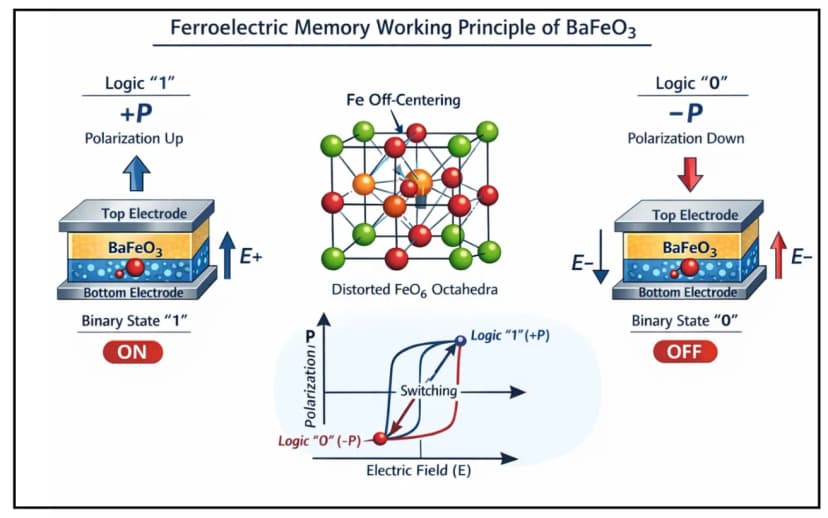
This work is significant because it investigates BaFeO₃ as a potential ferroelectric material for next-generation non-volatile memory applications using first-principles calculations. The study connects electronic structure, optical response, and polarization switching to key memory requirements, including reduced leakage, stable data retention, and reversible electric-field-driven operation. The proposed off-centering of Fe ions within distorted FeO₆ octahedra provides insight into polarization behavior. These findings establish a theoretical foundation for exploring multifunctional memory architectures integrating electrical, magnetic, and optical properties in future devices.
This study employs first-principles calculations to investigate the electronic, optical, and ferroelectric properties of BaFeO₃ for memory applications. Electronic structure analysis reveals a finite band gap, indicating semiconducting behavior. Optical parameters, including dielectric function, conductivity, absorption coefficient, extinction coefficient, and refractive index, characterize its optical response. Ferroelectric polarization is associated with Fe-ion off-centering in distorted FeO₆ octahedra, enabling reversible switching between polarization states under an electric field. The results highlight BaFeO₃'s potential for non-volatile storage and multifunctional memory technologies.
Article type: Research Article
Submitted: 14 June 2026
Revised: 24 June 2026
Accepted: 12 July 2026
First published: 8 August 2026
DOI: https://doi.org/10.69626/mse.2026.0129
Volume: 3
Issue: 03
Pages: 129-146
Citation: MatSci Express 3(3), 129-146 (2026)
Singh S., Singh A. P., Gautam Y. R., Srivastava A. P. 2026. BaFeO3 for Computer Memory Applications: A First–Principles Study of Ferroelectric Switching and Optical Response. MatSci Express 3(3), pp. 129-146; https://doi.org/10.69626/mse.2026.0129
Number of downloads: 6
Number of views: 40