


Subscribe To Get Information, Latest News And Other Interesting Events!



Important Links
Get In Touch
Ariston Publication
3167 Riverview Place
Columbus, OH 43202
United States of America
Copyright © 2026 Ariston Publications. All Rights Reserved.
Loading Your Library
Preparing your reading experience...
Loading content...
Ariston Publication
3167 Riverview Place
Columbus, OH 43202
United States of America
Mir Wakeel Ahmad, Mohammad Anas
Wakeel Ahmad1
Mohammad Anas2.*
1 Department of Electrical Engineering, College of Applied Industrial Technology, Jazan University, Baish, 45142, Kingdom of Saudi Arabia.
2 Department of Computer Science and Engineering, GN Group of Institutes, Greater Noida, Uttar Pradesh, 201310, India.
* Author to whom correspondence should be addressed:
mohdanas@gnct.co.in (Mohammad Anas)
In this study, we investigate the design and modeling of a multi cascode operational transconductance amplifier (OTA). The suggested OTAs are triple-cascode operational transconductance amplifiers (TCOTAs) built using CNTFETs (carbon nanotube field effect transistors) and MOSFETs at the 45 nm technology node. The suggested architectures use both conventional MOSFETs and CNTFETs because they are hybrid in nature. The published simulation analysis of the TCOTAs shows that the proposed hybrid devices perform significantly better than traditional ones. The DC gain, output resistance, power consumption, and bandwidth of the proposed hybrid device have all been found to greatly outperform those of conventional devices. By altering the CNT diameter, the recommended TCOTAs' efficiency can be altered or enhanced. In NCNT-PMOS-TCOTA, the delay has been lowered by 106%, power dissipation is reduced by 133%, and the power delay product is dropped by 382% whenever compared to pure CMOS-TCOTA. PCNT-NMOS-TCOTA achieves a 93% lower delay, a 3.2% lower power dissipation, and a 99.7% lower power delay product over pure CMOS-TCOTA. Furthermore, the operational performance of CNT-based OTAs is investigated by altering the CNTs' diameter (DCNT).
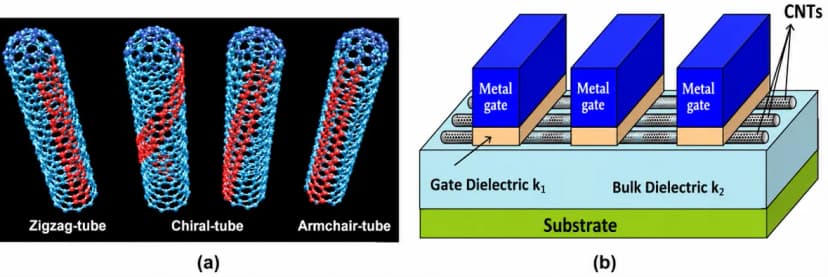
This work is significant because it demonstrates the potential of carbon nanotube field-effect transistors (CNTFETs) to improve the energy efficiency of operational transconductance amplifiers. By integrating CNTFETs with conventional MOSFETs in hybrid triple-cascode architectures, the study achieves substantial reductions in delay and power-delay product compared with conventional CMOS designs. The investigation also examines carbon nanotube diameter as a performance-tuning parameter. These findings provide useful design insights for developing low-power, high-speed analog circuits for energy-efficient electronic systems and advanced nanoscale integrated circuit applications.
This study designs and models three triple-cascode operational transconductance amplifiers using 45 nm technology: conventional CMOS, PCNT-NMOS-TCOTA, and NCNT-PMOS-TCOTA. HSPICE simulations evaluate circuit performance at a 0.9 V supply voltage and investigate the influence of carbon nanotube diameter. Compared with conventional CMOS-TCOTA, NCNT-PMOS-TCOTA reportedly reduces delay by 106% and power dissipation by 133%, while PCNT-NMOS-TCOTA reduces delay by 93% and power-delay product by 99.7%. The results highlight the potential of hybrid CNTFET–MOSFET architectures for low-power analog circuit design.
Article type: Research Article
Submitted: 28 June 2026
Revised: 8 July 2026
Accepted: 26 July 2026
First published: 22 August 2026
DOI: https://doi.org/10.69626/mse.2026.0155
Volume: 3
Issue: 03
Pages: 155-161
Citation: MatSci Express 3(3), 155-161 (2026)